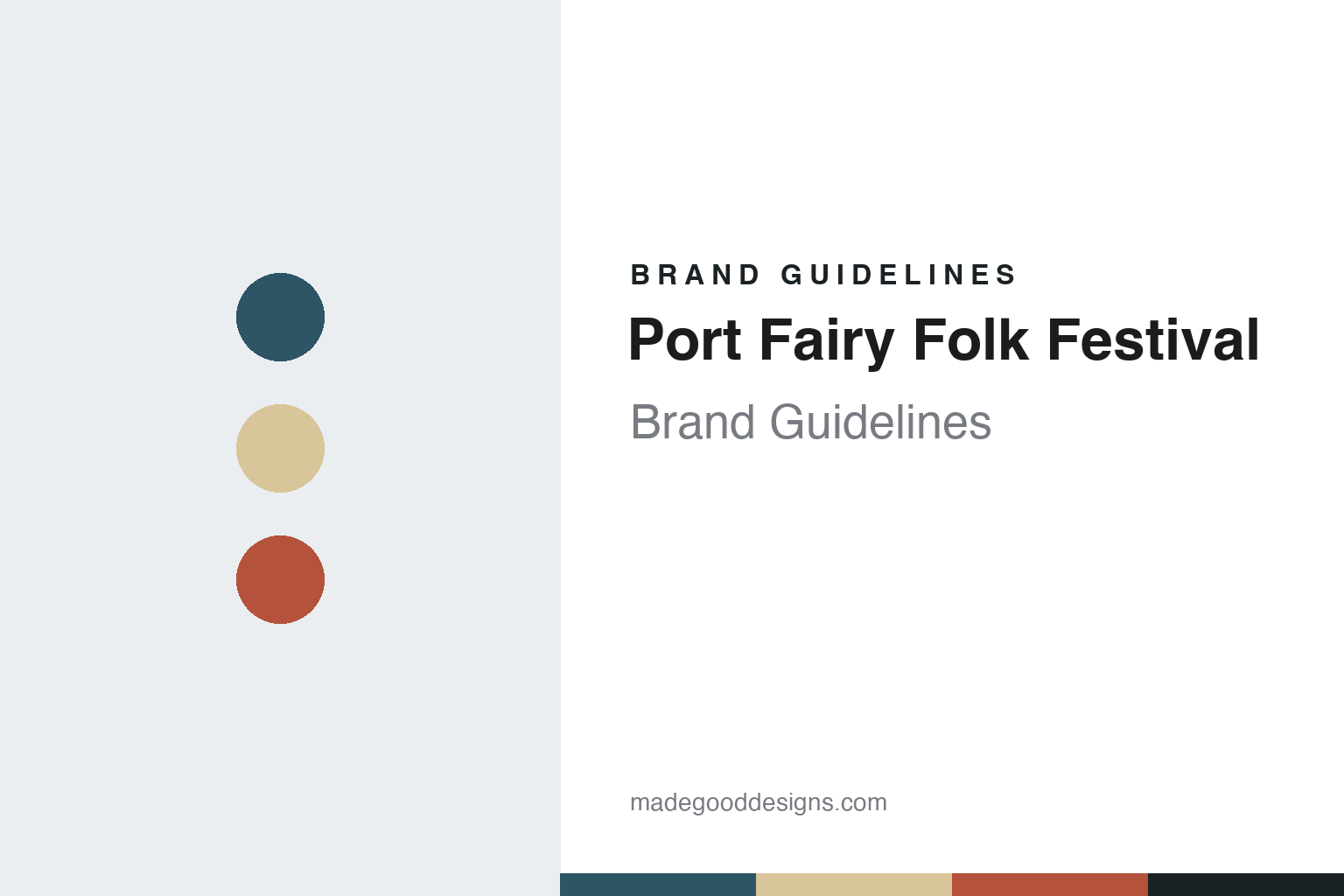
Port Fairy Folk Festival Brand Guidelines
A folk weekend that began on the back of a truck in a town garden, and still spills out into the streets every March.
Aa
Two constants: a harbour slate, dune sand and cottage red palette and a soft old-style serif register. Abstract homage — not a Port Fairy Folk Festival poster or mark; no logo, artwork or wristband is reproduced.
A festival from a folk club
From a stage on a truck in 1977 to an arena of tents on the coast.
The Port Fairy Folk Festival began in 1977 in Port Fairy, a small town on the south-west coast of Victoria, a short drive past Warrnambool. English Wikipedia dates the first edition to 2 December 1977 and says it ran under the theme “Australian and Irish Traditional Music”. Its founder was Jamie McKew, who led a small group of folk performers and supporters from Geelong and Melbourne. Speaking to Beat Magazine in September 2019, the festival’s then program director described McKew as a Geelong local and a member of the Geelong folk club, whose members decided to try a festival of their own; McKew had family connections in Port Fairy, and that settled the location.
The beginnings were modest. According to the same Beat Magazine interview, the first “Folkie”, as the festival is widely called, was staged on the back of a truck in the Port Fairy botanic gardens, with something like 300 people in the audience. In the early 1980s the programme moved from its first theme towards what Wikipedia calls “World Roots and Acoustic Music”, and later widened again to take in folk music from many cultures. Beat Magazine listed South Africa, Italy and Romania among the traditions on recent bills, alongside the Celtic and Irish roots that the town’s own history brings to the programme.
The festival is a not-for-profit event. Wikipedia says it has been produced by the Port Fairy Folk Festival Committee Incorporated, based in Port Fairy since 1992, and Beat Magazine described it in 2019 as run largely by a committee of volunteers. McKew was still festival director at the 40th edition in March 2016, according to Wikipedia; Caroline Moore took over as program director in 2017.
Colour
A long weekend that the town plans around.
The festival now sits on the Victorian Labour Day long weekend in March, four days from Friday to Monday. ABC News reported in August 2020 that the event usually takes place on the second weekend of March and draws up to 30,000 people to a town with a population of around 3,000. The 2021 edition, which would have been the 45th, was not held, and the festival returned from 11 to 14 March 2022, Wikipedia says.
Programming has since passed to Justin Rudge. The Standard, the Warrnambool daily, named him as the festival’s program director in February 2023, ahead of an edition that ran from 10 to 13 March that year. In July 2025 Rolling Stone Australia reported the first artist announcement for the 49th edition, held from 6 to 9 March 2026, with more than 100 artists across four main stages and a set of smaller venues around the town. That announcement included vocal groups from Sweden and the United States, Irish and Scottish bands and Australian songwriters.
The physical festival is split between a fenced arena and the town. The festival’s website describes the Festival Arena as a level grassed area with wide walkways between venues; the main stages are numbered Venues 1 to 4, all under cover except the open-air Fiddler’s Green. Families have a dedicated tent called Folklandia, and a free Street Fair runs in the town alongside venues in local halls. Beat Magazine put the arena’s capacity at 12,000 people in 2019 and noted the free activities that happen across the town over the weekend.
Typography
Folk festivals and their settings.
A folk festival is often remembered by where and when it happens before anything else. Some take over a park on the edge of a city in high summer, with marquees pitched on the lawns; others fill a seaside town in late August, spreading concerts, dances and workshops through its halls and streets. Some gather in a concert hall in the depths of winter, some on a hillside in a provincial park, and some on a showground or in a festival village built for the purpose. The setting and the week in the calendar do much of the work a logo does elsewhere.
Where a festival issues an annual poster or programme cover, its look is renewed each year, and the artist behind it, whether an illustrator, a printmaker or a designer, shapes how that edition is remembered. When a festival credits those artists, the run of posters becomes a visual record of the event, edition by edition, and a festival without a fixed mark can still read as one thing across many years.
Behind most of these names stands an organiser that keeps them going: a city council, a folk society, a non-profit association, a trust or a small company, supported in many cases by large teams of volunteers. Organisers can change, and formats with them, while the name stays: the Cambridge Folk Festival, for one, has kept the name it was given in 1965 through several changes of format.
The practical layer is what audiences handle on the day. Programme booklets, stage timetables, wristbands, campsite and site maps, and signs pointing between venues all carry the festival’s type and colour into daily use. This guide looks at each festival through that lens: its setting, its calendar, its organiser and the material its audience reads, set out in plain terms and with our own unofficial palettes.
Aa
A soft old-style serif — a seaside town’s long weekend. (Specimen set in Fraunces, a serif STAND-IN; NOT the Port Fairy Folk Festival logo.)
Port Fairy Folk Festival
A nickname, a numbered set of tents and a town.
The festival’s identity is carried as much by its nickname as by its full title. Local and national press, from The Standard to ABC News, call it “Folkie”, and the festival uses the same word in its own visitor guidance, down to the low “Folkie chairs” that audiences may bring into Venues 1, 2 and 3. For a design reading, that gives the festival two registers to work with: the full name for formal use and a short, friendly one for everyday use.
The practical layer is plainly described on the festival’s website. Ticket holders swap their ticket for a wristband at a Ticket Exchange, and with it they receive the printed Program, which carries the schedule and artist profiles; the schedule itself is published online in February. A row of parked seats known as the Great Wall of Chairs, a festival information stall staffed by volunteers in festival T-shirts and shuttle buses circling the town complete the picture. The festival also states, in an acknowledgement on its website, that it is held on Peek Whurrong country.
The link to the coast is part of the image too. The festival describes itself as gathered by the sea, and the town’s size shapes the experience: ABC News set its usual crowd of up to 30,000 against a resident population of about 3,000, so for four days the festival and the town overlap almost completely. That overlap is the main design fact: a festival brand here is a set of signs and tents placed into an existing fishing town, not a self-contained site.
There is also a dated tie to the Queensland festival in this round. In 2023 Sunshine Coast News named the Port Fairy Folk Festival’s founder as a member of the management committee of Woodfordia Inc, the not-for-profit that runs the Woodford Folk Festival.
For a design guide, Port Fairy Folk Festival shows how a volunteer-run event can keep a single calendar slot, a nickname and a small town as its fixed assets across nearly fifty editions. Compare Woodford Folk Festival, the Queensland festival that shares a committee member with Port Fairy, and Splendour in the Grass, another Australian festival guide in this series. For this guide we use a harbour slate, a dune sand and a cottage red with a serif, an unofficial interpretation; no product or logo is reproduced.
Explore & save
Keep Port Fairy Folk Festival’s identity on hand — save it to a board in the Made Good inspiration library.
Port Fairy Folk Festival identity set
Pin the Port Fairy Folk Festival harbour slate, dune sand and cottage red palette and the soft old-style serif register to your own board.
Source & notes
Frequently Asked Questions
What font can I use to match the Port Fairy Folk Festival look?
This guide describes Port Fairy Folk Festival’s type as “A soft old-style serif — a seaside town’s long weekend”. Its type specimen is set in Fraunces from Google Fonts as a stand-in; Fraunces is not Port Fairy Folk Festival’s own lettering.
What colours are in the Port Fairy Folk Festival palette?
This guide’s Port Fairy Folk Festival palette is Harbour slate #2D5566, Night ink #1B2226, Dune sand #D8C59A, Cottage red #B5523B and Salt paper #F5F2EA. The tones are the guide’s own unofficial interpretation, not official Port Fairy Folk Festival hex codes.
When was Port Fairy Folk Festival founded?
Port Fairy Folk Festival was founded in 1977, in Port Fairy, Victoria, Australia.
Who founded Port Fairy Folk Festival?
Port Fairy Folk Festival was founded in 1977 by Jamie McKew, with folk players from Geelong and Melbourne.