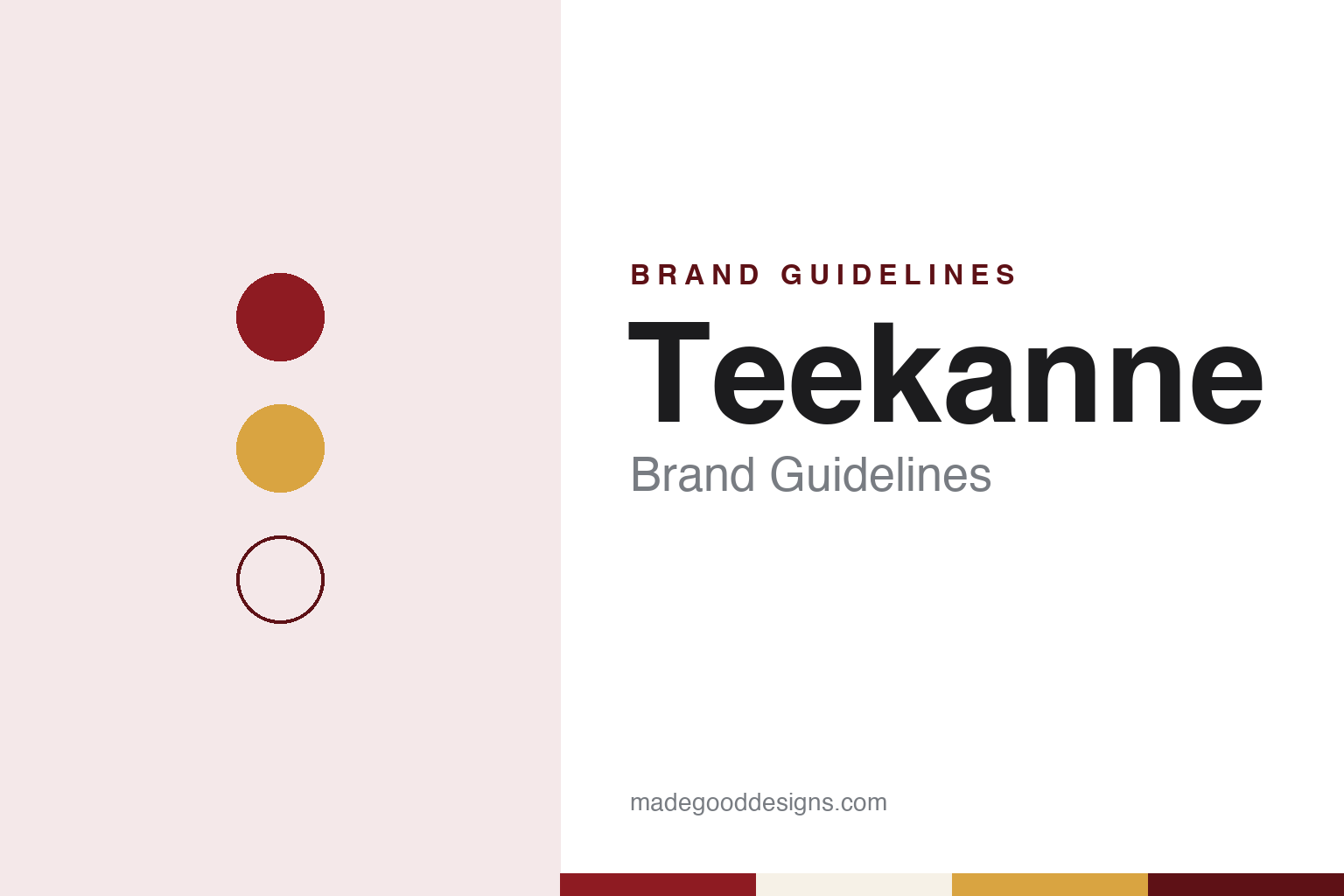
Teekanne Brand Guidelines
The Dresden tea house that built the double-chamber tea bag.
Aa
Two constants: a red, cream and gold palette and a Sturdy sans register. Abstract homage — not a Teekanne product or mark; no pack, teapot emblem or logo is reproduced.
R. Seelig & Hille
A Dresden shop, a teapot trademark and two employees.
Teekanne began in Dresden on 16 July 1882. German Wikipedia says the business opened that day as a shop for “Japan and China goods as well as tea” under the name R. Seelig & Hille, and names its owner as G. E. Dittrich. In 1888 the firm protected the name Teekanne — German for “teapot,” spelled “Theekanne” at the time — as a trademark; the company’s chronicle says the word and the image were both protected, under registration number 6541, and German Wikipedia calls it one of the oldest German trademarks.
The family era began four years later. In 1892 two employees, Rudolf Anders and Eugen Nissle, bought the company, and it has been family-owned since, according to both English and German Wikipedia; English Wikipedia’s introduction calls them the founders, but its own history section dates the founding to 1882 and their purchase to 1892. German Wikipedia says they were among the first in Germany to sell ready-blended, packaged tea on a large scale, and the company’s chronicle dates its first blended tea packed in tins to 1898. The brands Teefix and Pompadour followed — registered in 1913, according to German Wikipedia and the chronicle, or 1912 in English Wikipedia.
The second generation took over in the 1930s: German Wikipedia says that after Ernst Rudolf Anders, one of the 1892 buyers, died in the Hindenburg airship disaster in May 1937, his son Rolf Anders ran the firm with Johannes Nissle; the company’s chronicle dates their joint leadership to 1931.
Then the business was split. The Dresden plant was badly damaged in the bombing of 13 February 1945, and after the expropriation of 1946, German Wikipedia says, the families carried on in Viersen, on the Lower Rhine, and later in Düsseldorf, while the Saxon authorities moved the old Dresden business to Radebeul, where it became VEB Kaffee und Tee Radebeul. The company’s chronicle dates the move into a newly built Düsseldorf plant to 1954; English Wikipedia gives 1957 for the head office.
Colour
Adolf Rambold’s machines.
During the First World War, both Wikipedias and the chronicle say, the company supplied soldiers with “tea bombs,” hand-made gauze bags of tea. Adolf Rambold, who joined the company in 1924, then developed the Pompadour packing machine, which made 35 tea bags a minute; German Wikipedia, citing the company history 125 Jahre Teekanne, dates the machine to 1928 and Teekanne’s first infusion bags, of parchment paper, to 1929, while the company and English Wikipedia date the machine to 1929.
In 1949, the chronicle says, the double-chamber tea bag was patented — a bag folded into two pockets of tea, which English Wikipedia says lets water flow better through the leaf. It credits Rambold with the design and with the Constanta machine that made it, at 160 bags a minute; the chronicle dates the Constanta to 1950. Rambold worked through Teepack, a machinery company set up as part of the group — in 1947, according to the chronicle, or 1948, according to English Wikipedia — in which, English Wikipedia says, he was a co-owner. Its successor machine, the Perfecta, launched in 1990 according to the chronicle, makes 400 double-chamber bags a minute and, English Wikipedia says, is sold worldwide.
The group also grew abroad. The company says it opened its first foreign subsidiary, in Salzburg, Austria, with its own production, in 1951, followed by Pompadour Tè in Bolzano, Italy, in 1964 and a stake in Pompadour Ibérica in Spain in 1985, where it says it built a plant at Alicante in 1993. In Düsseldorf-Heerdt a new production hall opened in 2014, English Wikipedia says, and from 2021 a high-bay warehouse was built across the city boundary in Neuss, the Rheinische Post reported. In 2007 the Sächsische Zeitung put the group’s output at 7.5 billion tea bags a year.
Typography
Tea, trade and the pack.
The seven brands in this group all sell tea, and they come from three countries: Yorkshire Tea, Taylors of Harrogate, Ahmad Tea, Tetley and PG Tips from England, Teekanne from Germany, and Dammann Frères from France. Tea brands in general sit at many different points in the trade, from boxes of bags on a supermarket shelf to loose-leaf tins sold over the counter of a house’s own shop, and a single company can work at both ends at once.
A tea brand’s identity is usually carried less by a field than by a blend, a box and the cup it promises, because the leaf in the packet may have been grown a long way from where the name on the front was made. That makes the questions behind each name worth asking plainly: who started it, who owns it now, where its leaves are bought, and where its tea is actually blended and packed.
Each guide separates what independent sources record from what the company says about itself — its founding story, its owners over time, where its tea comes from and where it is packed — and marks plainly what rests only on the company’s own word.
Aa
A sturdy sans for a packaged-tea pioneer. (Specimen set in Libre Franklin, a sans STAND-IN; NOT the Teekanne logo.)
Teekanne
A family company with a teapot for a name.
After German reunification the company went back to Saxony. In 1991 it took over the reprivatised Radebeul business as Teehaus GmbH, German Wikipedia says, bringing production back to the Dresden area; the following years brought subsidiaries in Kraków in 1992 and Prague in 1994, according to the chronicle. In 1995 Teekanne bought Redco Foods of Windsor, Connecticut, the company says, which owns the American rights to the Red Rose and Salada tea brands; English Wikipedia says that since 2018 both have been produced in the United States under licence by Harris Tea Company. In 1996 its Austrian company bought the sweetener brand Kandisin.
Today the group is run from Düsseldorf by Teekanne Holding GmbH & Co. KG. Its consolidated accounts for the year to March 2022, published in the Bundesanzeiger in 2023 and cited by German Wikipedia, gave an average of 1,146 employees. The company calls itself an “independent family company” and has added formats such as tea capsules, in 2014, the foursenses pyramid bags, in 2015, and the NamasTee range, in 2021.
Its packaging has also been tested in court. In December 2015 Germany’s Federal Court of Justice ruled against Teekanne in a case brought by a consumer organisation over its Felix raspberry-and-vanilla fruit tea, whose pack showed raspberries and vanilla flowers although, Stiftung Warentest reported, neither appeared in the ingredient list; the product had been withdrawn in 2012, German Wikipedia says.
For a design guide, Teekanne shows how a trademarked name and an engineering idea — the double-chamber bag — can define a brand for more than a century. Compare Ronnefeldt, another family-run German tea house, and Twinings. For this guide we use red, cream and gold with a sans, an unofficial interpretation; no product or logo is reproduced.
Explore & save
Keep Teekanne’s identity on hand — save it to a board in the Made Good inspiration library.
Teekanne identity set
Pin the Teekanne red, cream and gold palette and the Sturdy sans register to your own board.