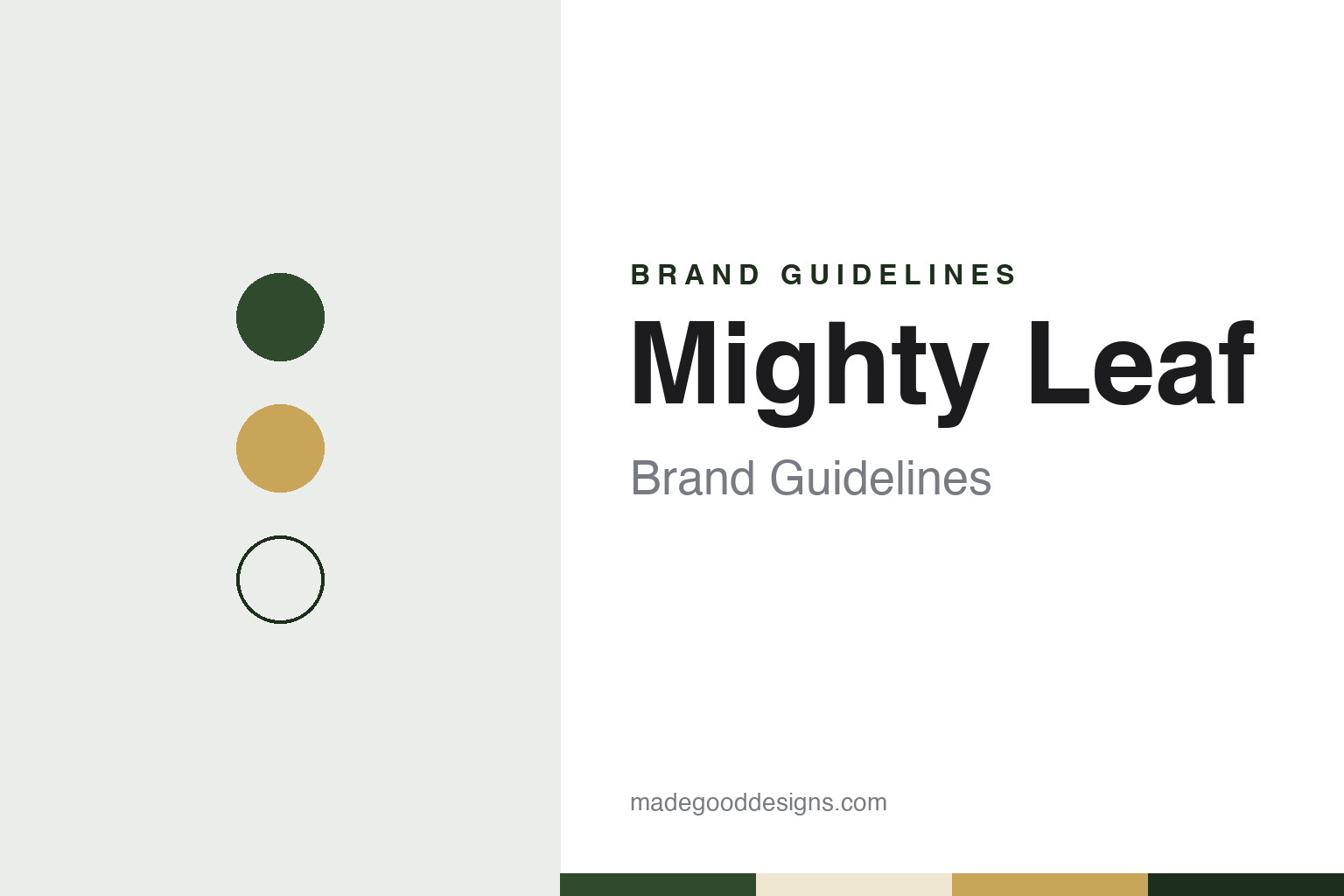
Mighty Leaf Brand Guidelines
The Bay Area tea brand built around a stitched pouch of whole leaves.
Aa
Two constants: a leaf green, cream and gold palette and a garden serif register. Abstract homage — not a Mighty Leaf product or mark; no pouch, carton or logo is reproduced.
A pouch of whole leaves
Two founders and a different kind of tea bag.
Mighty Leaf Tea was co-founded in 1996 by Gary Shinner and Jill Portman. Both English Wikipedia, citing a 2005 report in the Tea and Coffee Trade Journal, and Daily Coffee News, writing in August 2014, give that year and those two names. The company grew up in the San Francisco Bay Area: Daily Coffee News described it as having its corporate headquarters there, and Wikipedia places it in Emeryville, California, across the bay from San Francisco. Wikipedia describes the Mighty Leaf Tea Company as a specialty tea manufacturer and distributor, selling both teas and herbal infusions.
The brand was built on one product idea. Instead of filling a flat paper bag with fine-cut tea, Mighty Leaf packed whole tea leaves, along with fruit, flowers, herbs and spices, into a roomy pouch. When Peet’s bought the company in 2014, its chief executive described the format as Mighty Leaf’s “signature hand-designed mesh tea pouch.” The Peet’s pages that sell the tea today call them “signature silken stitched tea bags,” and the range also includes loose-leaf tea sold by the pound alongside the bagged boxes.
Both descriptions, the 2014 one and today’s, put the pouch first. For a design study, that makes the format itself, rather than a logo or a colour, the most consistently documented element of the Mighty Leaf identity across its owners.
Colour
Peet’s, JAB, JDE Peet’s and Keurig Dr Pepper.
Mighty Leaf stayed independent for nearly two decades. In August 2014, Peet’s Coffee & Tea announced that it had acquired the company. Daily Coffee News reported on 4 August 2014 that Peet’s made the purchase in partnership with Next World Group, a private investment firm that would hold a minority stake, and that the price was not disclosed. Peet’s said Mighty Leaf would continue to operate independently while having “full access to Peet’s resources, capabilities and scale.” The same report noted that Peet’s would keep selling its own tea in its stores and in grocery channels.
Peet’s itself had been bought by the investment group JAB Holding in 2012, according to Wikipedia. Peet’s then became part of a larger coffee group. English Wikipedia says Jacobs Douwe Egberts (JDE) merged with Peet’s in December 2019 to form JDE Peet’s, which was listed on Euronext Amsterdam in 2020. Wikipedia lists Mighty Leaf Tea among the subsidiaries of Peet’s.
Ownership changed again in the mid-2020s. On 25 August 2025, The New York Times reported that Keurig Dr Pepper had agreed to acquire JDE Peet’s in a deal worth about $18 billion. Reuters reported in January 2026 that Keurig Dr Pepper had launched its all-cash offer after obtaining competition clearances, and Keurig Dr Pepper has said it intends to separate its coffee business from its soft-drinks business. JDE Peet’s describes itself on its own website, as of October 2026, as “now part of Keurig Dr Pepper.” JDE Peet’s calls itself “the world’s leading pure-play coffee company,” so Mighty Leaf now sits several layers down in a group built mainly around coffee.
The change is visible online. The address mightyleaf.com now redirects to peets.com, where Mighty Leaf has its own page and a link in the Peet’s site menu, so the tea is sold under its own name inside a coffee brand’s shop.
Typography
Design and documentation.
The seven brands in this group all sell tea in North America: Bigelow, Celestial Seasonings, Stash, Tazo, Mighty Leaf and Numi are American, and Red Rose was founded in Canada before crossing the border. Between them they cover much of what a North American shopper finds on the tea shelf, from boxes of bagged black tea to herbal blends and caffeine-free infusions, sold through supermarkets as well as natural-foods stores.
A North American tea brand’s identity is usually carried by a box, a name and a blend rather than by a place, because the leaf inside may have been grown on another continent and blended somewhere else again. Names also travel between owners: a brand can be sold, licensed or split by country while the box on the shelf looks much the same, which makes the questions behind each one worth asking plainly — who started it, who owns it now, where its tea is bought and where it is actually blended and packed.
Each guide separates what independent sources record from what the company says about itself — its founding story, its owners over time, where its tea comes from and where it is packed — and marks plainly what rests only on the company’s own word.
Aa
A garden serif with a soft, botanical feel. (Specimen set in Cormorant Garamond, a serif STAND-IN; NOT the Mighty Leaf logo.)
Mighty Leaf
A tea brand inside a coffee company.
Today Mighty Leaf is presented as a premium tea line within Peet’s. The Peet’s page for the brand says each cup is “crafted from premium whole tea leaves, fruits, herbs, and spices,” and lists three promises under the heading “Different from the start”: the highest-quality ingredients, sourced “from farmers as particular as we are”; keeping leaves whole “so no nuance gets lost”; and “master blending.” These are the company’s own claims. The page does not say where the teas are blended or packed, and we found no documented location in the sources we checked, so we do not state one.
The current range mixes classic and flavoured teas. Blends on sale on the Peet’s site in October 2026 include Organic Breakfast, Green Tea Tropical, Organic Earl Grey and Chamomile Citrus, with matcha, chai and several herbal blends alongside them; many names carry an “Organic” prefix. Peet’s adds a note to its listings that “packaging may vary.” The brand also has outside recognition of a modest kind: in 2022 the food site Tasting Table ranked Mighty Leaf second in a list of fifteen green tea brands.
There is no published guide to Mighty Leaf’s logo, typeface or colours, and we have not found a documented designer for its identity. What can be documented is the format and the story: a 1996 Bay Area start-up that made the tea pouch its signature, then became one brand among many in a coffee group owned in turn by JAB, JDE Peet’s and Keurig Dr Pepper.
For a design guide, Mighty Leaf shows how a single product format can carry a brand through several changes of owner. Compare Harney & Sons, another American tea blender, and Numi Organic Tea, a Bay Area neighbour that stayed in its founders’ hands. For this guide we use leaf green, cream and gold with a serif, an unofficial interpretation; no product or logo is reproduced.
Explore & save
Keep Mighty Leaf’s identity on hand — save it to a board in the Made Good inspiration library.
Mighty Leaf identity set
Pin the Mighty Leaf leaf green, cream and gold palette and the garden serif register to your own board.