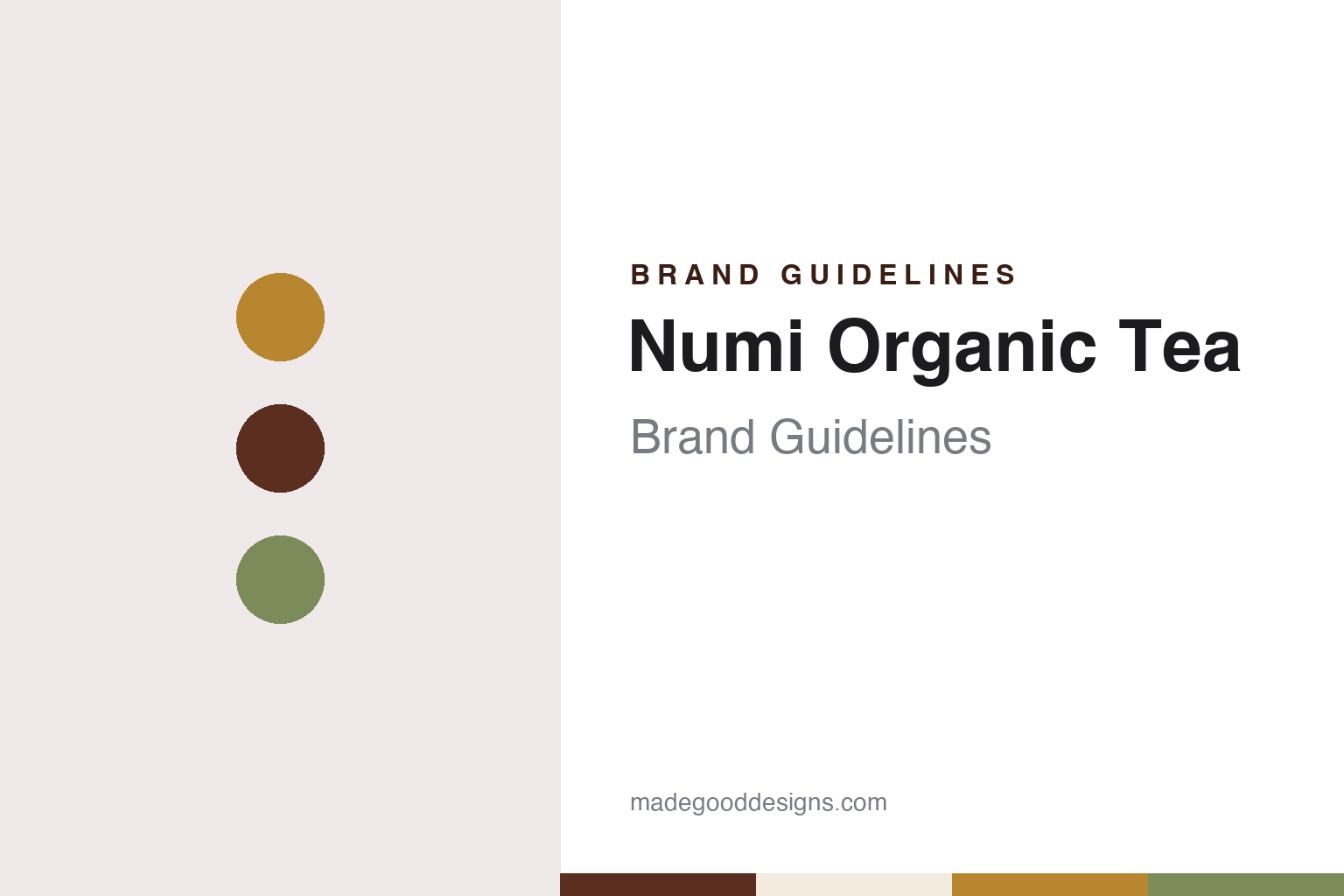
Numi Organic Tea Brand Guidelines
The Oakland tea company named after a dried desert lime.
Aa
Two constants: an amber, umber and sage palette and a crafted geometric sans register. Abstract homage — not a Numi product or mark; no box, wrapper, artwork or logo is reproduced.
A tea named after a lime
A brother, a sister and an apartment in Oakland.
Numi Organic Tea was founded in Oakland, California, in 1999 by a brother and sister, Ahmed Rahim and Reem Hassani. The company says it began in a small apartment, and English Wikipedia, citing the San Francisco Chronicle in 2008 and Oakland North in 2011, gives the same founders and year.
The name comes from a drink the founders knew as children in Iraq: a tea of steeped dried desert lime. The company says the word numi means “citrus” in Arabic, and Hassani has written that while the dried lime is used in cooking across the region, in Iraq it is steeped into a tea. In a July 2026 post marking the company’s 27th year, Hassani wrote that the founders wanted to introduce this lime tea to an American audience, that it was one of Numi’s first nine teas, and that the range has since grown to more than 35 blends, plus latte powders and drinking chocolates. The company says it now buys its dried limes from Fair Trade Certified organic farms in Burkina Faso.
The two founders brought different skills. According to the company, Rahim studied theatre and psychology in New York, then spent about a decade in Europe as a filmmaker and photographer, where he designed and ran two teahouses in Prague. At Numi he creates the blends and leads sourcing, travelling to growing regions. Hassani trained first as a biomedical engineer and then as an artist, with a diploma from the Lorenzo de’ Medici art institute in Florence and an MFA from JFK University in California.
Colour
Organic, Fair Trade and a founding B Corp.
From the start, Numi positioned itself around how its tea is grown and traded. English Wikipedia says all of its teas are USDA certified organic, and the company says on its own site that all of its products are certified organic and that all of its teas, and most of its other products, carry either Fair Trade or Fair Labor certification. It also says it requires laboratory testing of its teas and a certificate of analysis with each purchase, and that its suppliers face random and annual inspections. In 2010, according to a trade report cited by Wikipedia, Numi was the largest brand purchaser of Fair Trade Certified teas in the United States. The company says its organic, Fair Trade black tea comes from the Tonganagaon estate in India.
Numi was among the first companies certified as a B Corporation. The B Corp listing cited by Wikipedia records its certification in December 2007, and Wikipedia describes it as a founding B Corp. The company’s legal name on its website today is Numi, Inc. P.B.C., a public benefit corporation, and Wikipedia notes that it is Climate Neutral certified.
The product range has also brought less familiar teas to American shelves. Food & Wine reported in May 2005 on Numi’s line of flowering teas, bundles of leaves sewn around flowers that open in hot water. A 2012 press release described Numi as the first to bring a full line of pu-erh teas to the US market.
Wikipedia describes Numi as privately owned, and the company lists both founders in senior roles, Rahim as Chief Visionary Officer and Hassani as Chief Brand Officer. Baking Business reported in February 2016 that The J.M. Smucker Company held a minority stake in the company. The company says its headquarters are in Oakland’s Adams Point neighbourhood, next to the Grand Lake district, and it sells its European range through a separate site.
Typography
Design and documentation.
The seven brands in this group all sell tea in North America: Bigelow, Celestial Seasonings, Stash, Tazo, Mighty Leaf and Numi are American, and Red Rose was founded in Canada before crossing the border. Between them they cover much of what a North American shopper finds on the tea shelf, from boxes of bagged black tea to herbal blends and caffeine-free infusions, sold through supermarkets as well as natural-foods stores.
A North American tea brand’s identity is usually carried by a box, a name and a blend rather than by a place, because the leaf inside may have been grown on another continent and blended somewhere else again. Names also travel between owners: a brand can be sold, licensed or split by country while the box on the shelf looks much the same, which makes the questions behind each one worth asking plainly — who started it, who owns it now, where its tea is bought and where it is actually blended and packed.
Each guide separates what independent sources record from what the company says about itself — its founding story, its owners over time, where its tea comes from and where it is packed — and marks plainly what rests only on the company’s own word.
Aa
A crafted geometric sans with an artist’s warmth. (Specimen set in Josefin Sans, a sans STAND-IN; NOT the Numi logo.)
Numi Organic Tea
Packaging led by an artist.
At Numi, packaging is overseen by a founder. The company says Reem Hassani, as Chief Brand Officer, “oversees brand identity, including all packaging design,” and that her original artwork, inspired by her brother’s photographs, has been a source of inspiration for Numi’s brand vision and packaging. The company’s FAQ also refers to a packaging refresh, saying the brand has “a new look” while its blends and recipes are unchanged; it does not give a date. No guide to the Numi logo, typeface or colours has been published.
Much of what is documented about the packaging concerns materials. Wikipedia, citing Inc. in 2011 and the company’s B Corp profile, says Numi used filter-paper tea bags rather than “silk” bags often made from petroleum-based materials, in recyclable boxes made from 85 percent post-consumer waste, printed with soy-based inks and not wrapped in plastic. The company says its tea bags are now made from manila hemp fibre, unbleached, with cotton strings and tags printed with soy-based inks.
In January 2020, Whole Foods Magazine reported that Numi had introduced plant-based tea wrappers. The company says the wrappers are made from FSC-certified paper lined with sugarcane-based PLA and a metallised eucalyptus layer, are commercially compostable, and are not recyclable because of that lining; a few green teas are the exceptions. The company says third-party certification of the wrappers is in progress. Numi also says its teas are Kosher and Halal certified.
For a design guide, Numi shows how an origin story, a founder’s artwork and a material choice can all be part of an identity. Compare Pukka, another organic tea brand with illustrated packaging, and Mighty Leaf, its Bay Area neighbour. For this guide we use amber, umber and sage with a sans, an unofficial interpretation; no product or logo is reproduced.
Explore & save
Keep Numi Organic Tea’s identity on hand — save it to a board in the Made Good inspiration library.
Numi Organic Tea identity set
Pin the Numi amber, umber and sage palette and the crafted geometric sans register to your own board.