Tetley Brand Guidelines
The Yorkshire tea merchant that brought tea bags to Britain.
Aa
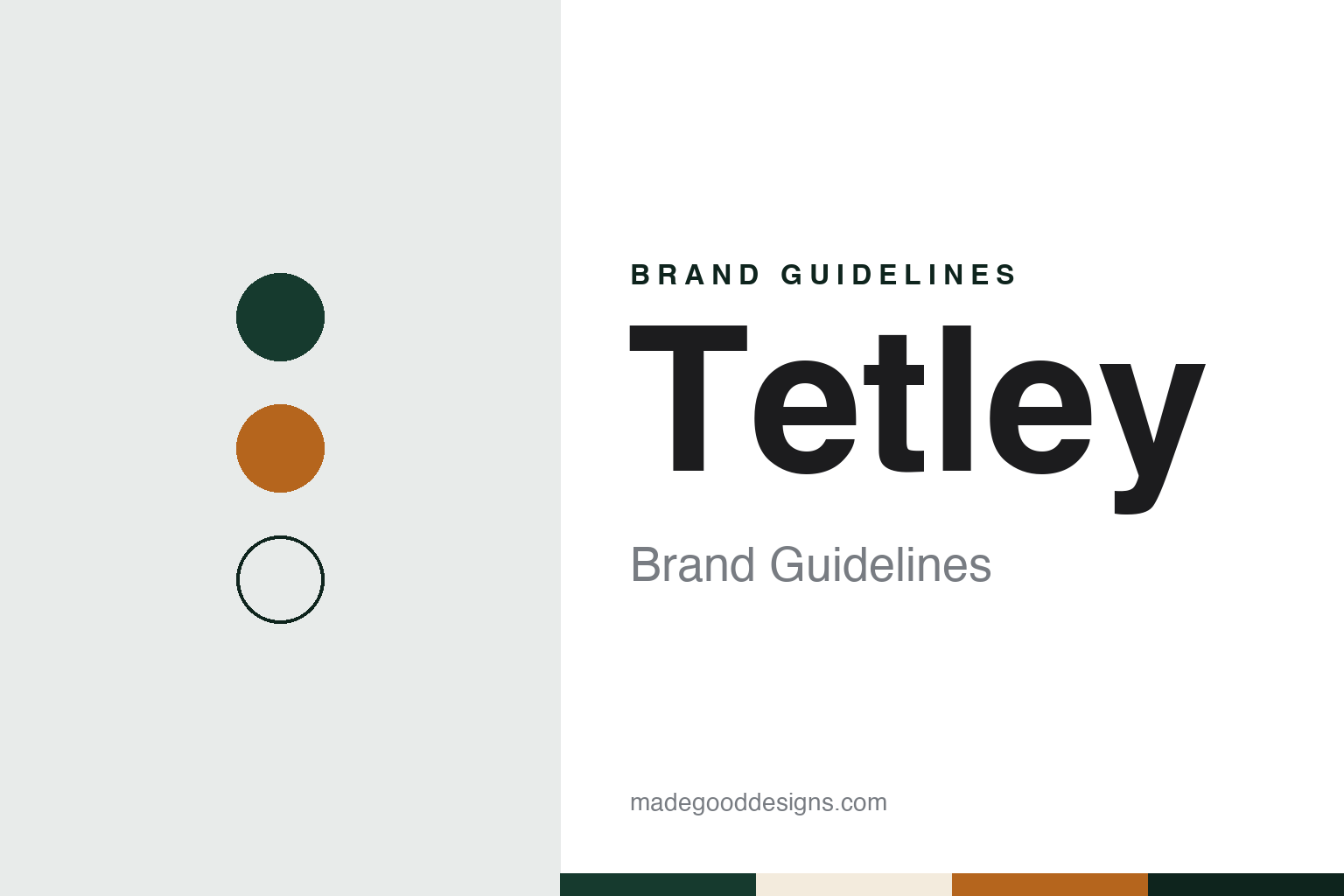
Two constants: a leaf green, amber and cream palette and a heritage serif register. Abstract homage — not a Tetley product or mark; no pack, logo or character is reproduced.
Salt, then tea
Two brothers, a pack horse and a Yorkshire start.
Tetley’s story begins in Yorkshire. English Wikipedia, citing a brand history published by Tata Global Beverages, says the brothers Joseph and Edward Tetley were selling salt from a pack horse in Huddersfield in 1822, began selling tea, and in 1837 set up as tea merchants under the name Joseph Tetley & Co. The company dates itself to the same year: its UK website says Tetley was “founded in 1837 by the Tetley brothers in Yorkshire, England,” and signs off its pages “blending quality teas since 1837.”
The business did not stay in Yorkshire. In 1856, Wikipedia says, it moved to London and became Joseph Tetley & Company, Wholesale Tea Dealers, in partnership with Joseph Ackland — a detail drawn from an archived history page on the company’s former American website. Today Wikipedia lists the British business as headquartered in Greenford, in west London.
Tetley’s best-known first came more than a century later. English Wikipedia says it was the first company to sell tea in tea bags in the United Kingdom, in 1953; the year before, Petula Clark’s single “Anytime Is Tea Time Now” had been used to advertise the brand on Radio Luxembourg. In 1989, after consumer tests of British preferences, Tetley launched the round tea bag, according to a history once published by the Tetley Tea Academy and cited by Wikipedia.
Colour
The Tea Folk, and a run of owners.
The other thing many British viewers remember is the Tetley Tea Folk. The English Wikipedia article on the campaign credits their origin in 1973 to the Canadian copywriter John McGill Lewis of the agency McCann Erickson, with the art director Peter Rigby creating the characters and the studio Wyatt Cattaneo animating them. The cast grew over two decades: Gaffer, their leader, from 1973; Sydney from 1975; Maurice, the inventor, from 1982; then Clarence, Gordon the gardener, Tina — the only woman in the group — and, in 1993, Archie, Gaffer’s nephew.
The campaign ran until 2001, Wikipedia says, when Tetley said it was “re-examining our Advertising Agency arrangements.” The Tea Folk returned on 30 June 2010 and appeared again between 2014 and 2016. Channel 4’s “100 Greatest TV Ads” placed them at number 40.
Ownership changed in the same period. In 1973 Tetley was bought by J. Lyons and Co., forming Lyons-Tetley, according to Nick Hall’s 2000 book The Tea Industry, cited by Wikipedia; Lyons later became part of Allied Lyons and then Allied Domecq. In July 1995 a group of investors bought the worldwide beverage business from Allied Domecq in a management buy-in, creating the Tetley Group, Wikipedia says.
Typography
Britain’s tea brands.
The seven brands in this group all sell tea, and they come from three countries: Yorkshire Tea, Taylors of Harrogate, Ahmad Tea, Tetley and PG Tips from England, Teekanne from Germany, and Dammann Frères from France. Tea brands in general sit at many different points in the trade, from boxes of bags on a supermarket shelf to loose-leaf tins sold over the counter of a house’s own shop, and a single company can work at both ends at once.
A tea brand’s identity is usually carried less by a field than by a blend, a box and the cup it promises, because the leaf in the packet may have been grown a long way from where the name on the front was made. That makes the questions behind each name worth asking plainly: who started it, who owns it now, where its leaves are bought, and where its tea is actually blended and packed.
Each guide separates what independent sources record from what the company says about itself — its founding story, its owners over time, where its tea comes from and where it is packed — and marks plainly what rests only on the company’s own word.
Aa
A heritage serif for a tea merchant dating itself to 1837. (Specimen set in Libre Baskerville, a serif STAND-IN; NOT the Tetley logo.)
Tetley
A Tata brand since 2000.
The decisive sale came in February 2000, when India’s Tata Group bought the Tetley Group for £271 million, according to a Tata release cited by Wikipedia, which describes it as one of the largest overseas acquisitions by an Indian company at the time. The buyer was then Tata Tea; it later became Tata Global Beverages, and on 7 February 2020, when the consumer products business of Tata Chemicals was merged into it, it was renamed Tata Consumer Products, Wikipedia says, citing the Indian business press. Tetley remains a wholly owned subsidiary.
The supply chain changed after the takeover. An article in Quartz, cited by Wikipedia, reported that Tetley’s supply chains were consolidated with Tata Tea’s and that most of its leaves now come from Tata’s plantations in India and Sri Lanka. The company says it sources 100% of its teas from Rainforest Alliance Certified farms and was a founding member of the Ethical Tea Partnership. It says its UK tea factory is at Eaglescliffe, in North East England, and that the site has sent zero waste to landfill since 2013, runs on green electricity and is certified to the ISO 50001 energy-management standard; we give these as the company’s claims.
The range has also widened well beyond black tea. Tetley’s own timeline lists Pure Green, a blend of Asian and African green teas, in 2004; Pure Redbush, which it says is sourced from the Cederberg region of South Africa, in 2007; a range called Super Tea, with added vitamins, in 2014; and a new premium range in 2025. The same timeline says that by 2010 Tetley was buying a million kilos of tea a week.
Packaging is where the brand has been most active recently. Tetley’s UK website says its black tea packs were changed to drop non-recyclable laminates, are “100% recyclable and 25% more compact,” and now hold plant-based tea bags, and that as of 2024 all of its UK on-shelf packaging was fully recyclable under OPRL definitions. Its own timeline records a brand refresh with a new logo in 2015, rolled out “across all products and communications.” The designer is not named in the sources we checked, and no official colours or typefaces are published.
For a design guide, Tetley shows how a merchant’s family name can carry through two centuries and several owners, with advertising characters helping to fix it in memory. Compare PG Tips, its long-time rival in British tea advertising, and Twinings, another London tea name with a long history. For this guide we use leaf green, amber and cream with a serif, an unofficial interpretation; no product or logo is reproduced.
Explore & save
Keep Tetley’s identity on hand — save it to a board in the Made Good inspiration library.
Tetley identity set
Pin the Tetley leaf green, amber and cream palette and the heritage serif register to your own board.