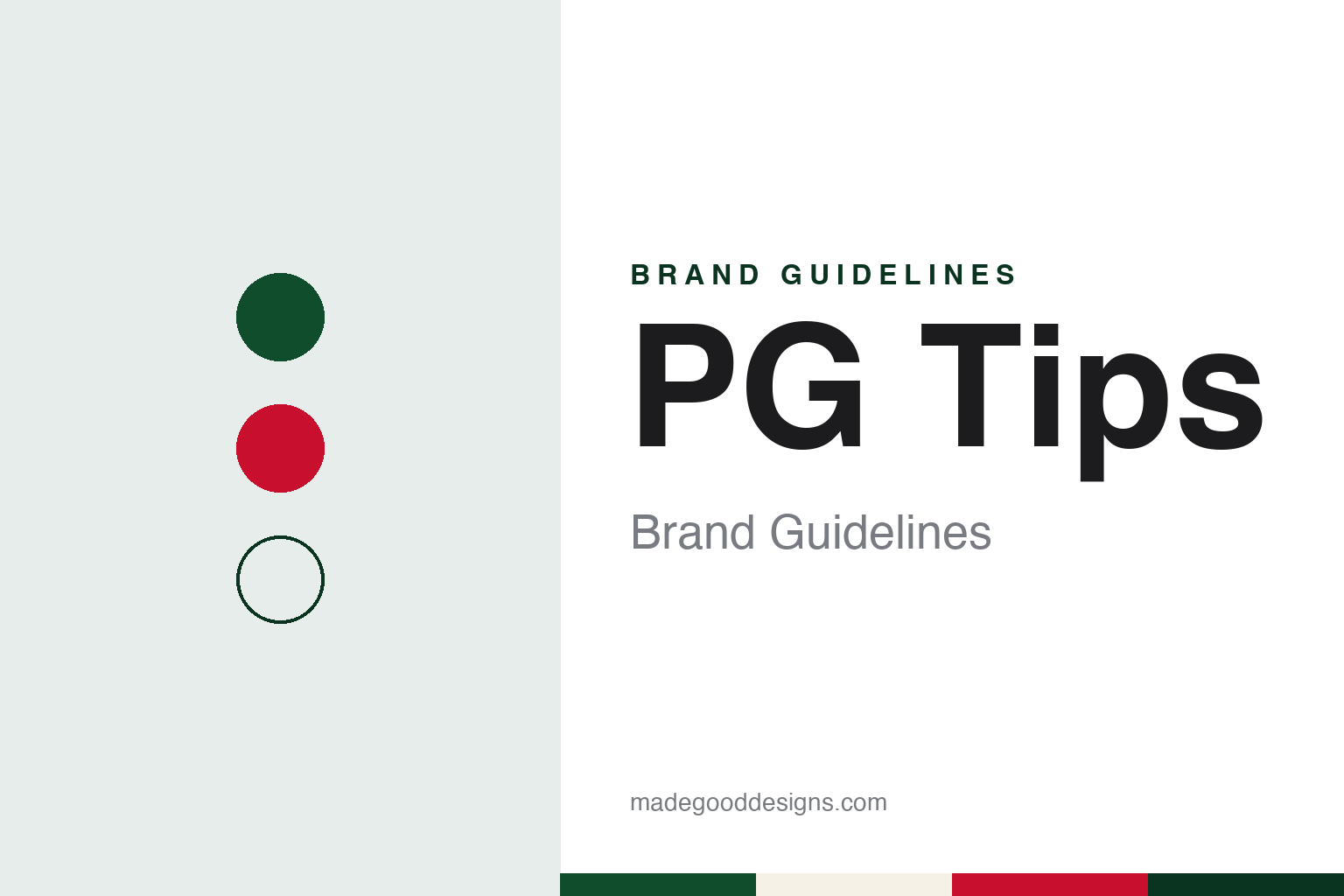
PG Tips Brand Guidelines
Brooke Bond’s Manchester tea, from chimps to square bags.
Aa
Two constants: a deep green, red and cream palette and a bold grotesque register. Abstract homage — not a PG Tips product or mark; no pack, logo or character is reproduced.
Brooke Bond
A Manchester tea shop and an imaginary partner.
PG Tips began as a product of Brooke Bond, the Manchester tea business founded by Arthur Brooke. In 1869, the BBC reported in a 2005 feature marking the brand’s 75th anniversary, Brooke, a tea dealer from Ashton-under-Lyne, opened his first shop on Market Street in Manchester, selling tea, coffee and sugar. The sign above the door read “Brooke, Bond and Company,” but, the BBC said, “there was no Mr. Bond” — Brooke simply liked the sound of it. One of his early slogans promised that “good tea unites good company, exhilarates the spirits, banishes restraint from conversation and promotes the happiest purposes of social intercourse.”
Brooke Bond became one of the largest tea companies of the twentieth century. English Wikipedia says it launched Red Label in British India in 1903 and that by 1957 it was possibly “the largest tea company in the world, with one third share of both the British and Indian tea markets”; it merged with Liebig in 1968 and was acquired by Unilever in 1984. From 1954 to 1999 its packets carried collectable picture cards, some 85 series in all, Wikipedia says.
PG Tips itself arrived in 1930. Its first name was Pre-Gestee — Wikipedia’s Brooke Bond article spells it Pre-Gest-Tea — a variant of an earlier name, “Digestive Tea,” the BBC and Wikipedia say; the name implied the tea could be drunk before a meal as an aid to digestion. Salesmen and grocers shortened it to “PG.” “Tips,” the BBC explained, refers to the top two leaves and bud of the tea plant used in the blend; Wikipedia dates the adoption of the PG Tips name to 1950–51.
Colour
Chimps, birds and a monkey.
The brand’s fame rests heavily on its advertising. In 1956 PG Tips began using chimpanzees dressed in human clothes in its television commercials — the “Tipps family” — with voices supplied by performers including Peter Sellers, Donald Sinden and Bob Monkhouse, English Wikipedia says. By 1958, according to The Independent, cited there, PG Tips had risen from fourth to first place in the British tea market. The BBC’s 2005 feature described the chimps advert as “the second TV ad ever aired” and said the campaign was in the Guinness Book of Records as the longest-running ever.
The chimpanzees came from Twycross Zoo in Leicestershire. The adverts were dropped in the 1970s after complaints from animal-rights organisations, then brought back 18 months later when sales fell, Wikipedia says; the last chimpanzee advert was broadcast in January 2002, The Daily Telegraph reported. Among the best remembered is the 1988 “Mr Shifter” piano-removal advert.
The successors were the T-Birds, a house-sharing group of claymation birds animated by Aardman, the studio behind Wallace and Gromit, from 2002 to 2005. In January 2007 the brand brought in Monkey, a puppet first seen in advertising for ITV Digital, with the comedian Johnny Vegas as his friend Al and Ben Miller as Monkey’s voice. PG Tips retired Monkey in May 2024, announcing a “well-deserved retirement”; he returned in May 2025, now voiced by Ivo Graham, The Daily Telegraph reported.
The product changed alongside. Wikipedia lists stringed “PG Tags” in 1985 and pyramid-shaped tea bags in 1996, designed to let the leaves move more freely, and says all the tea used in PG Tips has been Rainforest Alliance certified since April 2012. In Scotland the brand sells a Scottish Blend, marketed as blended for the country’s soft water.
Typography
Britain’s tea brands.
The seven brands in this group all sell tea, and they come from three countries: Yorkshire Tea, Taylors of Harrogate, Ahmad Tea, Tetley and PG Tips from England, Teekanne from Germany, and Dammann Frères from France. Tea brands in general sit at many different points in the trade, from boxes of bags on a supermarket shelf to loose-leaf tins sold over the counter of a house’s own shop, and a single company can work at both ends at once.
A tea brand’s identity is usually carried less by a field than by a blend, a box and the cup it promises, because the leaf in the packet may have been grown a long way from where the name on the front was made. That makes the questions behind each name worth asking plainly: who started it, who owns it now, where its leaves are bought, and where its tea is actually blended and packed.
Each guide separates what independent sources record from what the company says about itself — its founding story, its owners over time, where its tea comes from and where it is packed — and marks plainly what rests only on the company’s own word.
Aa
A bold grotesque for a mass-market British tea. (Specimen set in Barlow, a sans STAND-IN; NOT the PG Tips logo.)
PG Tips
From Unilever to Lipton Teas and Infusions.
For almost four decades PG Tips was a Unilever brand. That ended with the sale of Unilever’s tea division, which it had set up as a separate business called ekaterra. In November 2021 Unilever agreed to sell ekaterra to CVC Capital Partners for €4.5 billion, the Financial Times and The Grocer reported; the Australian trade title Food & Drink Business reported the sale complete on 6 July 2022. Unilever kept its tea businesses in India, Nepal and Indonesia and its ready-to-drink joint ventures with PepsiCo. The business was renamed Lipton Teas and Infusions in 2023, according to Wikipedia, and is headquartered in Amsterdam; its brands include Lipton, Pukka, Tazo and T2 as well as PG Tips. The Brooke Bond name, Wikipedia notes, has been dropped from PG Tips packaging.
Wikipedia says PG Tips is blended from bulk estate teas to a recipe known as blend 777, which can contain between 12 and 35 estate teas depending on the season, at the Trafford Park factory in Greater Manchester; the BBC reported in 2005 that PG Tips was “still made here in Manchester” at the Brooke Bond plant there. We could not confirm the current arrangement from the owner’s website.
The most recent redesign came in September 2023, when, Talking Retail reported, Lipton Teas and Infusions gave PG Tips “a completely new look and blend,” with Original, Gold and Decaf packs and what the brand’s UK and Ireland general manager, Liam McNamara, called “the market’s only square tea bags,” which replaced the pyramids. PG Tips said the new blend brewed in 60 seconds; the BBC reported the project took two years and £50 million, and quoted the UK Tea Academy’s director, Jennifer Wood, questioning whether it was an innovation. The pack designer is not named in the sources we checked, and no official brand colours or typefaces are published.
For a design guide, PG Tips shows how a name coined for a 1930s blend outlived its original meaning, carried for decades by its advertising characters. Compare Tetley, its long-time rival with the Tea Folk, and Pukka, a herbal brand now under the same owner. For this guide we use deep green, red and cream with a sans, an unofficial interpretation; no product or logo is reproduced.
Explore & save
Keep PG Tips’s identity on hand — save it to a board in the Made Good inspiration library.
PG Tips identity set
Pin the PG Tips deep green, red and cream palette and the bold grotesque register to your own board.