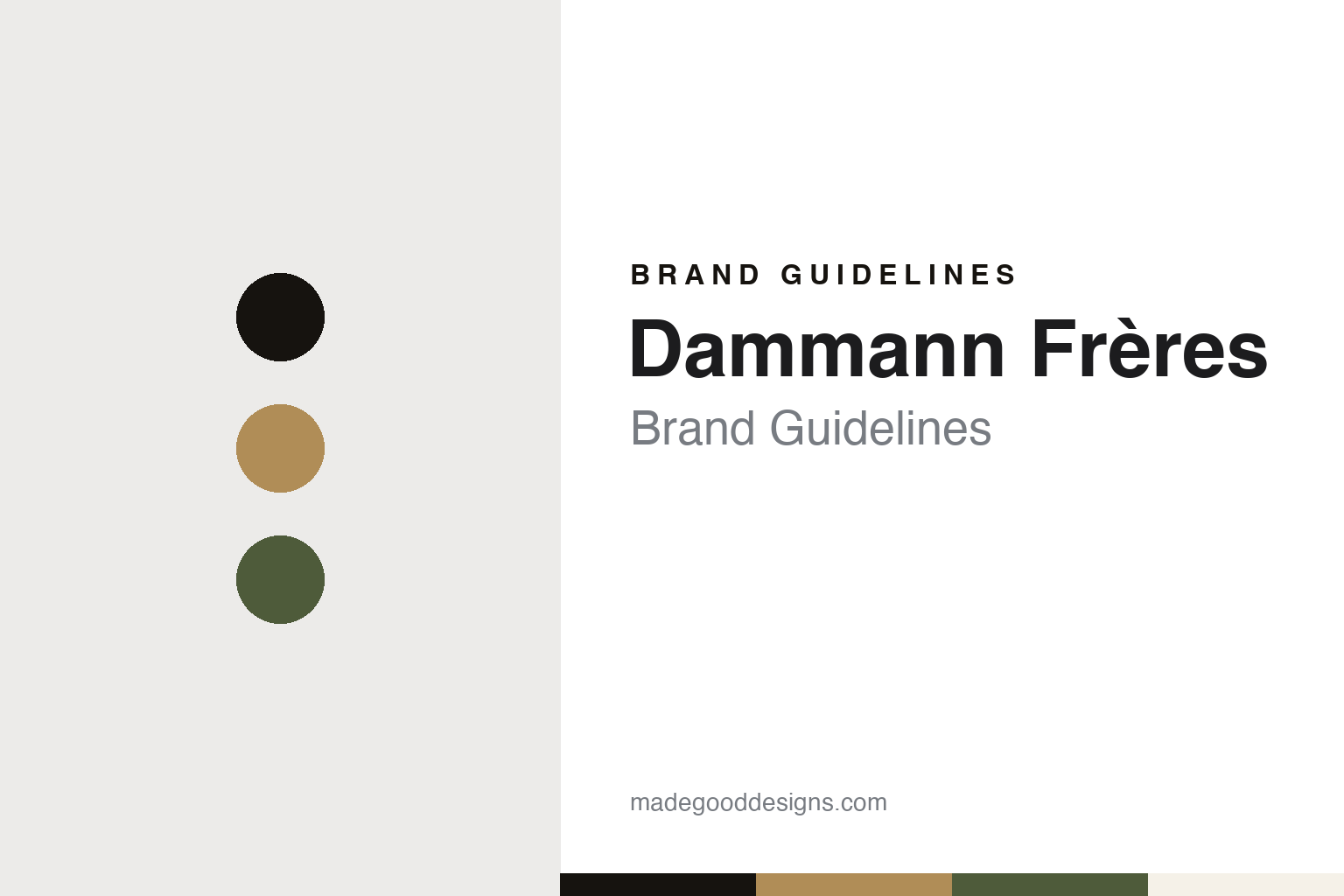
Dammann Frères Brand Guidelines
The French tea house behind the Cristal sachet.
Aa
Two constants: a Dammann Frères tin-black, gilt and leaf-green palette and a Parisian tea-house serif register. Abstract homage — not a Dammann Frères product or mark; no tin, sachet, logo or photograph is reproduced.
From Batavia to Paris
A tea trade older than the brand on the tin.
Dammann Frères is a French tea house based in Dreux, in the Eure-et-Loir department west of Paris, and its history begins with a date that no longer heads its own timeline. French Wikipedia says the company has claimed that royal archives record a privilege, dated 1692 under Louis XIV, granting a Dutchman named François Damame the exclusive right to sell coffee, tea, sorbets and chocolates; La Tribune, profiling the firm in 2009, opened its story with the same seventeenth-century decree. French Wikipedia adds that this Damame does not appear to be related to the Dammann family. The timeline on the company’s website now starts in 1825, when, it says, Dammann Frères bought Derode, a trader in tea and vanilla, taking over a tea counter in Batavia, in what is now Indonesia.
The brothers in the name came later. The company says Pierre and Robert Dammann were running the business in 1925 and opened a spice counter at Tamatave, in Madagascar, and that in 1926 a tea counter opened in New York on the initiative of Véra Dammann. La Tribune described the brothers importing teas from China, India and Ceylon and the house supplying the Compagnie Générale Transatlantique, but said its finances stayed precarious until the arrival of Jean Jumeau-Lafond. The company dates his arrival to 1949 and says he ran the firm alongside Robert Dammann, after which tea became its only trade; French Wikipedia gives 1954 as the year he succeeded Robert Dammann. We give both dates.
Jean Jumeau-Lafond’s best-known creation is a blend. The company calls Goût Russe Douchka the first modern flavoured tea; La Tribune reported that he created it as a tribute to his wife, and French Wikipedia says it was inspired by her habit of mixing her hot tea with a little fresh orange juice. For decades the house worked mostly out of sight: La Tribune wrote that it supplied the great names of French fine-food retailing with their teas “sans jamais apparaître” — without ever appearing — and French Wikipedia names Fauchon and Hédiard among the houses it produced for. In 1980, French Wikipedia says, Jean’s eldest sons, Jacques and Didier Jumeau-Lafond, took over the running of the company.
Colour
An Italian owner and a factory in Dreux.
Ownership changed in the 2000s. La Tribune reported in 2009 that Didier Jumeau-Lafond took control through a leveraged buyout in 2003, unwound after a year when the Italian coffee company Illy bought a majority of the capital and left him in charge; French Wikipedia dates the buyout to 2005. The company’s own timeline says the Illy group became its majority shareholder in 2007, and French Wikipedia cites a Tea & Coffee Trade Journal item of April 2007 headlined “Illycaffe buys Dammann Freres.” French Wikipedia, citing Reuters, also says Illy announced a holding company in 2019, Polo del Gusto, grouping the chocolate maker Domori, the Mastrojanni wine estate and Dammann Frères, and that Domori and Dammann together accounted for 80 per cent of Illy’s sales outside coffee in 2018.
The tea is blended and packed in France. The company moved from Orgeval, in the Yvelines, to Dreux in 2011; Les Echos reported that September that it was taking over the former Philips site in the town. The company says its workshops there cover 32,000 square metres, that a team of 190 people prepares a collection of some 300 single-origin teas, classic blends and flavoured teas, and that its buyers purchase teas and herbs directly from producers. It says a tea blender keeps the classic blends consistent while an in-house flavourist creates new flavoured teas, that every incoming lot is quarantined and tested by an independent laboratory accredited by COFRAC, and that raw material passes through optical sorting machines or, for the most delicate leaves, is sorted by hand. French Wikipedia records 207 employees in 2018 and revenue of €37.6 million in 2021.
The house has also had a brush with regulators. In December 2020 France’s competition authority, the Autorité de la concurrence, fined Dammann Frères €226,000 for imposing resale prices on its distributors over a two-year period, Le Figaro reported, citing AFP.
Typography
Seven tea brands, three countries.
The seven brands in this group all sell tea, and they come from three countries: Yorkshire Tea, Taylors of Harrogate, Ahmad Tea, Tetley and PG Tips from England, Teekanne from Germany, and Dammann Frères from France. Tea brands in general sit at many different points in the trade, from boxes of bags on a supermarket shelf to loose-leaf tins sold over the counter of a house’s own shop, and a single company can work at both ends at once.
A tea brand’s identity is usually carried less by a field than by a blend, a box and the cup it promises, because the leaf in the packet may have been grown a long way from where the name on the front was made. That makes the questions behind each name worth asking plainly: who started it, who owns it now, where its leaves are bought, and where its tea is actually blended and packed.
Each guide separates what independent sources record from what the company says about itself — its founding story, its owners over time, where its tea comes from and where it is packed — and marks plainly what rests only on the company’s own word.
Aa
A Parisian tea-house serif — black tins, gilt lettering and a shop on the place des Vosges. (Specimen set in Playfair Display, a serif STAND-IN; NOT the Dammann Frères logo.)
Dammann Frères
A tea bag you can see through.
Dammann Frères’ signature object is its tea bag. The company says the Cristal sachet was developed in 1980 by Jacques and Didier Jumeau-Lafond, a transparent bag that lets the drinker see the leaves and plants inside; French Wikipedia says it is woven from threads rather than made of muslin. Didier Jumeau-Lafond told La Tribune that until the 1980s the choice was a paper or a cloth bag, and that the company had up to 60 people sewing bags by machine at its Orgeval factory; the paper reported that he bought the new machines with his own money and produced 4.8 million sachets in the first year. French Wikipedia says the company filed the mark DAMMANN SACHETS CRISTAL with France’s INPI in June 2004, and the company says that since 2021 its sachets have been made of PLA, a bio-sourced material derived from maize or sugar cane.
The house became a retail brand late. The company says that in 2005, after years of supplying the great fine-food and gastronomy houses, it began to sign its own products and recipes and created a new visual identity, and that it launched its first online shop in 2007. It opened its first boutique at 15 place des Vosges in Paris at the end of 2008. “I wanted to establish the brand’s reputation, take on Japan and the luxury market. But for that, you need a shop,” Didier Jumeau-Lafond told La Tribune (our translation). The company says it opened a shop and tea room in Osaka in 2011 and was present in 62 countries outside France by 2012; its store list now runs to boutiques across Paris and in French cities from Marseille to Brest.
For a design guide, Dammann Frères shows how a house that spent decades unseen behind other retailers’ names built its own identity late, around a see-through bag, a Paris address and a long family timeline. Compare Mariage Frères, another Paris tea house, and Palais des Thés, a French rival in the same market. For this guide we use tin black, gilt and leaf green with a serif, an unofficial interpretation; no product or logo is reproduced.
Explore & save
Keep Dammann Frères’s identity on hand — save it to a board in the Made Good inspiration library.
Dammann Frères identity set
Pin the Dammann Frères tin-black, gilt and leaf-green palette and the Parisian tea-house serif register to your own board.