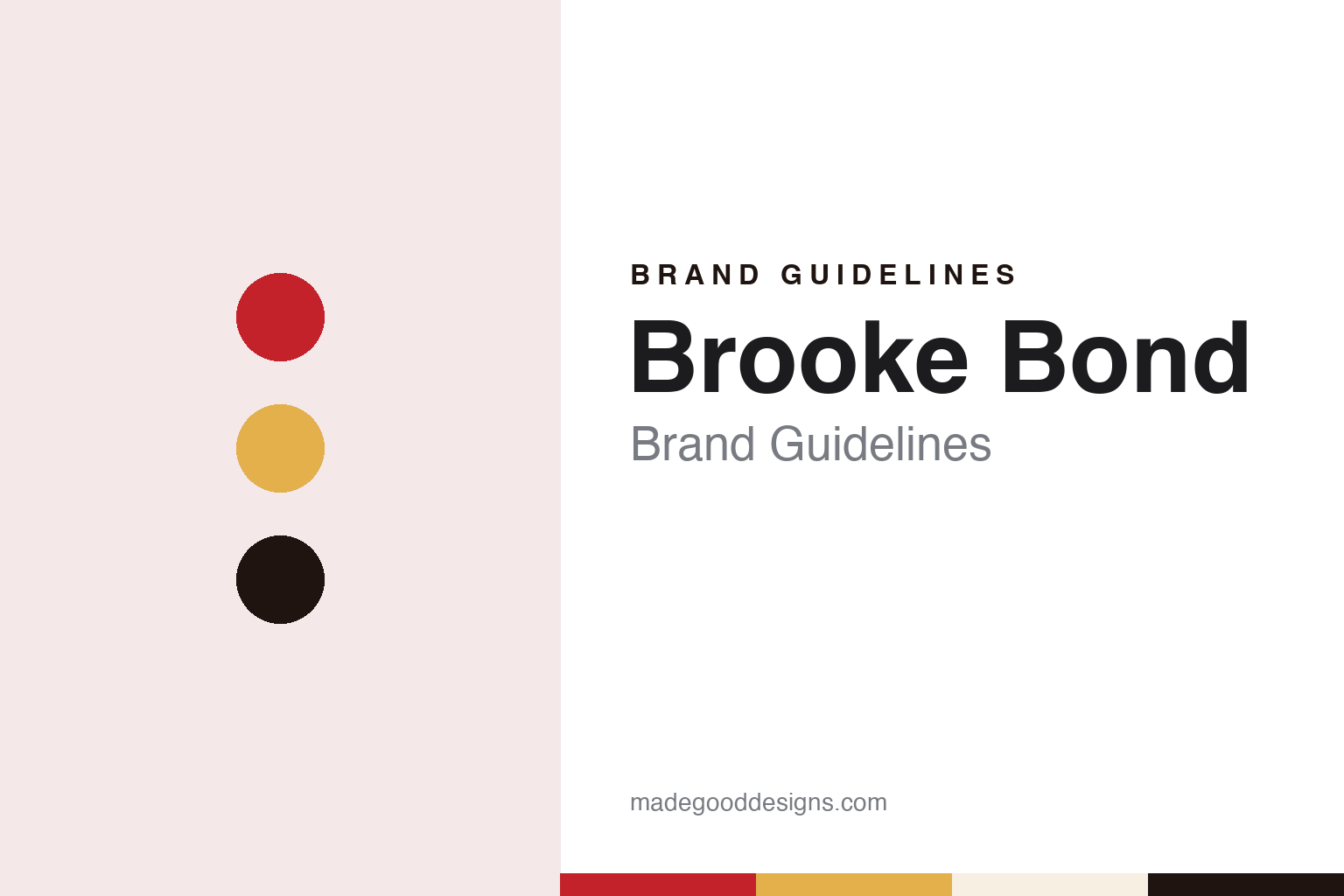
Brooke Bond Brand Guidelines
The Manchester teahouse name that became India’s Red Label.
Aa
Two constants: a Brooke Bond red and gold palette and a Victorian merchant serif register. Abstract homage — not a Brooke Bond product or mark; no pack, card or logo is reproduced.
A teahouse on Market Street
Arthur Brooke’s bond to his customers.
Brooke Bond began with one shop. English Wikipedia, citing a history of the brand, says Arthur Brooke, born in Ashton-under-Lyne in Lancashire in 1845, opened his first teahouse at 23 Market Street, Manchester, in 1869. There was no partner called Bond: the same source says Brooke chose the name because it was his “bond” to his customers to provide good tea. The firm moved into wholesale tea in the 1870s.
The business grew into packing and printing as well as trading. In 1908 Brooke Bond set up the Berkshire Printing Company in Reading as its printing division, producing tea packets and, later, the cards that went inside them; from the 1930s it also printed playing cards by lithography, according to the World of Playing Cards reference site. In 1911 the company opened a packing factory in Goulston Street, Stepney, in east London, a 1960 Stepney borough guide records.
Brooke Bond was also early into India. In 1903 it launched Red Label in British India, according to a marketing textbook by Rajagopal published in 2000, and that blend is now the name most closely tied to Brooke Bond. At home, the company launched PG Tips in 1930 under the name Pre-Gest-Tea, the BBC reported in 2005; grocers shortened it to “PG,” and the BBC said the Brooke Bond factory at Trafford Park, near Manchester, had produced PG Tips since that year.
By 1957, a Harvard Business School paper cited by Wikipedia says, Brooke Bond was probably the largest tea company in the world, with about a third of both the British and the Indian tea markets.
Colour
Tea cards, chimps and a merger.
Much of Brooke Bond’s visual memory in Britain lives on small pieces of card. From 1954 until 1999, packets of Brooke Bond tea carried illustrated cards, usually in series of 50, which children collected in albums. English Wikipedia, drawing on a collectors’ set list, counts about 85 titles issued around the world: 59 series in the UK, 17 in Canada between 1959 and 1974, six in what was Rhodesia and three in South Africa. Most of the early series were about wildlife, and the bird painter Charles Tunnicliffe was among the best-known illustrators; later sets covered transport, space, costume and sport, and the last ones in the 1990s turned to the chimpanzees from the television adverts.
Those chimpanzees belonged to PG Tips. From 1956 the brand’s television adverts showed chimpanzees dressed as people, the “Tipps family,” with voices from performers including Peter Sellers and Bob Monkhouse; the last Tipps family advert was broadcast in January 2002, The Telegraph reported. Over time the Brooke Bond name was dropped from PG Tips packs, and the tea is now sold simply as PG Tips.
The company itself changed shape. In 1968 it merged with Liebig, the meat-extract business, to become Brooke Bond Liebig, and in 1984 that company was acquired by Unilever, according to English Wikipedia. Unilever reduced the use of the Brooke Bond name in Britain, and it disappeared from British shelves for about two decades.
It came back briefly. In 2019, for the 150th anniversary of Arthur Brooke’s first shop, Brooke Bond tea returned to UK stores after a 20-year absence, The Grocer and Convenience Store reported that August and September.
Typography
Tea, trade and documentation.
The seven brands in this group all sell tea, and their names were founded in five countries: Lipton and Brooke Bond in Britain, Tata Tea and Wagh Bakri in India, Ito En in Japan, Basilur in Sri Lanka, and Salada in Canada. Where a tea brand was founded is only the start of its story, because a name can travel a long way from the city where it began, and the country on its founding record need not be the country where its owner sits today.
A tea brand’s identity is usually carried less by a field than by a blend, a packet and the cup it promises, because the leaf inside may have been grown far from the place where the name on the front was made. That makes the questions behind each name worth asking plainly: who started it, who owns it now, where its leaves are bought, and where its tea is actually blended and packed.
Each guide separates what independent sources record from what the company says about itself — its founding story, its owners over time, where its tea comes from and where it is packed — and marks plainly what rests only on the company’s own word.
Aa
A Victorian merchant serif for an 1869 shop name. (Specimen set in DM Serif Display, a serif STAND-IN; NOT the Brooke Bond logo.)
Brooke Bond
A British name with an Asian heart.
Today the Brooke Bond name has two owners, divided by territory. When Unilever sold most of its tea business to CVC Capital Partners — agreed in November 2021 for €4.5 billion and completed in July 2022 — the Brooke Bond brand went with it to the new company, Lipton Teas and Infusions, except in India, Nepal and Indonesia, where Unilever kept it, according to English Wikipedia, citing The Times. In August 2022 the new owner said it would stop selling Lipton and Brooke Bond tea in Russia, RBC reported.
In India the brand sits in the portfolio of Hindustan Unilever, Unilever’s Indian company, which English Wikipedia lists as selling Brooke Bond Red Label, Taj Mahal, Taaza and 3 Roses. Hindustan Unilever’s website said in 2012 that Taj Mahal had been sold since 1966 and called it India’s first premium tea, and named the tabla player Ustad Zakir Hussain as its first brand ambassador, followed by the actor Saif Ali Khan; we give those as the company’s claims.
Elsewhere the name lives on through Lipton Teas and Infusions. Brooke Bond launched Laojee in Sri Lanka in 1972, the Daily News of Colombo reported, and English Wikipedia lists Laojee among Lipton Teas and Infusions’ brands in Sri Lanka. In Pakistan, English Wikipedia says, the company markets Brooke Bond Supreme, a blend of Kenyan tea, as stronger than Lipton Yellow Label. In Canada, Wikipedia says, Brooke Bond’s main product was Red Rose, which the same owner still sells there.
For a design guide, Brooke Bond shows how a company name can step back behind its products — Red Label in India, PG Tips in Britain — and still be remembered through its packaging and cards. Compare PG Tips, the Brooke Bond tea that outgrew its parent’s name, and Red Rose Tea, the Canadian tea that English Wikipedia calls Brooke Bond’s main North American product. For this guide we use red, gold and a strong tea brown with a serif, an unofficial interpretation; no product or logo is reproduced.
Explore & save
Keep Brooke Bond’s identity on hand — save it to a board in the Made Good inspiration library.
Brooke Bond identity set
Pin the Brooke Bond red and gold palette and the Victorian merchant serif register to your own board.