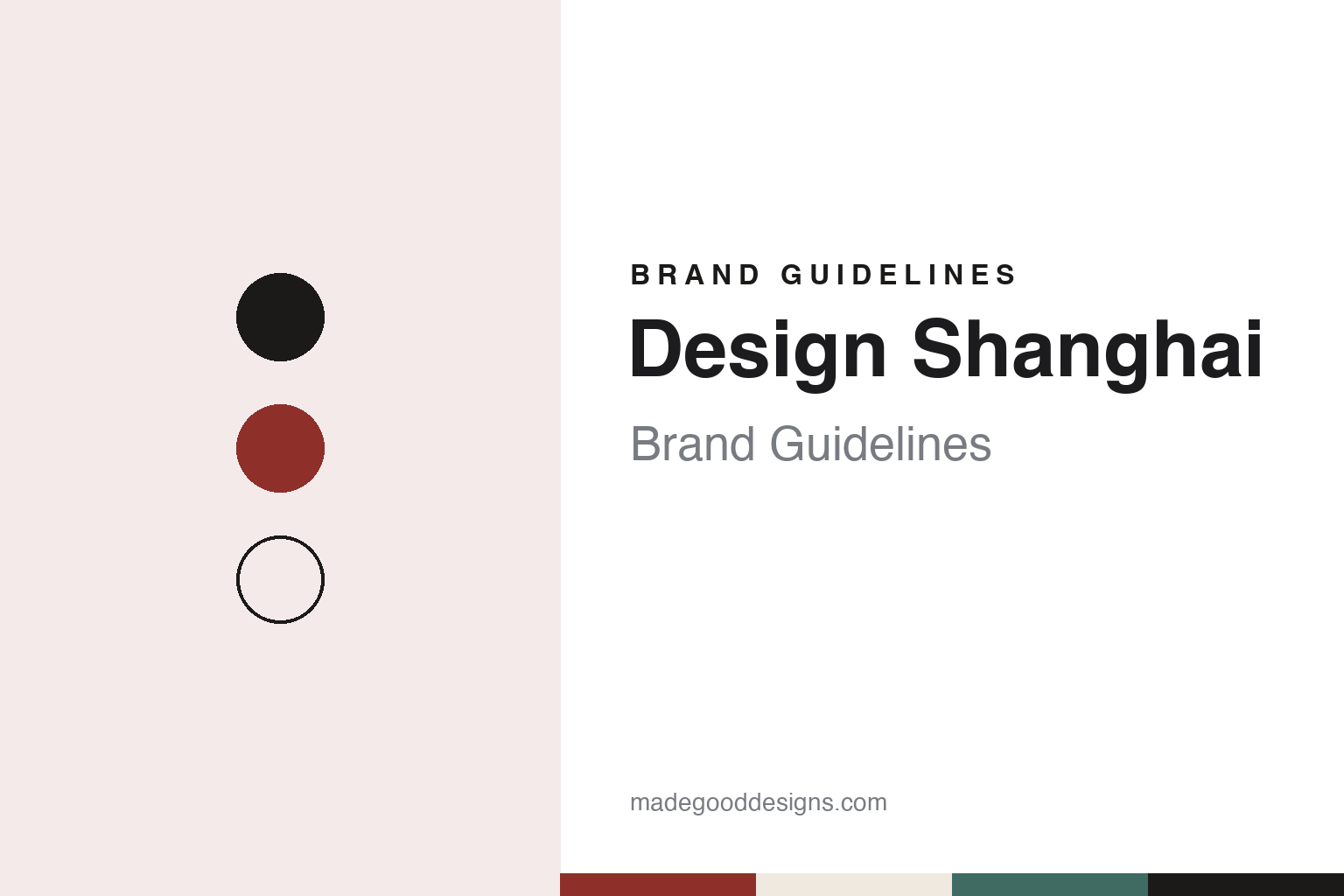
Design Shanghai Brand Guidelines
A design fair for Shanghai, under vaulted ceilings, since 2014.
Aa
Two constants: a lacquer red, rice paper and celadon palette and an exhibition sans register. Abstract homage — not a Design Shanghai asset; no logo, poster or exhibit is reproduced.
West Meets East
A London organiser, a Shanghai art fair and three halls.
Design Shanghai is an annual trade fair for furniture, lighting and interior design, held in Shanghai since 2014. It was launched as a partnership between Media 10, an Essex-based British events company whose shows included Clerkenwell Design Week and 100% Design, and the Shanghai Art Fair. Accounts of where the idea began differ. Interior Design reported on 22 November 2013 that Philip Dodd, a former broadcaster and founder of the creative-industries company Made in China, had approached Media 10 and the Shanghai Art Fair to organise the show together. A preview in Furniture News called it the brainchild of Mr Gu, general manager of the Shanghai Art Fair, with Media 10 as co-organiser.
The first edition ran from 27 February to 2 March 2014 at the Shanghai Exhibition Centre, the building that Furniture News described as newly renovated and Russian-style. Interior Design said the fair would be divided into three halls, Contemporary, Classic and Collectible, and named Jaguar Land Rover as sponsor. After the show, Exhibition News reported on 10 March 2014 that Media 10 claimed more than 47,000 visitors, and that the exhibitors included Tom Dixon, Fritz Hansen, Magis and HAY, alongside more than 50 UK brands. The organiser said that about 65 per cent of visitors were architects, interior designers, developers, dealers and design-minded consumers, and the programme included the AD China Design Forum, with five seminars a day profiling Western and Eastern designers.
Before the opening, Interior Design reported that the fair planned to bring more than 150 international brands to the Chinese market, most of them never before exhibited or distributed in China. The Furniture News preview added that Jaguar would bring Wallpaper* Handmade, a series of commissioned pieces that had toured Milan, London and Miami, to China for the first time, and that galleries would show in the Collectible hall.
Colour
From Media 10 to Clarion Events.
The fair expanded over its first five years. Sixth Tone, reporting from the 2019 edition on 8 March 2019, counted more than 400 brands from 32 nations under the vaulted ceilings and neoclassical columns of the Shanghai Exhibition Center. Tan Zhuo, then China general manager for Media 10, told the publication that only two Chinese brands had taken part in 2014, against 93 that year. The paper reported more than 14,000 visitors on the opening day.
Ownership changed in 2019. On 15 May 2019 Clarion Events, a British events company, announced that it had acquired Design Shanghai and its sister fair, Design China Beijing, from Media 10. Clarion said the Shanghai fair had been launched by Media 10 five years earlier, and that both events would continue to be headed by Zhuo Tan as event director. Media 10’s own website also describes the 2019 sale to Clarion. A promoted Dezeen feature in September 2019 described Design China Beijing as the sister event to the larger Shanghai fair, held at the National Agricultural Exhibition Centre in Beijing.
The venue changed for a time. The twelfth edition ran from 4 to 7 June 2025 at the site of the 2010 Shanghai World Expo, and Wallpaper*, reviewing it on 24 June 2025, called it the final edition held there before a return to the Shanghai Exhibition Centre. The organisers grouped that edition into furniture, lighting, kitchens, bathrooms, system design, lifestyle and materials, according to a promoted Dezeen feature.
The thirteenth edition did return. Wallpaper* reported on 20 March 2026 that it opened at the Shanghai Exhibition Centre on 19 March and ran until 22 March, with more than 500 brands from 20 countries by the organisers’ count. The magazine described five curated sections: Talents, Made in JDZ, Beyond Craft, Collectible Design & Art and Materials First. Show director Zhuo Tan told Wallpaper* that for 13 years the fair had championed modern design across China and Asia.
Typography
Design and documentation.
Design weeks and design fairs usually take one of two kinds of name. Some pair a city with the words “design week” or “design festival,” so that the place does most of the work; others use a short coined name or a set of initials, such as NYCxDesign, read aloud as “NYC by Design,” or ICFF, which stands for the International Contemporary Furniture Fair. In both cases the name tends to stay fixed from one year to the next while everything around it changes.
Behind the name there is usually an organiser, and often a trade-fair company. Some events began as city projects run by public agencies and later passed to private operators or not-for-profit bodies; others are trade shows owned by exhibition groups that run dozens of events across several industries, and those groups can themselves change hands. Smaller shows are sometimes absorbed into larger fairs and carry on as a named section inside them.
Most of these events are tied to places. A trade fair returns to the same convention hall or exhibition centre each year, while a citywide festival spreads across showrooms, galleries, studios and museums, linked by trails, maps, opening parties and late-night showroom evenings in particular neighbourhoods. Catalogues, printed and online calendars, and wayfinding inside large halls help visitors find their way through hundreds of exhibitors or events.
Visual identity therefore works on two levels. A logo or wordmark, sometimes designed by a named studio, stays constant, while posters, campaign images, floor plans and installations are commissioned again for each edition. This guide describes those identities only as dated sources describe them; the colours and typefaces shown here are our own interpretation, not the organisers’ own.
Aa
A clear sans for halls, maps and signage. (Specimen set in Archivo, a sans STAND-IN; NOT the Design Shanghai logo or identity typeface.)
Design Shanghai
A dragon made of chairs.
Design Shanghai’s first campaign image is the one most fully described in print. The 2014 preview in Furniture News said the show was built around the concept “West Meets East,” and that its lead creative was a dragon, chosen as a lucky symbol in China, made up of well-known furniture designs. Three separate dragons stood for the three halls, Contemporary Design, Classic Design and Collectible Design, giving each section its own identity within the one fair.
The building is part of the picture. The Shanghai Exhibition Centre, described by Sixth Tone in 2019 as a hall of vaulted ceilings and neoclassical columns, is where the fair began in 2014 and where it returned in 2026. In 2026 Wallpaper* described a show arranged in curated sections, among them Talents and Beyond Craft, while the promoted Dezeen feature listed product categories from furniture and lighting to materials.
The organisers have also built a citywide programme around the fair, under the name Design in the City, which they describe as an extension of Design Shanghai dating from 2014.
For a design guide, Design Shanghai shows how a trade fair can carry one city name through a change of owner and a change of venue while its sections and campaign images are renewed each year. Compare the Salone del Mobile, the Milan furniture fair, and Fritz Hansen, one of the brands at the first edition in 2014. For this guide we use a lacquer red, a rice-paper cream and a celadon green with a sans, an unofficial interpretation; no product or logo is reproduced.
Explore & save
Keep Design Shanghai’s identity on hand — save it to a board in the Made Good inspiration library.
Design Shanghai identity set
Pin the Design Shanghai lacquer red, rice paper and celadon palette and the exhibition sans register to your own board.
Source & notes
Frequently Asked Questions
What font can I use to match the Design Shanghai look?
This guide describes Design Shanghai’s type as “A clear sans for halls, maps and signage”. Its type specimen is set in Archivo from Google Fonts as a stand-in; Archivo is not Design Shanghai’s own lettering.
What colours are in the Design Shanghai palette?
This guide’s Design Shanghai palette is Lacquer red #8E2F2A, Ink #1C1A19, Rice paper #EFE9DF, Celadon green #3F6B63 and Column stone #CFC7B8. The tones are the guide’s own unofficial interpretation, not official Design Shanghai hex codes.
When was Design Shanghai founded?
Design Shanghai was founded in 2014 (first edition), in Shanghai, China.