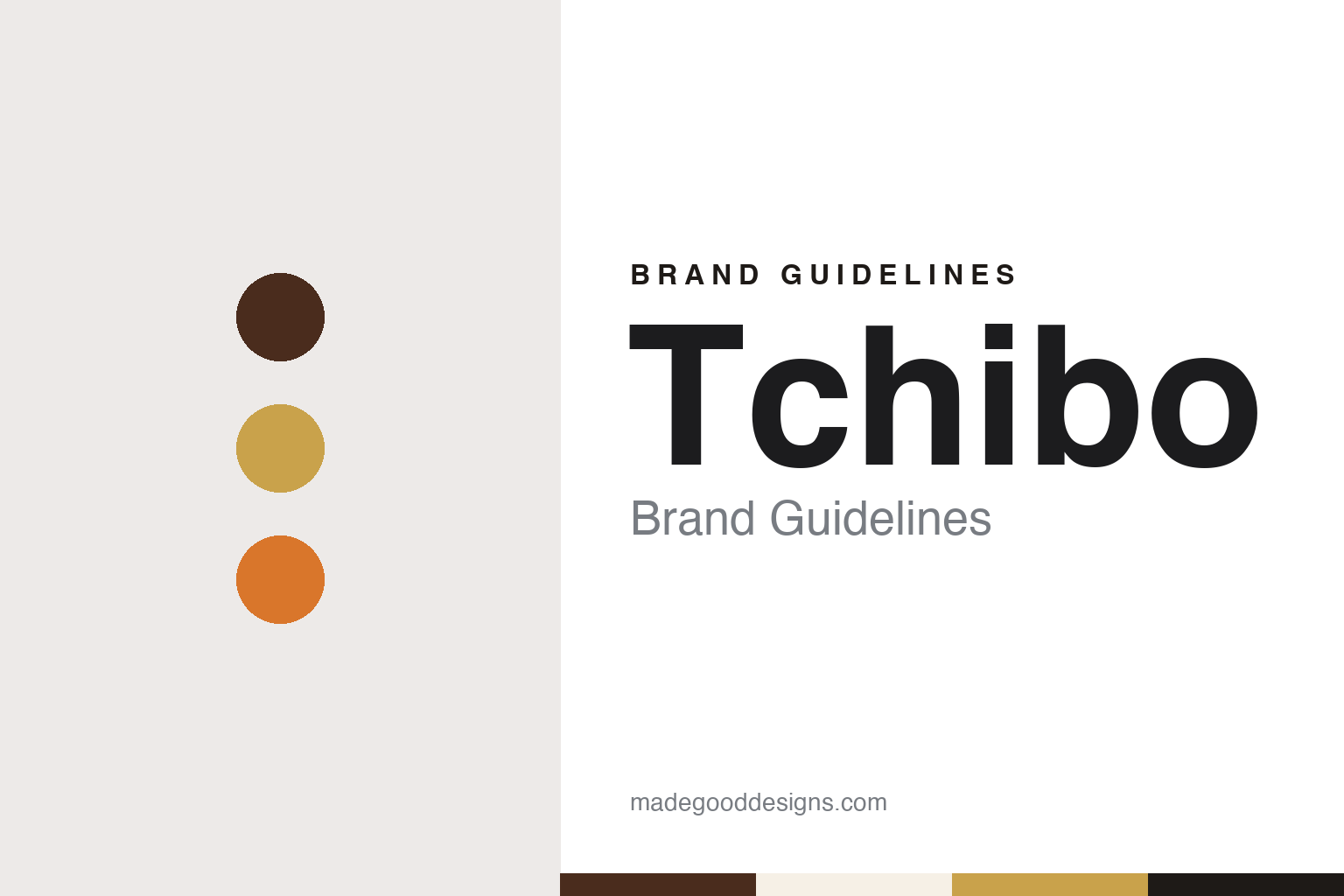
Tchibo Brand Guidelines
The Hamburg roaster that sold coffee by post and a new world every week.
Aa
Two constants: a Tchibo brown, gold and orange palette and a Plain sans register. Abstract homage — not a Tchibo product or mark; no logo, packaging or shop design is reproduced.
Coffee by post
A coffee merchant, a spice trader and a mail-order idea.
Tchibo was founded in Hamburg in 1949 by Max Herz, a coffee merchant, and Carl Tchilinghiryan, a spice trader, who owned the company in equal shares, German Wikipedia says. Their idea was to send roasted coffee by post. The name is a contraction of “Tchiling” and Bohne, the German word for bean; the company’s own history calls the second founder Carl Tchiling. English Wikipedia says the coffee for the mail-order business was roasted in the company’s own facility in Hamburg’s Hoheluft district. Herz bought out his partner in 1952, German Wikipedia says, and kept the name, which was already well known.
Shops followed. The first opened in Hamburg on 13 October 1955, on the Caffamacherreihe, the company says, and let customers taste a cup before buying a packet. By 1958 there were 77 shops and by 1965 more than 400, according to the company, which dates its Gold-Mocca blend to 1954. From 1963 Tchibo set up “Frisch-Depots” — branded shelves — in bakeries and confectioners; the company says there were almost 2,900 by 1971, and from 1987 they spread to supermarkets. In 1961 Wensley Pithey made his first television appearance as “Mr. Tchibo,” a coffee expert who visited growing countries and advised customers in the shops, a role the company says lasted until the early 1980s.
Max Herz died in 1965. The company says his sons Günter and Michael continued the business; German Wikipedia names Günter Herz as its head from 1965.
Colour
A new world every week.
Tchibo’s second business began with a court ruling. German Wikipedia says that in the 1950s, when coffee was treated as a luxury, Tchibo sold it in cloths and later in orange tins, and gave away extras such as aroma tins and cookbooks. After a 1973 decision of the Federal Court of Justice it could no longer give such items away with coffee, so it sold the remaining stock instead. The company dates its first non-coffee goods to 1973: table mats and breakfast boards. In 1994 it adopted the line “Jede Woche eine neue Welt” — “a new world every week” — for a weekly changing range that German Wikipedia says runs from fashion and jewellery to sports goods, furniture, kitchenware and consumer electronics.
The model kept widening. The company dates catalogue ordering to 1996, online sales and a travel business to 1997, and mobile phone contracts under Tchibo mobil to 2004; German Wikipedia says the mobile service runs in cooperation with Telefónica Deutschland and that Tchibo stopped selling travel at the end of October 2023. Coffee moved into machines: Tchibo launched the Cafissimo capsule system in 2005, the Qbo capsule system in 2016 and its first bean-to-cup machine, the Esperto Caffè, in 2018, the company says. Its Privat Kaffee range, of coffees from selected growing countries, dates from October 1987.
Today Tchibo says it runs about 860 shops and more than 15,500 retail depots in eight countries, plus national online shops, and that it had 10,676 employees and revenue of €3.72 billion in 2025. It describes itself as the roasted-coffee market leader in Germany, Austria, the Czech Republic and Hungary. German Wikipedia reports a loss of €167 million for 2022 and, after about 300 jobs were cut, a profit of €67 million for 2023.
Typography
Design and documentation.
The seven brands in this group all roast coffee, and they come from five European countries: Segafredo Zanetti and Kimbo from Italy, Julius Meinl from Austria, Tchibo and Dallmayr from Germany, Douwe Egberts from the Netherlands, and Paulig from Finland. Coffee brands in general sit at many different points in the trade, from vacuum packs on a supermarket shelf to espresso poured in a café under the roaster’s own sign, and a single company can work at both ends at once.
A coffee brand’s identity is usually carried less by a place of growth than by a blend, a pack and the cup it promises, because the beans inside will have been grown a long way from where the name on the front was roasted. That makes the questions behind each name worth asking plainly: who started it, who owns it now, where its coffee is bought, and where it is actually roasted and packed.
Each guide separates what independent sources record from what the company says about itself — its founding story, its owners over time, where its coffee comes from and where it is roasted — and marks plainly what rests only on the company’s own word.
Aa
A plain sans — for a high-street coffee name. (Specimen set in Manrope, a sans STAND-IN; NOT the Tchibo logo.)
Tchibo
A family holding and a Hamburg roastery.
Tchibo has stayed with the Herz family. In 1988 the company became Tchibo Holding AG and moved the coffee business into a subsidiary, German Wikipedia says. The holding company took over the rival roaster Eduscho in 1997, the company says, and German Wikipedia adds that Eduscho shops were renamed Tchibo or closed during the 2000s. The family also built stakes outside coffee: English Wikipedia says Tchibo became the majority shareholder of the cigarette maker Reemtsma in 1980 and sold that stake to Imperial Tobacco in 2002.
In July 2007 the holding company renamed itself maxingvest, a name German Wikipedia says combines the first names of Max Herz and his wife Ingeburg with the word for investment; in July 2023 it became maxingvest GmbH & Co. KGaA. According to German Wikipedia, it owns all of Tchibo and holds close to 51 per cent of the voting rights in Beiersdorf, and its owners are Michael Herz and Wolfgang Herz, with 40 per cent each, and the Max and Ingeburg Herz Foundation, with 20 per cent; Günter and Daniela Herz sold their shares to their brothers after 2001, when Ludger Staby took charge of Tchibo Holding. Tchibo GmbH is based in Hamburg’s City Nord.
The coffee is roasted in Hamburg. German Wikipedia describes the Tchibo roastery on Süderstraße, in the Hamm district, as one of the largest and most modern in Europe, processing about 60,000 tonnes of raw coffee a year, citing the trade magazine Lebensmittel Praxis in 2018, and calls it the company’s home roastery. In August 2016 Tchibo bought the Glasgow roaster Matthew Algie, which Daily Coffee News reported would remain a standalone brand. Abroad, the company says, Tchibo opened subsidiaries in Hungary, Slovakia and the Czech Republic in 1991.
For a design guide, Tchibo shows a coffee brand whose shops sell a weekly changing range alongside the coffee. Compare Melitta, another German coffee name, and Julius Meinl. For this guide we use a roast brown, a mocca gold and a tin orange with a sans, an unofficial interpretation; no product or logo is reproduced.
Explore & save
Keep Tchibo’s identity on hand — save it to a board in the Made Good inspiration library.
Tchibo identity set
Pin the Tchibo brown, gold and orange palette and the Plain sans register to your own board.