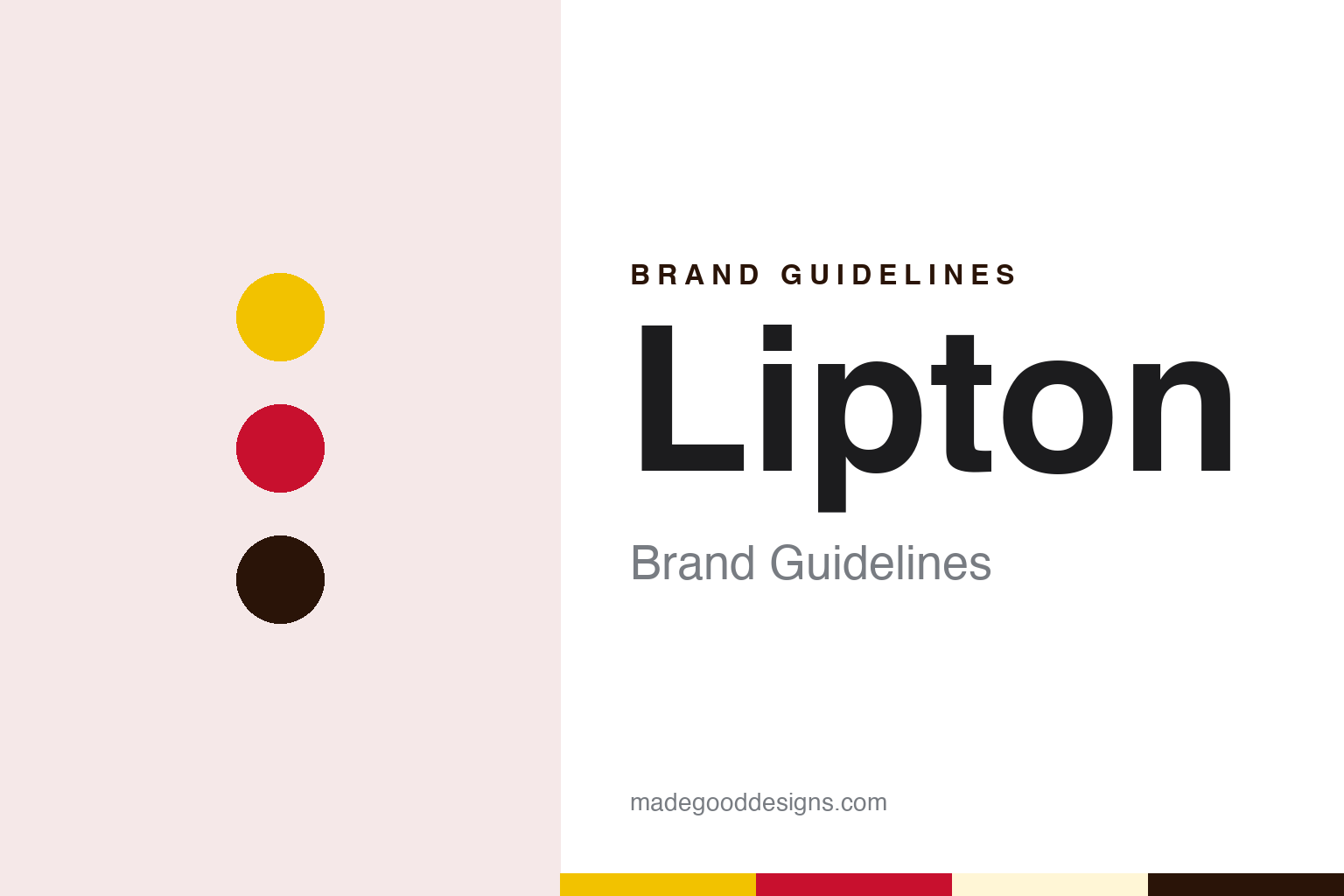
Lipton Brand Guidelines
The Glasgow grocer’s tea that went from the garden to the teapot.
Aa
Two constants: a Lipton yellow and red palette and a bold grocer sans register. Abstract homage — not a Lipton product or mark; no pack, shield or logo is reproduced.
The Glasgow grocer
A shop in 1871, a tea in 1890.
Lipton began as a grocer, not a tea merchant. English Wikipedia, citing a company history, says Thomas Lipton (1848–1931) of Glasgow used his small savings to open a shop in 1871, and that by the 1880s the business had grown to more than 200 stores. The Lipton name went on many of the goods those shops sold; tea came later and became the product the name is best known for.
The turn came in 1890. English Wikipedia’s article on the brand says Lipton bought tea gardens in Ceylon, now Sri Lanka, that year, and packaged and sold the first Lipton tea from there; its article on the man says he visited Ceylon in 1890, did business with the planter James Taylor, and that his company bought Ceylon tea for sale in Europe and the United States. Both accounts agree on the year and the island. The same sources describe the selling idea: tea packed cheaply and sold in pound, half-pound and quarter-pound packets under the slogan “Direct from the tea gardens to the teapot.” English Wikipedia identifies the Dambatenne tea factory near Badulla, in Sri Lanka’s Uva Province, as Lipton’s first plantation.
Lipton himself became a public figure. The London Gazette records his appointment as a Knight Commander of the Royal Victorian Order in March 1901 and his creation as a baronet in July 1902. Between 1899 and 1930 he challenged five times for the America’s Cup, through the Royal Ulster Yacht Club, with yachts named Shamrock — he never won.
The shops and the tea later went separate ways. In 1929 the Lipton grocery business was one of several chains merged with Home and Colonial Stores and the Maypole Dairy Company into a group of more than 3,000 shops, English Wikipedia says, while the tea business followed its own path into the hands of Unilever.
Colour
Unilever, PepsiCo and the yellow pack.
Unilever did not buy Lipton tea in one go. English Wikipedia describes a series of transactions that began in 1938, when Unilever bought the United States and Canadian Lipton business. It later held 12 per cent of Allied Suppliers, the retail group that owned the rest of Lipton, with a third of the votes. In 1972 Unilever sold those shares to Sir James Goldsmith’s Cavenham Foods for £10.4 million on the understanding that it could buy the Lipton tea business at a price set by an independent adjudicator; that price was £18.5 million, and the purchase was completed in August 1972, according to the Liverpool Daily Post and Geoffrey Wansell’s 1987 biography of Goldsmith, as cited by Wikipedia.
Under Unilever the name split into two businesses. In 1991 Unilever and PepsiCo formed the Pepsi Lipton Tea Partnership to market ready-to-drink tea in North America, The New York Times reported in December that year. A second venture, Pepsi Lipton International, followed in 2003 for many markets outside North America, and was extended in September 2007 to larger European markets, Food Manufacture reported. English Wikipedia says the two companies each control half of these ventures, which sell Lipton Ice Tea, Brisk and Pure Leaf.
The leaf-tea side is anchored by Lipton Yellow Label. Lipton’s own website said in 2012 that the blend had been sold since 1890, when Thomas Lipton introduced the first version of the yellow pack with a red Lipton shield, and that it was sold in 150 countries. In May 2007 Unilever said it would source all its tea sustainably, working with the Rainforest Alliance, and that all Lipton Yellow Label tea bags sold in Western Europe would be certified by 2010 and all Lipton tea bags worldwide by 2015.
Unilever’s tea site said in 2009 that Lipton blends draw on plantations in countries including Sri Lanka, India, Kenya and China. English Wikipedia notes one oddity: despite its Scottish origins, Lipton leaf tea is not marketed in the United Kingdom, where the same owner sells PG Tips, though Lipton Ice Tea from the joint venture is on sale there.
Typography
Tea, trade and documentation.
The seven brands in this group all sell tea, and their names were founded in five countries: Lipton and Brooke Bond in Britain, Tata Tea and Wagh Bakri in India, Ito En in Japan, Basilur in Sri Lanka, and Salada in Canada. Where a tea brand was founded is only the start of its story, because a name can travel a long way from the city where it began, and the country on its founding record need not be the country where its owner sits today.
A tea brand’s identity is usually carried less by a field than by a blend, a packet and the cup it promises, because the leaf inside may have been grown far from the place where the name on the front was made. That makes the questions behind each name worth asking plainly: who started it, who owns it now, where its leaves are bought, and where its tea is actually blended and packed.
Each guide separates what independent sources record from what the company says about itself — its founding story, its owners over time, where its tea comes from and where it is packed — and marks plainly what rests only on the company’s own word.
Aa
A bold grocer sans for a shopkeeper’s name. (Specimen set in Archivo, a sans STAND-IN; NOT the Lipton logo.)
Lipton
One name, two owners.
In November 2021 Unilever agreed to sell most of its tea business, which it had grouped as a division called ekaterra, to the private-equity firm CVC Capital Partners for €4.5 billion, the Financial Times and The Grocer reported. The sale was completed in July 2022, and English Wikipedia says the business took the name Lipton Teas and Infusions, with ekaterra used as its name until 2023. Unilever kept the tea business in India, Nepal and Indonesia, its half of the ready-to-drink ventures with PepsiCo, and the Lipton name on soup mixes in North America.
The result is a brand with two masters. Lipton leaf tea in most of the world belongs to Lipton Teas and Infusions, which English Wikipedia places in Amsterdam, with about 17,000 employees in 2024 and a portfolio that includes PG Tips, Brooke Bond, Pukka, T2, Tazo, Red Rose and Salada. Lipton Ice Tea, in bottles and cans, is made and sold by the PepsiCo–Unilever ventures. In August 2022 the new company said it would withdraw from Russia, the Russian business daily RBC reported.
The company has also made changes in East Africa. In February 2024 it launched the Lipton Tea Innovation & Technology Academy with the government of Kenya and the University of Kabianga, and in May 2024 it agreed to sell its tea estates in Kenya, Tanzania and Rwanda to Sri Lanka’s Browns Investments, Kenya’s Business Daily reported. On its own website, the company calls itself “the world’s largest tea company,” says it has built its expertise in blending “since 1871,” and says almost one million farmers contribute to its teas; we give those as its claims.
For a design guide, Lipton shows how a single colour can carry a brand across more than a century of changing owners: the yellow pack and red shield the company dates to 1890. Compare Tazo, a newer tea brand now in the same portfolio, and Dilmah, which built its identity on Ceylon tea. For this guide we use yellow, red and a deep tea brown with a sans, an unofficial interpretation; no product or logo is reproduced.
Explore & save
Keep Lipton’s identity on hand — save it to a board in the Made Good inspiration library.
Lipton identity set
Pin the Lipton yellow and red palette and the bold grocer sans register to your own board.