Leonidas Brand Guidelines
A confectioner’s praline shop, sold through a window.
Aa
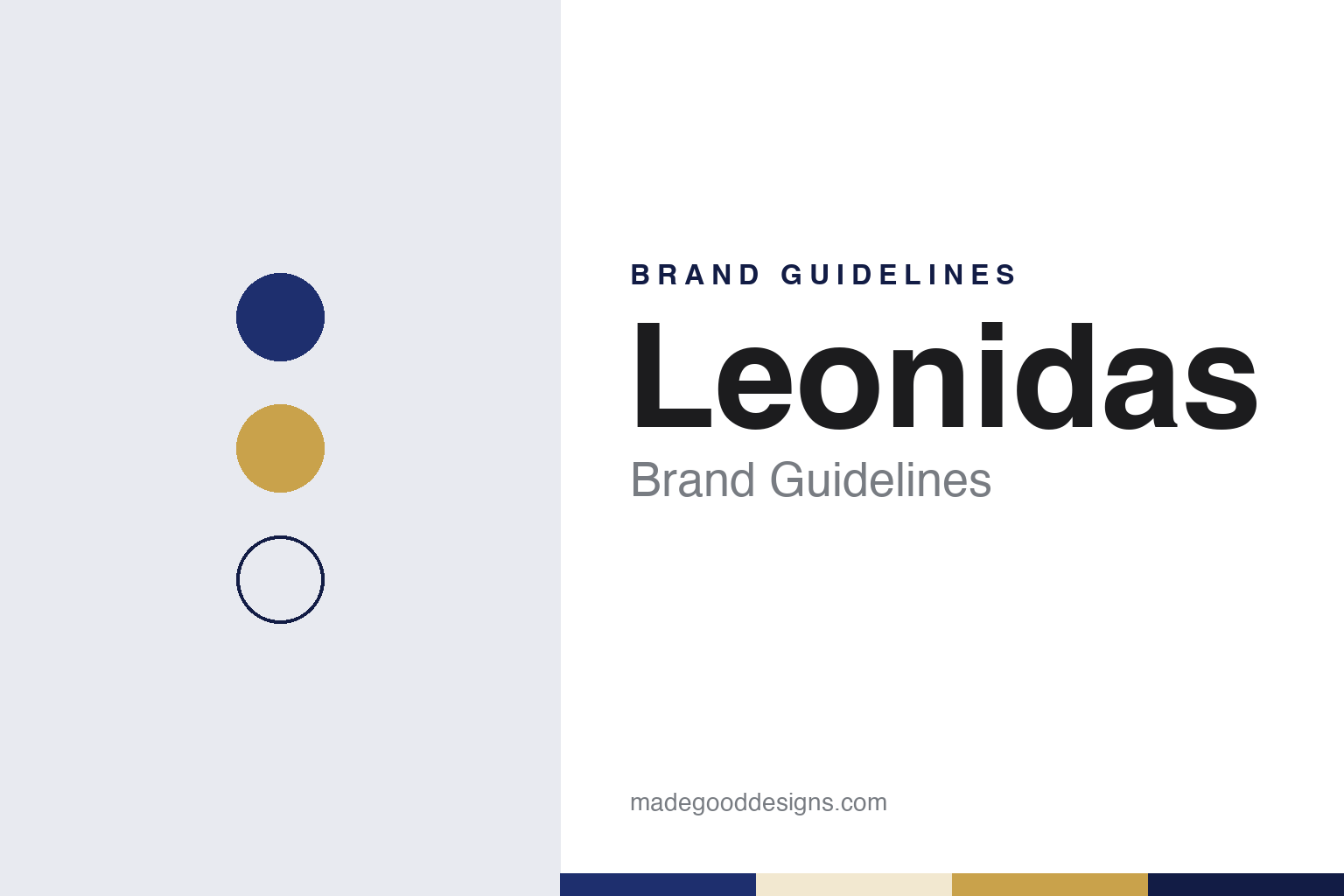
Two constants: a Leonidas blue, cream and gold palette and an inscription serif register. Abstract homage — not a Leonidas product or mark; no bag, logo or chocolate is reproduced.
From Anatolia to Ghent
Granita, wine, New York and two world’s fairs.
Leonidas is named after a person, not only a king. Leonidas Georges Kestekides was born in 1882 in Niğde, in Anatolia, to a Greek family. The company’s history says he sold granita and sweets on the street with his brother as a boy, tried the wine trade in Italy at 18 and was ruined when an uninsured lorry carrying his barrels crashed, then went to the United States, where he learned confectionery.
He came to Belgium as a member of the Greek-American delegation to the 1910 Brussels World Exhibition, where his confectionery won a bronze medal. There he met Joanna Emelia Teerlinck; they married in 1912 and settled in Ghent. At the 1913 Ghent World Exhibition he won a gold medal, the company says on 27 October, and the same year he opened a tearoom at Veldstraat 34 in Ghent, selling pastries, sweets and ice cream. That is the founding date the brand uses. After the First World War he added a tasting room in Blankenberge, on the coast, in the Lion d’Or hotel.
In 1922 relatives followed him from Greece. The company names his nephew Basilio Kestekides as the one who learned the trade from him; Dutch Wikipedia calls Basilio a cousin and names a young nephew, Jean Daskalidès, alongside him. By 1924, the company says, uncle and nephew had opened the Pâtisserie Centrale Leonidas in Brussels.
Colour
A sash window, a Spartan king and a franchise.
The format that made Leonidas came from a police order. Basilio made pralines at night in a small workshop near the Grand-Place and sold them from a horse and cart in the morning; in 1935, the company says, police told him to sell from a shop instead. He rented a narrow room at Boulevard Anspach 58 with no door onto the street, set the pralines on the sill and sold them through a sliding sash window, directly from workshop to customer, at about half the price of competitors, by the company’s account. The window became the chain’s trademark until a 2005 redesign retired it.
In 1937 Basilio registered the name Leonidas with the City of Brussels, after his uncle, and chose as its emblem the Greek warrior Leonidas I, King of Sparta; the company calls this the first step towards the logo used today. Leonidas Kestekides died on 20 February 1948, and Basilio expanded the workshop rather than raise prices, moving to Boulevard Anspach 46, a shop the brand still uses.
Growth came through other people’s shops. Dutch Wikipedia dates the first franchise to Aalst in 1966 and the first in France, at Lille, to 1969. Basilio had brought in his younger brother Alexandros in 1950; after Basilio died in 1970 the business passed to his siblings and their children, with Maria Kesdekoglu-Kestekides taking charge in 1985, and the company later bought the former Crown-Baele factory in Anderlecht, then the old Bel cheese factory nearby. Around 1980, the company says, Yanni Kesdekoglou reworked the Manon, coating a buttercream and hazelnut filling in white chocolate; it is still the house’s signature. Leonidas became a certified purveyor to the Belgian court on 15 November 2013.
Typography
Design and documentation.
The seven brands in this group are all Belgian: Neuhaus, Leonidas, Godiva, Côte d’Or, Guylian, Galler and Wittamer. Together they show how wide the phrase “Belgian chocolate” has become, from a filled praline chosen piece by piece over a shop counter to a bar or a box sold in supermarkets and airport shops around the world.
The praline — in Belgium, a shell of chocolate around a filling such as ganache, nut paste or cream — is the country’s signature, and the ballotin, the small card box it is packed into, is part of the same ritual. At one end of the trade are names that grew into large groups, with factories, franchise shops and global distribution, and whose identity has to work on a shelf as well as in a window. At the other are pâtissier-chocolatiers on squares such as the Grand Sablon in Brussels, where the name rests on one address, a workshop nearby and a long local history.
Each guide separates what independent sources record from what the company says about itself — who founded it, who owns it now and where its chocolate is made — and marks plainly what rests only on the company’s own word.
Aa
An inscription serif — a nod to the Spartan king in the emblem. (Specimen set in Cinzel, a serif STAND-IN; NOT the Leonidas logo.)
Leonidas
A family firm, now in Nivelles.
Leonidas has stayed in the family. Its history names three branches of the founding family on the board, Maria Kesdekoglu-Kestekides, the president Vasiliki Kestekidou and Dimitrios Kestekoglou, who joined in 2004 to move the company from family to professional management; Dutch Wikipedia, citing De Tijd, records a struggle for control in 1998, and an outside chief executive, Philippe de Selliers de Moranville, was in place from 2017, Bloovi reported in 2021. The family spells its name several ways, Kestekides, Kestekidou and Kesdekoglu among them.
Production has just moved. In October 2022 the trade paper Gondola reported plans to bring two Anderlecht sites together in a 30,000-square-metre building in Nivelles, in Walloon Brabant, about 30% larger than the old space and with some 1,000 square metres for research and development; at the time it counted about 400 shops in Belgium alone. The company says the first stone was laid on 12 December 2023, and in 2026 its history page announces the move of its factory “from Anderlecht to Nivelles”; its contact page now gives a Nivelles address.
Leonidas does not grind its own beans. Its website says it buys about 5,000 tonnes of chocolate a year, made with pure cocoa butter and no palm oil, and that since 1 October 2021 the cocoa has been certified under Rainforest Alliance and Cocoa Horizons programmes; it has also signed Belgium’s Beyond Chocolate charter. The company counts more than 1,200 points of sale in 40 countries, most of them franchised, and describes its look as royal-blue bags with a cream logo around a gold ballotin.
For a design guide, Leonidas shows how a retail format, a window and then a franchise, can be as much the brand as the product. Compare Neuhaus, the older Brussels praline house, and Tony’s Chocolonely, a younger brand built on its wrapper. For this guide we use royal blue, cream and gold with a serif, an unofficial interpretation; no product or logo is reproduced.
Explore & save
Keep Leonidas’s identity on hand — save it to a board in the Made Good inspiration library.
Leonidas identity set
Pin the Leonidas blue, cream and gold palette and the inscription serif register to your own board.