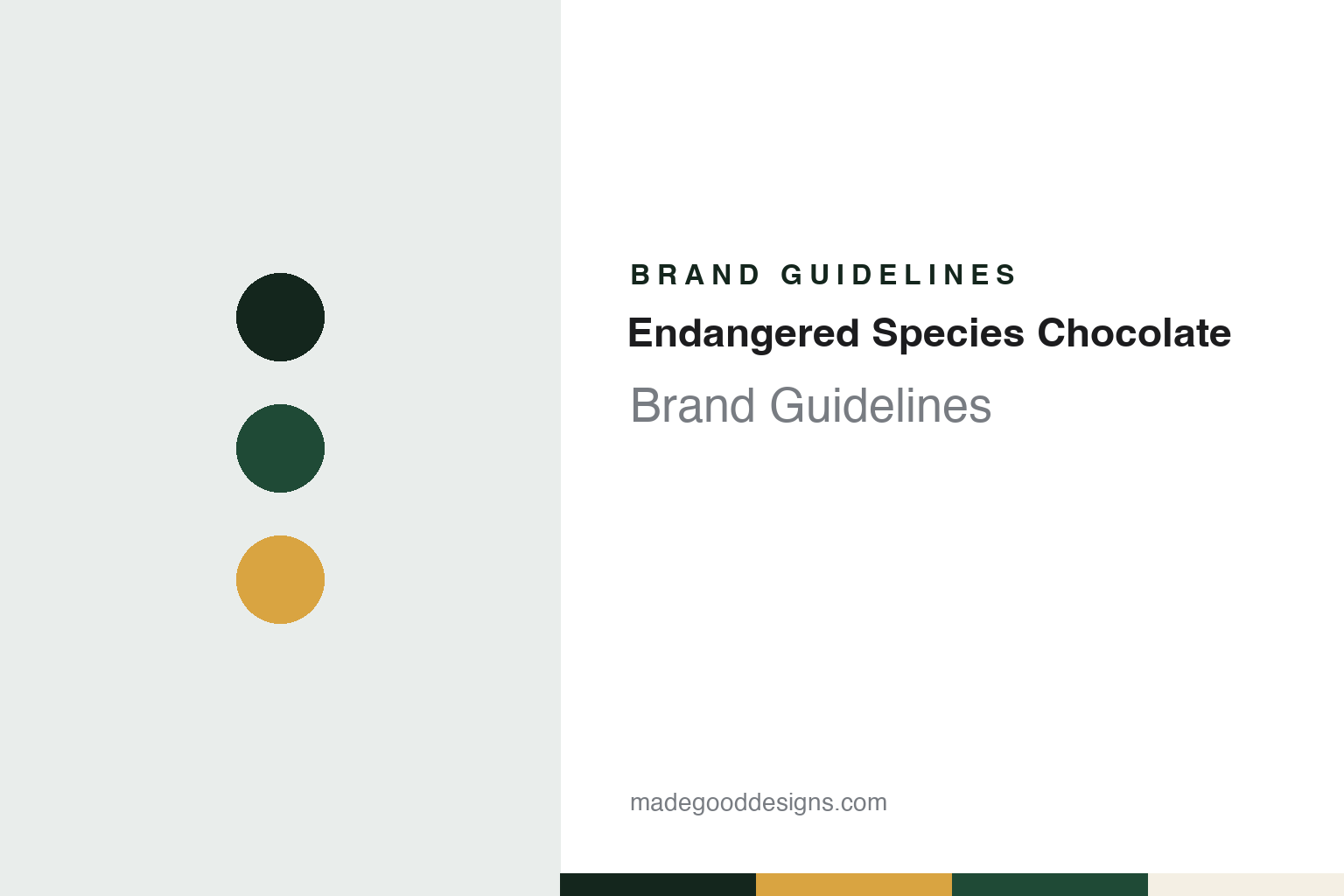
Endangered Species Chocolate Brand Guidelines
The animal-wrapper bar from Indianapolis.
Aa
Two constants: an Endangered Species Chocolate green, gold and cream palette and a field-guide serif register. Abstract homage — not an Endangered Species Chocolate product or mark; no bar, wrapper, animal illustration or logo is reproduced.
A cause in a wrapper
From an Oregon workshop to an Indianapolis plant.
Endangered Species Chocolate dates its start to 1993. Its own website, as archived by the Wayback Machine in 2007 and 2008, says the company “was founded in 1993” to spread awareness of the plant and animal species disappearing from Earth, and the company now describes itself as having made chocolate “for three decades.” Its earlier website, archived in 2001 and 2003, credits the creation of the company to Jon Stocking, who set out to use “premium Belgian chocolate as a medium” for an environmental message and spoke to school classrooms about it.
The idea was written down plainly. A mission statement archived in 2003 says the company aimed “to use the universal appeal of chocolate to spread a positive environmental message as far as possible,” with chocolate “wrapped into appealing packaging that highlights the importance of animals and their habitats,” and with “at least 10% of our profits” going to environmental groups. That pairing — a bar, an animal and a donation — is still the brand’s core.
The company began in Oregon. In 2005, its website said in 2007, it moved “from its original 5,000-square-foot facility in Oregon to Indiana,” to keep up with demand and to use a central Midwest location to cut shipping time and cost. The new Indianapolis plant was described as 43,000 square feet, expandable to 77,000, and LEED-registered. By 2009 the site’s footer named the business as Endangered Species Chocolate, LLC, owner of the registered trademark “Endangered Species.” Indianapolis remains its headquarters, its website says.
Colour
An animal on every bar, and a changing cocoa supply.
The wrapper is the brand. The company’s 2007 website described its “exquisite chocolate and colorful wrappers” as a way to raise awareness of species listed as threatened or endangered on the U.S. Fish and Wildlife Service’s Endangered Species List, and of animals facing habitat loss, poaching and pollution. Many bars, it said, were “identified with an at-risk species” and carried information about that animal. Today’s bars still go by animal names — the company’s FAQ refers, for example, to a Rhino bar and an Eagle bar — and the wrappers now also carry certification marks, including Vegan Action’s “Certified Vegan” symbol, which the company says it added so shoppers could spot vegan flavors.
The same 2007 page named a core value, “Reverence for Life,” modeled, it said, on Albert Schweitzer’s ethic of the same name.
Its cocoa sourcing has changed several times. The company said in 2007 that its organic products had been Fair Trade Certified through TransFair “up and through summer 2006,” using organic cocoa from the Conacado cooperative in the Dominican Republic, and that it would instead put the money earmarked for certification directly into support for Conacado farmers; English Wikipedia’s article on fair-trade cocoa records the same change, dating it to February 2006. The company’s pages from 2007 and 2008 also describe all-natural cacao from the Ikom region of Nigeria, organic cacao from Peru, and Côte d’Ivoire as “the newest source.”
Today the company says it uses “only FairTrade certified cocoa beans” from Côte d’Ivoire, bought from small family-owned cooperatives in West Africa, and that its other ingredients are Fairtrade certified where certification is available. It says its products are not organic, are Non-GMO Project Verified and certified gluten-free, and are made on shared equipment that also handles milk. Its milk chocolate is 48% cocoa and its dark chocolate runs from 60% to 88%, it says. In January 2020 it announced oat-milk chocolate bars, launched first at Whole Foods Market.
Typography
Boxes, shop fronts and bars.
The seven brands in this group are all American: Ethel M, See’s Candies, Russell Stover, Fannie May, Lake Champlain Chocolates, French Broad Chocolates and Endangered Species Chocolate. Together they cover much of the range of American chocolate and candy, from the gift box bought for a holiday to the single bar picked up at a grocery checkout.
American boxed chocolate grew up around the shop front. Many of the country’s candy companies began as a single kitchen or store selling to local customers, and some built chains of their own shops, while others moved into drugstores, supermarkets and seasonal aisles. The assorted box, with its printed lid and its paper map of fillings, became a familiar gift, and regional makers came to be known as much for a place as for a product. More recently, small makers have added bean-to-bar chocolate, cafés and factory tours, and bar brands have used the wrapper itself to carry a story or a cause.
Each guide separates what independent sources record from what the company says about itself — who founded it, who owns it now, where its cocoa comes from and where its chocolate is made — and marks plainly what rests only on the company’s own word.
Aa
A sturdy field-guide serif for animal names and causes. (Specimen set in Bitter, a serif STAND-IN; NOT the Endangered Species Chocolate logo or wrapper lettering.)
The 10% GiveBack
A pledge on profits, and a new owner in 2025.
The donation pledge has run through every version of the company’s website, though its wording has shifted from “at least 10%” of profits in 2003, to “after tax profits” on another 2003 page, to 10% of net profits since at least 2007. Under chief executive Curt Vander Meer, named in company releases in 2018 and 2019, the program was branded the GiveBack. In January 2017 the company reported its “first 10% GiveBack installment” to the Wildlife Conservation Network; in January 2019 it named the Dian Fossey Gorilla Fund and the National Forest Foundation as GiveBack partners, each guaranteed a minimum annual donation, and said it had given $1.7 million to conservation groups over the previous three years. Those totals are the company’s own figures.
The current website ties the mission to 4ocean, the Florida-based ocean-cleanup company, with a stated goal of helping remove one million pounds of plastic from marine environments by 2028. Confectionery Production reported the company’s claim of an “industry first” with “ocean plastic neutral” status.
Ownership changed in July 2025. In a release dated 29 July 2025, the company announced that Chocxo Chocolatier, an organic-chocolate maker based in Delta, British Columbia, had acquired Endangered Species Chocolate. The release said the Indianapolis facility would bring three chocolate-bar lines to the Chocxo–Chewters manufacturing platform — Chewters being a contract manufacturer founded in 1984, according to its website — giving the group production in both Canada and the United States, alongside a planned facility in Rockwall, Texas. Chocxo’s chief executive, Richard Foley, called the deal “more than growth.” The deal is documented here from that release; who owned the company between its founding and 2025 is not set out in the sources we checked.
For a design guide, Endangered Species Chocolate shows how a single, repeatable device — one animal per bar — can carry a cause across three decades, two states and a change of owner. Compare Theo Chocolate, another American bar maker built on certification, and Tony’s Chocolonely, whose wrapper also carries its mission. For this guide we use a canopy green, a savanna gold and a wrapper cream with a serif, an unofficial interpretation; no product or logo is reproduced.
Explore & save
Keep Endangered Species Chocolate’s identity on hand — save it to a board in the Made Good inspiration library.
Endangered Species Chocolate identity set
Pin the Endangered Species Chocolate green, gold and cream palette and the field-guide serif register to your own board.