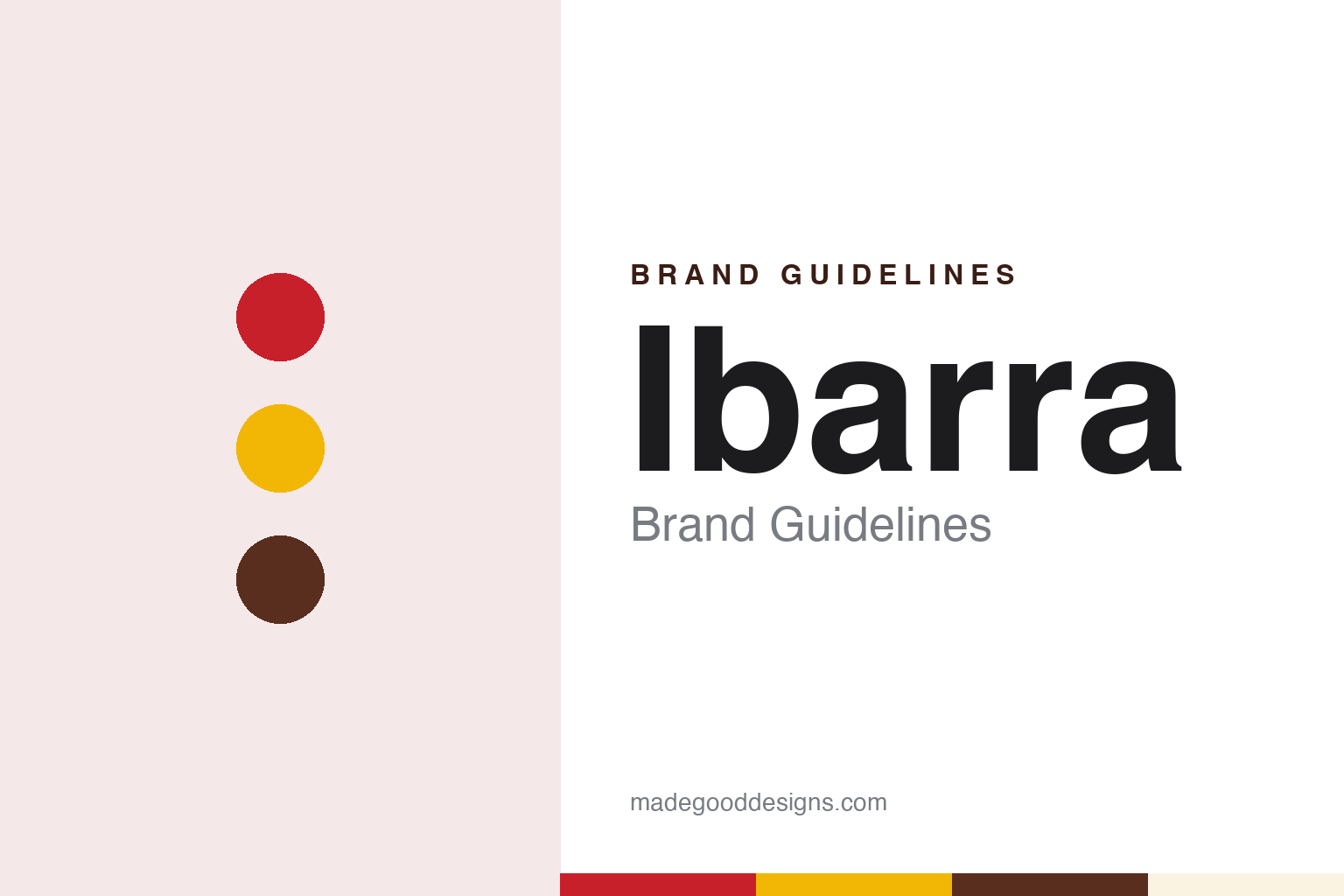
Ibarra Brand Guidelines
Guadalajara’s table chocolate in the red-and-yellow hexagon.
Aa
Two constants: an Ibarra red, yellow and cocoa palette and a condensed carton sans register. Abstract homage — not an Ibarra product or mark; no box, tablet, logo or photograph is reproduced.
From a Guadalajara kitchen
A couple’s home recipe becomes a national brand.
Chocolate Ibarra is a Guadalajara maker of Mexican chocolate para mesa — table chocolate, sold in tablets for making hot chocolate rather than for eating as a bar — and its round tablets in a red-and-yellow hexagonal box are its best-known product. English Wikipedia describes Ibarra as produced since 1925, and since 1954 by the company Chocolatera de Jalisco, and says it is sold throughout Mexico and abroad, mainly in the Americas but also in parts of Europe. The company marked its centenary in 2025 under the line “100 years saboreando lo verdadero.”
The story starts in a family kitchen. A timeline published on the company’s website in the early 2000s says that a married couple, María Ruiz and Camilo Gómez Ibarra, began making chocolate at home in 1924 and selling it in irregular pieces, and that in 1946 Camilo Gómez Ibarra decided to sell the table chocolate under its own brand. Later versions of the website date things differently: an archived 2017 page calls Grupo Chocolate Ibarra a “100% Mexican” company “founded in 1925 and exporting from 1946,” and the current site’s history opens with the founding in 1925 and the first exports in 1946. In January 2026 the broadcaster adn Noticias told the same origin story — the couple making chocolate at home for family and friends, then deciding in 1925 to sell their recipe — and Milenio reported in 2021 that the first tablets were sold in Guadalajara’s Mercado Corona.
Sources differ on when the chocolate first left Mexico. The company gives 1946; Milenio (2021) and adn Noticias (2026) give 1945; a February 2026 article on the site Tus Buenas Noticias gives 1948. All three describe the United States as the first export market. The early-2000s company timeline says a purpose-built factory opened in 1967 and calls Ibarra the first Mexican chocolate exporter, which is the company’s own description.
Colour
A family company in its fourth generation.
Ibarra has stayed with the founding family. The early-2000s company timeline says the couple’s sons, Ernesto, Gustavo and Guillermo, joined the business at the end of the 1950s, bought more modern machinery and moved the factory to larger premises. In July 2013 El Informador reported that the Jalisco council of industrial chambers would give its Medalla al Mérito Industrial to Armando Gómez Ibarra de la Mora, chairman of Grupo Chocolate Ibarra, describing him as the third generation of a firm then 88 years old; the paper said the company had about 650 employees and could process 13,000 tonnes of chocolate a year. In 2016 the same paper reported that the group’s executive president, Ernesto Gómez Ibarra de la Mora, had written De empresa familiar a familia empresarial, a 559-page book on turning a family business into an institution, printed in 500 copies and not offered for sale. Milenio named the director general in 2021 as Armando Gómez Ibarra, of the founding family’s fourth generation, and adn Noticias said in 2026 that the fourth generation leads the company. The sources we checked record no sale to an outside group; the company named on the website today is Chocolatera Ibarra SAPI S.A. de C.V.
The chocolate is made in Guadalajara. Milenio reported in 2021 that about 300 people worked at the plant on Avenida Mariano Otero, a factory whose chocolate smell, the paper had written in 2016, reaches passers-by. In August 2016 the same paper had reported plans for a new factory at the Centro Logístico in the municipalities of Acatlán de Juárez and Zacoalco de Torres, with Ernesto Gómez Ibarra de la Mora putting the cost at a minimum of 20 million dollars and expecting it to operate from 2018; UDG TV reported that year that the state had granted Chocolatera de Jalisco 30,000 square metres of land there. The 2021 report still placed production on Mariano Otero, and the sources we checked do not say whether the move has since taken place. The company’s website does not say where its cocoa beans are grown.
The recipe is short. The company says its traditional tablet uses four ingredients — cocoa paste, cane sugar, soy lecithin and a touch of cinnamon — and that its chocolate is certified by NYCE as meeting the Mexican standard NOM-186-SSA1/SCFI-2013 for “chocolate genuino.” Beside the tablets it sells a granulated version, a bittersweet Ibarra Premium (launched in 2008, it says), the chocolate drink powder Choco Choco (1988) and Canelate (2018). Milenio reported in 2021 that Ibarra exports to the United States, Canada, Europe and Australia, and that Choco Choco holds a leading position in Central America.
Typography
Japan, Brazil and Mexico.
The seven brands in this group all sell chocolate, and they come from three countries: Royce’, Meiji and Morinaga from Japan, Garoto, Cacau Show and Kopenhagen from Brazil, and Ibarra from Mexico. Each guide looks at one name on its own terms, at home first and abroad second.
Chocolate brands reach people in different ways, and the differences show in their design. A mass-market confectioner sells bars and boxes through supermarkets and corner shops, where a wrapper has a moment to be recognised on a crowded shelf. A gift brand sells mainly through its own shops and counters, where the box, the ribbon and the shop itself carry much of the identity. A maker of a traditional product — a tablet bought for the kitchen rather than as a treat — may keep the same carton for decades, so that the package itself becomes the brand. Many firms do more than one of these things at once.
Each guide separates what independent sources record from what the company says about itself — who founded it, who owns it now, where its cocoa comes from and where its chocolate is made — and marks plainly what rests only on the company’s own word.
Aa
A condensed carton sans — bold capitals on a red-and-yellow box. (Specimen set in Oswald, a sans STAND-IN; NOT the Ibarra logo.)
Ibarra
A hexagon on the kitchen shelf.
Ibarra’s look starts with its box. English Wikipedia describes the tablets as packed in a distinctive red-and-yellow hexagon-shaped cardboard box; each round tablet, about 13 mm thick and 83 mm across, is moulded into eight wedges, with the letters IBARRA moulded into the chocolate. The wedges are meant to be broken off: Wikipedia says the packaging suggests about two wedges for each cup of hot milk or water, blended or whisked with a wooden molinillo, and that the chocolate also goes into some moles, including mole poblano. The current website invites visitors to “move and get to know the packaging” in a rotating view, and its history timeline sets each year in large red numerals beside bold condensed capitals.
The name travels on more than the box. A photograph in the website’s history section shows CHOCOLATE IBARRA and the word Guadalajara painted along the side of an early delivery van. The company’s 2017 timeline lists a co-branding licence with Disney’s Frozen in 2015, and in November 2018 InformaBTL reported that the craft beer brand Cerveza Minerva had brewed a seasonal 9% chocolate beer with Ibarra, using 540 Ibarra tablets for a run of 8,500 bottles.
For a design guide, Ibarra shows how a single package shape can carry a brand for generations: a hexagon in two strong colours, with the name repeated in the chocolate itself. Compare Taza Chocolate, an American maker of stone-ground, Mexican-style chocolate, and Casa Bosques, a Mexico City chocolate brand that grew out of a bookshop. For this guide we use box red, yellow, cocoa and cinnamon with a condensed sans, an unofficial interpretation; no product or logo is reproduced.
Explore & save
Keep Ibarra’s identity on hand — save it to a board in the Made Good inspiration library.
Ibarra identity set
Pin the Ibarra red, yellow & cocoa palette and the condensed carton sans register to your own board.