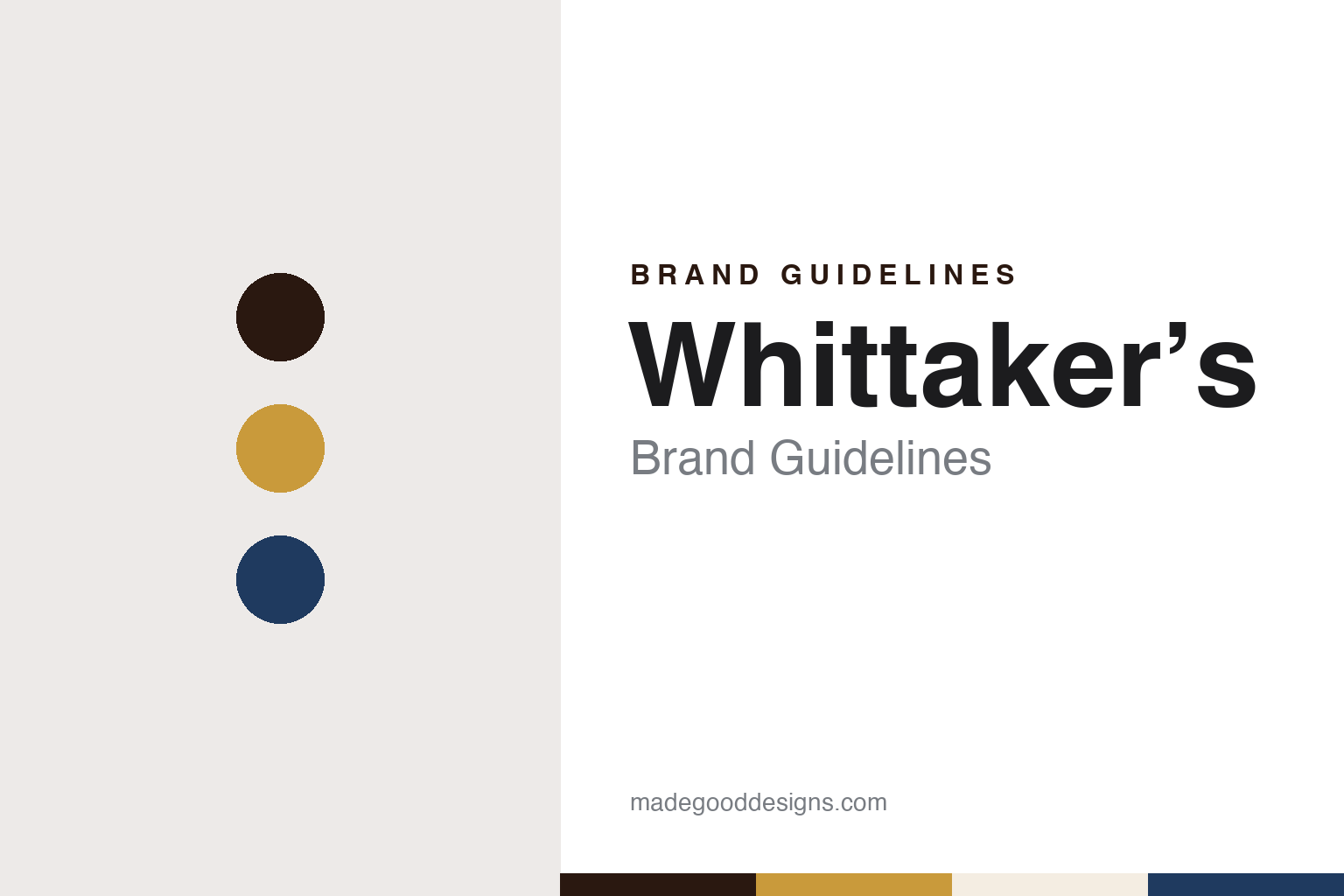
Whittaker’s Brand Guidelines
The family chocolate maker of Porirua, since 1896.
Aa
Two constants: a cocoa, harbour blue and gold palette and a heritage serif register. Abstract homage — not a Whittaker’s product or mark; no wrapper, logo or block is reproduced.
A Cadbury salesman
From a horse and van to a limited company.
Whittaker’s traces itself to James Henry Whittaker (1868–1947), who had worked in the British confectionery industry from the age of 14 and moved to New Zealand with his wife, Leah Alice, in 1890, according to a National Library of New Zealand record. He had been a salesman for Cadbury’s chocolate before the move and was one again after it, the same record says.
In 1896, in Christchurch, he began making chocolate confectionery himself, selling it directly to customers from a horse and van, the company says. In 1913 he formed a partnership with his two sons, Ronald and James, and moved the business to Wellington. It became a limited liability company, J. H. Whittaker & Sons, Ltd, in 1937, and Wikipedia, citing the company, says third-generation Whittakers remain its sole shareholders. A fourth generation now works in the business: in 2020 Matt and Holly Whittaker were its co-chief operating officers, FMCG Business reported, and Matt Whittaker described it in 2019 as a “fourth generation family-run business.”
In 1969 the company moved from Vivian Street in central Wellington to Porirua, north of the city, because it needed more space and its premises lay in the path of motorway construction, according to the company and a 1986 Wellington City Magazine profile. It has made its chocolate there since. The New Zealand Herald reported in 2010 that Whittaker’s controls its whole manufacturing process at Porirua and describes itself as a “bean-to-bar” maker — roasting cocoa beans rather than buying in finished chocolate — and called it the country’s largest chocolate brand.
Colour
Ghana, Samoa and a peanut slab.
Most of the company’s cocoa comes from Ghana. In April 2020 Matt Whittaker told FMCG Business that Whittaker’s sources all of its beans from Ghana, buying from two cooperatives there, apart from small amounts of speciality beans from Samoa and Nicaragua. That month the company announced that all 116 of its products made with Ghanaian beans were Rainforest Alliance Certified, and that the frog seal would appear on its packaging as old stock was used up. It had previously held Fairtrade certification for about ten years on its two best-selling 250-gram blocks, 5-Roll Refined Creamy Milk and 72% Dark Ghana.
The Samoan link is a revival. Whittaker’s says it bought Samoan beans decades ago, when the islands’ cocoa trade was strong. In 2014 it set up the Whittaker’s Cocoa Improvement Programme with the local supplier Savai’i Koko, run by the Vaa’i family, and in 2017 expanded it with New Zealand’s Ministry of Foreign Affairs and Trade. By 2019, FMCG Business reported, yields on participating farms had doubled to about 300 kilograms of dried beans per hectare and Samoa’s cocoa exports had risen from 15 to 30 tonnes a year.
The products are mostly blocks and bars. The Peanut Slab dates from the 1950s, the company says, and was first exported in 1985; in the 1970s and 1980s the firm also made Santé bars, Toffee Milks and K Bars, and it began making large blocks in the 1990s. Toffee Milks were discontinued in March 2024, the New Zealand Herald reported. Wikipedia describes the chocolate as made without palm oil, and the company’s marketing phrases include “good honest chocolate” and “from bean to bar.”
Typography
Design and documentation.
The seven brands in this group all sell chocolate, and they come from three countries: Haigh’s, Darrell Lea and Koko Black from Australia, Whittaker’s from New Zealand, and Laura Secord, Purdys and Rogers’ Chocolates from Canada. They are grouped here because they share a market position more than a style: each is a home-grown name in a country whose chocolate shelves are also stocked by international groups.
They reach shoppers in different ways. Some are known mainly through their own shops, where the window, the counter and the box do much of the work of a brand; others are known mainly through supermarket shelves, where a wrapper has a few seconds to be recognised. Many sit between the two, and the line between a chocolatier, a confectioner and a chocolate maker is not always drawn the same way from one company to the next.
Each guide separates what independent sources record from what the company says about itself — who founded it, who owns it now, where its cocoa comes from and where its chocolate is made — and marks plainly what rests only on the company’s own word.
Aa
A bookish heritage serif for a family firm. (Specimen set in Libre Baskerville, a serif STAND-IN; NOT the Whittaker’s logo.)
Whittaker’s
Trust, exports and a te reo label.
Whittaker’s reputation at home rests partly on trust surveys. It was voted New Zealand’s most trusted brand every year from 2012 to 2023, Stuff and other outlets reported; commentators in The Press and Stuff linked part of that rise to Cadbury’s 2009 palm-oil controversy and its 2017 closure of its Dunedin factory. In 2021 Whittaker’s was named Exporter of the Year at the ExportNZ ASB Wellington Export Awards, and in 2022 it won the supreme award at the Wellington Gold Awards. About 30% of its production is exported, the Otago Daily Times reported in 2017, and it entered Malaysia in 2014. In March 2026 Stuff reported that a Canstar Blue survey had named it Australia’s favourite chocolate block for a third year running.
Its packaging has occasionally carried the message. In 2020 it made a limited Māori-language label for its Creamy Milk block, and in August 2022, for Māori Language Week, it sold the block nationwide as Miraka Kirīmi; Stuff reported both praise and a hostile backlash. In 2024 the company said it would no longer produce the label but would support the week in other ways. In 2023 it sent the singer Ed Sheeran a Creamy Milk block with his face on the wrapper and then auctioned signed T-shirts and chocolate with him for Auckland flood relief. Its advertising has featured Nigella Lawson, filmed at Wellington railway station in 2014, and in 2022 Karl Urban as a time-travelling J. H. Whittaker.
The company has also had to ration. Its hollow chocolate kiwi Easter egg, launched in 2016 with a donation to kiwi conservation, was not made in 2024 or 2025 because of production capacity and the global cocoa shortage, the New Zealand Herald reported.
For a design guide, Whittaker’s shows how a family maker can make one factory town and one founding year its whole story. Compare Wellington Chocolate Factory, a much smaller bean-to-bar maker in the same region, and Haigh’s, the family-owned Australian chocolate maker across the Tasman. For this guide we use cocoa brown, harbour blue and gold with a serif, an unofficial interpretation; no product or logo is reproduced.
Explore & save
Keep Whittaker’s’s identity on hand — save it to a board in the Made Good inspiration library.
Whittaker’s identity set
Pin the Whittaker’s cocoa, harbour blue and gold palette and the heritage serif register to your own board.