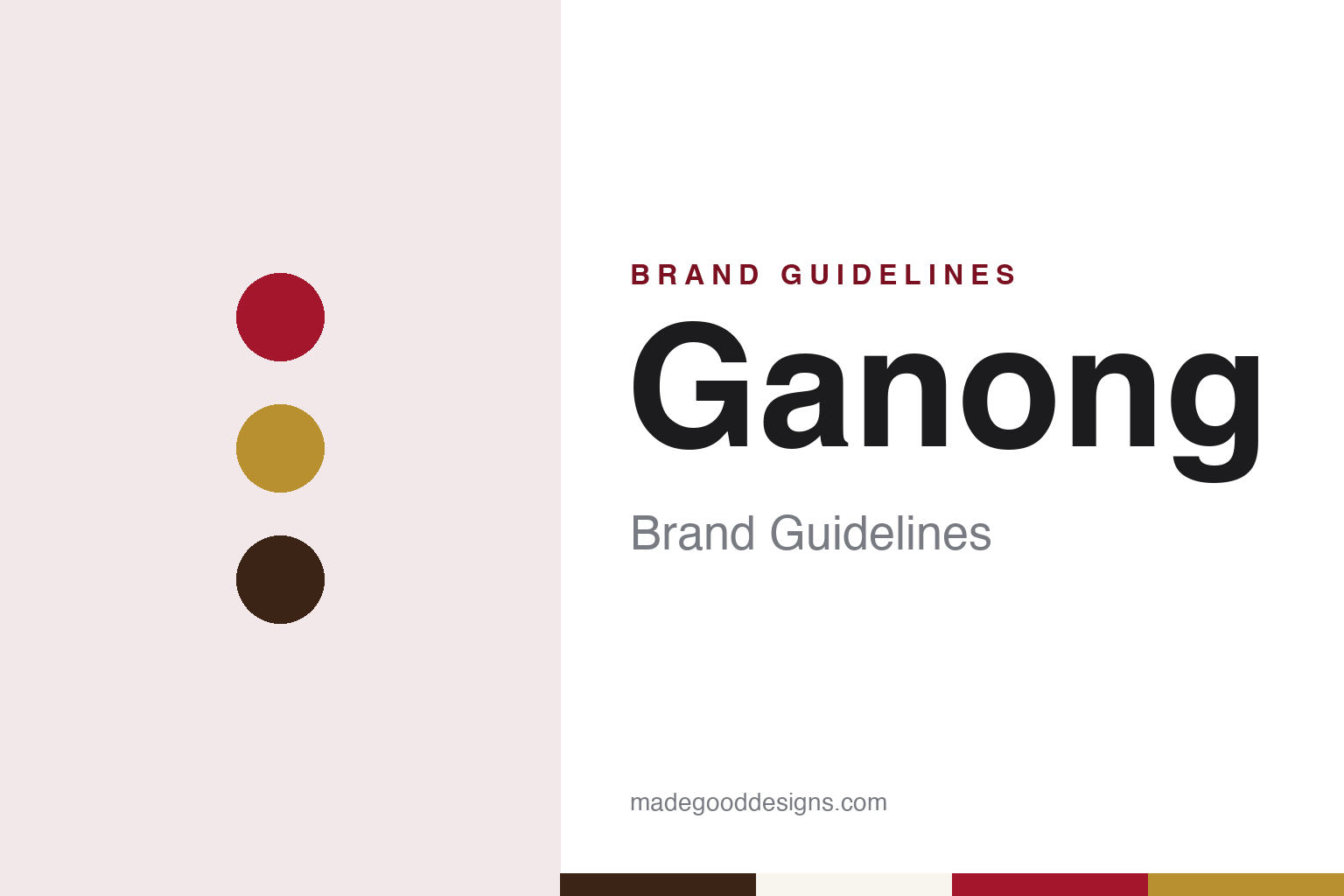
Ganong Brand Guidelines
The St. Stephen candy maker behind Chicken Bones and Delecto.
Aa
Two constants: a Ganong red, gold and cocoa palette and a heritage serif register. Abstract homage — not a Ganong product or mark; no box, wrapper or logo is reproduced.
Two brothers in St. Stephen
A general store on the Maine border that turned to candy.
Ganong began in St. Stephen, New Brunswick, a town on the St. Croix River across from Maine. The company says that on 5 June 1873 the brothers James and Gilbert (G.W.) Ganong founded the business; English Wikipedia says it opened as “G. W. Ganong, Commission Merchant, Etc.,” a grocery that James had persuaded his brother, a teacher, to start with him. According to English Wikipedia, the brothers turned to selling candy and then to making it themselves after struggling to get suppliers to deal with them. In 1884 the partnership was dissolved: Gilbert kept the confectionery and James left to run a soap works in the same town.
The company describes itself today as “Canada’s oldest chocolate and candy company” and as the country’s longest-standing family-owned and operated chocolate maker; English Wikipedia calls it the oldest company in its industry in Canada. Its history is told in David Folster’s book The Chocolate Ganongs of St. Stephen, New Brunswick (Goose Lane, 1991).
Several Canadian “firsts” are attached to the name, and they come from different sources. The company says its candy maker Frank Sparhawk invented the Chicken Bones in 1885 — a cinnamon-flavoured candy filled with bittersweet chocolate — and that in 1888 Ganong began marking its hand-dipped chocolates on the underside with embossed celluloid pads patented by Gilbert Ganong. It also says it was the first in Canada to make lollipops, in 1895. English Wikipedia credits Arthur Ganong, Gilbert’s nephew, with making the first wrapped chocolate bar and dates Ganong’s first chocolate bars to 1910; the company lists “Chocolate Nut Bars” among its Canadian firsts.
The heart-shaped box is the best known of these claims. English Wikipedia says Ganong was the first to introduce a heart-shaped box of chocolates in North America, first used at Christmas before it caught on for Valentine’s Day; the company’s own timeline says it introduced the first heart-shaped boxes to Canada in the 1930s. We give both.
The business grew beyond St. Stephen early. In 1911, English Wikipedia says, Ganong bought the bankrupt White Candy Company in Saint John and ran a factory there until 1931. Arthur Ganong became president in 1917 and led the company for 40 years, the company says, followed by R. Whidden Ganong in 1957 and David Ganong in 1977.
Colour
Delecto, the gold coach and Chicken Bones.
Much of Ganong’s design history is the history of its boxes. The company says it first released boxed chocolates around 1900 under the name Evangeline, with a figure of a young woman on the lid, and that in 1917 Gilbert and Arthur Ganong put their finest chocolates under a new name, Delecto, a twist on “delectable,” which became its best-known boxed range.
The company tells a specific story about the Delecto box. It says that in 1935 an English visitor, Vivien Mansell, whose London printing plant produced decorative scenes, offered a gold ink that would not tarnish, and that on a second visit, dated 1941, he brought a gold print of a coach and horses. That coach became the symbol of the Delecto box for more than 50 years, the company says. In the 1970s it broke from the coach for a more contemporary design, then brought the horse and coach back in 1975.
Later changes are dated on the company’s timeline. In 2006 Ganong introduced a new Delecto package with a new logo and illustrations of the pieces; in 2011 the Delecto look turned to Canadian heritage, adding a maple leaf and a chocolate swirl meant to stand for the “G” motif in the Ganong logo; for the 140th anniversary in 2013 it issued heritage designs; and at Christmas 2014 it launched its first limited-edition Delecto tins. In 2020 the company announced a brand refresh built on the line “Helping Canadians Celebrate Their Sweetest Moments,” which it describes as a “clean, modern” look being rolled out across its packaging.
Other products have their own dates. The company says the Pal-o-Mine bar — fudge and peanuts coated in dark chocolate — was invented by its candy maker Ed Bosein in 1920. Its double-thick wintergreen mints, made since the late 19th century, were dropped in 2019 as production costs rose, the Globe and Mail reported in 2025, and returned for a limited time in 2021 in a keepsake tin, the company says.
Typography
Canada’s chocolate makers.
The seven brands in this group all make chocolate, and they come from six countries on four continents: Ganong and Chocolats Favoris from Canada, Abuelita from Mexico, La Ibérica from Peru, Glico from Japan, Orion from the Czech Republic and Simón Coll from Spain. Read together, they show how differently a chocolate name can be built, kept and presented from one market to the next.
A chocolate brand can belong to the family that started it or to a group that bought it later, and the name on the wrapper and the company that owns it are not always the same thing. It can be known for bars and boxed chocolates, for a drink or for a seasonal novelty, and its packaging can draw on very different local traditions. Each guide looks at how one brand’s own history shows up in what it puts on the shelf.
Each guide also separates what independent sources record from what the company says about itself — who founded it, who owns it now, where its cocoa comes from and where its chocolate is made — and marks plainly what rests only on the company’s own word.
Aa
A heritage serif for a boxed-chocolate maker. (Specimen set in Playfair Display, a serif STAND-IN; NOT the Ganong logo.)
Ganong
Still in the family, with a partner since 2022.
Ganong has stayed in St. Stephen and in the family, with one change in each. English Wikipedia says that in 1988 the company built a plant in Bangkok, Thailand, to which equipment from St. Stephen was shipped, and that in 1990 it opened a new factory on Chocolate Drive in St. Stephen. The company now says it manufactures all its products in St. Stephen, at a plant split into nut and nut-free operations. The original brick factory downtown became the Chocolate Museum, which opened in 1999 and houses the Ganong Chocolatier shop; the town’s Chocolate Fest, held every August, dates from 1984 according to the company and 1985 according to English Wikipedia.
In 2008 Ganong appointed its first chief executive from outside the family, Doug Ettinger, a food-industry executive. The company and the Globe and Mail say Bryana Ganong, David Ganong’s daughter and the fifth generation, became president and chief executive in 2014; her brother Nicholas became chief operating officer in 2022.
In October 2022 Ganong announced what it called a “major partnership investment” from Glenn Cooke, chief executive of the New Brunswick seafood group Cooke Inc., to buy new equipment and use Cooke’s presence in grocery retail, Huddle reported; the private companies did not release the terms. In December 2025 the Globe and Mail described Cooke as holding an ownership stake “the size of which is undisclosed,” and reported that Ganong employed around 350 people and that 75 per cent of its production was co-manufacturing for other brands. The company has held the Canadian licence for Sunkist fruit snacks since 1997, and in July 2024 it took on the Sixlets licence and the Color It Candy brand, which it said it would relaunch in the United States and Canada.
For a design guide, Ganong shows how a regional candy maker can carry one box design — the gold coach — across generations and then refresh it without dropping its heritage. Compare Russell Stover and Fannie May, two North American boxed-chocolate names. For this guide we use red, gold and cocoa brown with a serif, an unofficial interpretation; no product or logo is reproduced.
Explore & save
Keep Ganong’s identity on hand — save it to a board in the Made Good inspiration library.
Ganong identity set
Pin the Ganong red, gold and cocoa palette and the heritage serif register to your own board.