Fannie May Brand Guidelines
The Chicago candy shop whose Pixies and Meltaways outlived its owners.
Aa
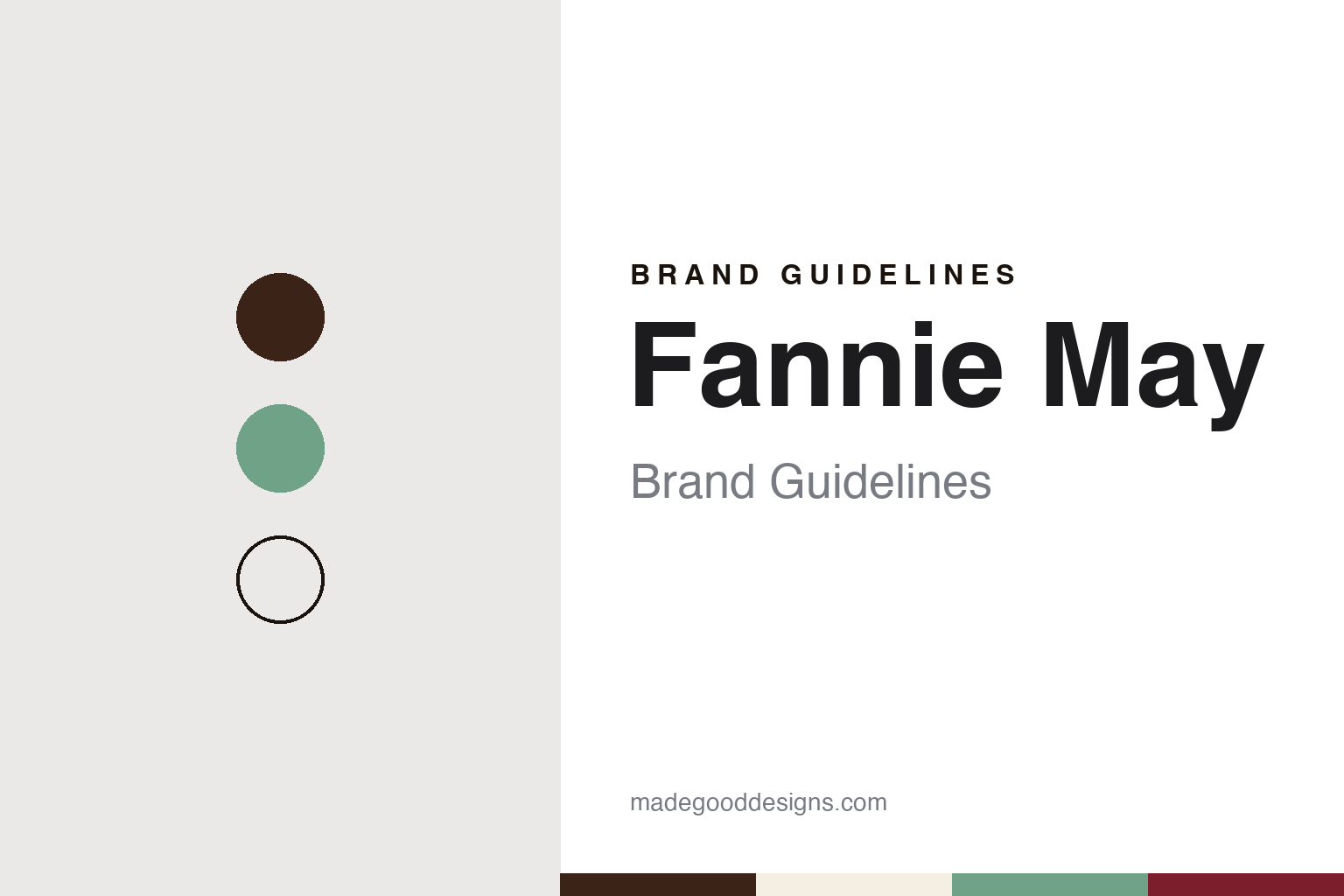
Two constants: a pecan brown, cream and Meltaway green palette and a display serif register. Abstract homage — not a Fannie May product or mark; no box, chocolate or logo is reproduced.
11 North LaSalle Street
A Chicago shop and a handful of recipes.
Fannie May began as a Chicago candy shop. The company says H. Teller Archibald opened it at 11 North LaSalle Street, in the city’s Loop, in 1920, with “only a handful of recipes”; Ferrero’s 2017 announcement of its purchase also gives 1920 as the founding year. The Chicago Tribune, writing in 2004, dated the candy “first sold in Chicago by H. Teller Archibald” to 1915, so both dates appear in print; we follow the company’s 1920.
The business, run by the Archibald Candy Corporation, grew through its own shops rather than through other people’s counters, and for decades it was a Chicago manufacturer as well as a Chicago retailer. For more than 80 years, the Tribune reported in 2017, Fannie May chocolate was made at a plant on West Jackson Boulevard, in the city’s West Loop. By 2004 the paper described that factory as about 70 years old, a building “where the wooden floors had long ago become soaked with chocolate.”
Before 1991 the company was owned by the Archibald-Thorn family, the Tribune reported, quoting John Thorn, a former president whose mother had been chairman. Growth had been deliberate. “We want to expand, but in the right way,” Richard Peritz, then the company’s president, told the paper in 1986. English Wikipedia says Fannie May opened its first store in Missouri in the mid-1980s and had more than 250 locations, mostly in the Midwest, by the end of that decade.
Colour
Pixies, Meltaways and Trinidads.
Fannie May’s identity rests on a short list of candies with their own names. The company’s timeline dates its Buttercreams to 1920 and says that during the Second World War, when ingredients were scarce, it kept to its original recipes. The Pixie followed in 1946; the company describes it as “hand-poured caramel, lightly roasted pecans, and chocolate,” and English Wikipedia calls it the company’s most popular candy. The Mint Meltaway, a mint-chocolate centre coated in chocolate or a green pastel confection, arrived in 1963.
Later additions kept the habit of naming. The Trinidad, a dark truffle centre in white confection and toasted coconut, dates from 1972; its name, the company says, “comes from the island nation that is a source for legendary cocoa and coconut.” The caramel, marshmallow and chocolate Carmarsh followed in 1992. Those names did the work of a logo for many customers: in 2004 the Tribune described Chicagoans who “stocked up on Pixies and Meltaways for holidays, gifts and special treats.”
Today the company says it makes more than 100 different confections and continues “to develop new and innovative American flavor profiles.” Its website frames the brand around heritage, with a timeline headed “A Sweet Legacy,” a “Heritage Collection” assortment and the line “Together is Timeless.” Its timeline also lists in-store tasting events from 2018 and individually wrapped “Premium Bags” from 2019. No official colour or typeface is published, so the palette in this guide is our own interpretation.
Typography
Design and documentation.
The seven brands in this group are all American: Ethel M, See’s Candies, Russell Stover, Fannie May, Lake Champlain Chocolates, French Broad Chocolates and Endangered Species Chocolate. Together they cover much of the range of American chocolate and candy, from the gift box bought for a holiday to the single bar picked up at a grocery checkout.
American boxed chocolate grew up around the shop front. Many of the country’s candy companies began as a single kitchen or store selling to local customers, and some built chains of their own shops, while others moved into drugstores, supermarkets and seasonal aisles. The assorted box, with its printed lid and its paper map of fillings, became a familiar gift, and regional makers came to be known as much for a place as for a product. More recently, small makers have added bean-to-bar chocolate, cafés and factory tours, and bar brands have used the wrapper itself to carry a story or a cause.
Each guide separates what independent sources record from what the company says about itself — who founded it, who owns it now, where its cocoa comes from and where its chocolate is made — and marks plainly what rests only on the company’s own word.
Aa
A display serif for a Chicago candy-shop brand. (Specimen set in DM Serif Display, a serif STAND-IN; NOT the Fannie May logo.)
Fannie May
Bankruptcy, a florist and Ferrero.
The ownership story is turbulent. The investment firm Jordan Co. bought Archibald in 1991, the Tribune reported, and in 1992 Archibald bought Fanny Farmer, an East Coast candy-store chain — the year given by the Tribune in 2017 and by English Wikipedia, though a consultant quoted by the paper in 2004 put the purchase in 1995. Archibald also bought the Canadian chocolatier Laura Secord and the bulk-candy retailer Sweet Factory, and moved Fanny Farmer and Laura Secord production to the West Jackson Boulevard plant. Its debt had reached $170 million by 2002, when it first sought bankruptcy protection; after a second filing in January 2004 it shut the remains of a 228-store chain in February, leaving more than 3,000 employees without jobs, the Tribune reported.
The brands survived. Alpine Confections bought them out of bankruptcy in 2004, reopened a few dozen company stores, closed the Chicago plant and moved manufacturing to Ohio, where it already owned Harry London Candies, the Tribune and English Wikipedia report. In 2006 the online florist 1-800-Flowers.com bought Fannie May for $85 million. On 15 March 2017 Ferrero, the Italian group behind Nutella and Ferrero Rocher, announced a definitive agreement to buy Fannie May Confections Brands, including the Fannie May and Harry London brands, from 1-800-Flowers; the Tribune put the price at $115 million. Fannie May then had 80 stores and 750 full-time employees, and Ferrero said it would run the company as a standalone business and keep its Ohio plant. Today the company says its chocolates are made at its factory in North Canton, Ohio, which offers tours, while the brand still presents itself as a Chicago chocolatier.
For a design guide, Fannie May shows how named candies and a city’s loyalty can carry a brand through changes of owner. Compare Russell Stover, another American boxed-chocolate name now owned by a European group, and See’s Candies, a shop-based candy brand from the West Coast. For this guide we use pecan brown, cream, a Meltaway green and a burgundy with a serif, an unofficial interpretation; no product or logo is reproduced.
Explore & save
Keep Fannie May’s identity on hand — save it to a board in the Made Good inspiration library.
Fannie May identity set
Pin the Fannie May pecan brown, cream and Meltaway green palette and the display serif register to your own board.