Hofbauer Brand Guidelines
A Viennese confiserie that turned the city’s landmarks into pralines.
Aa
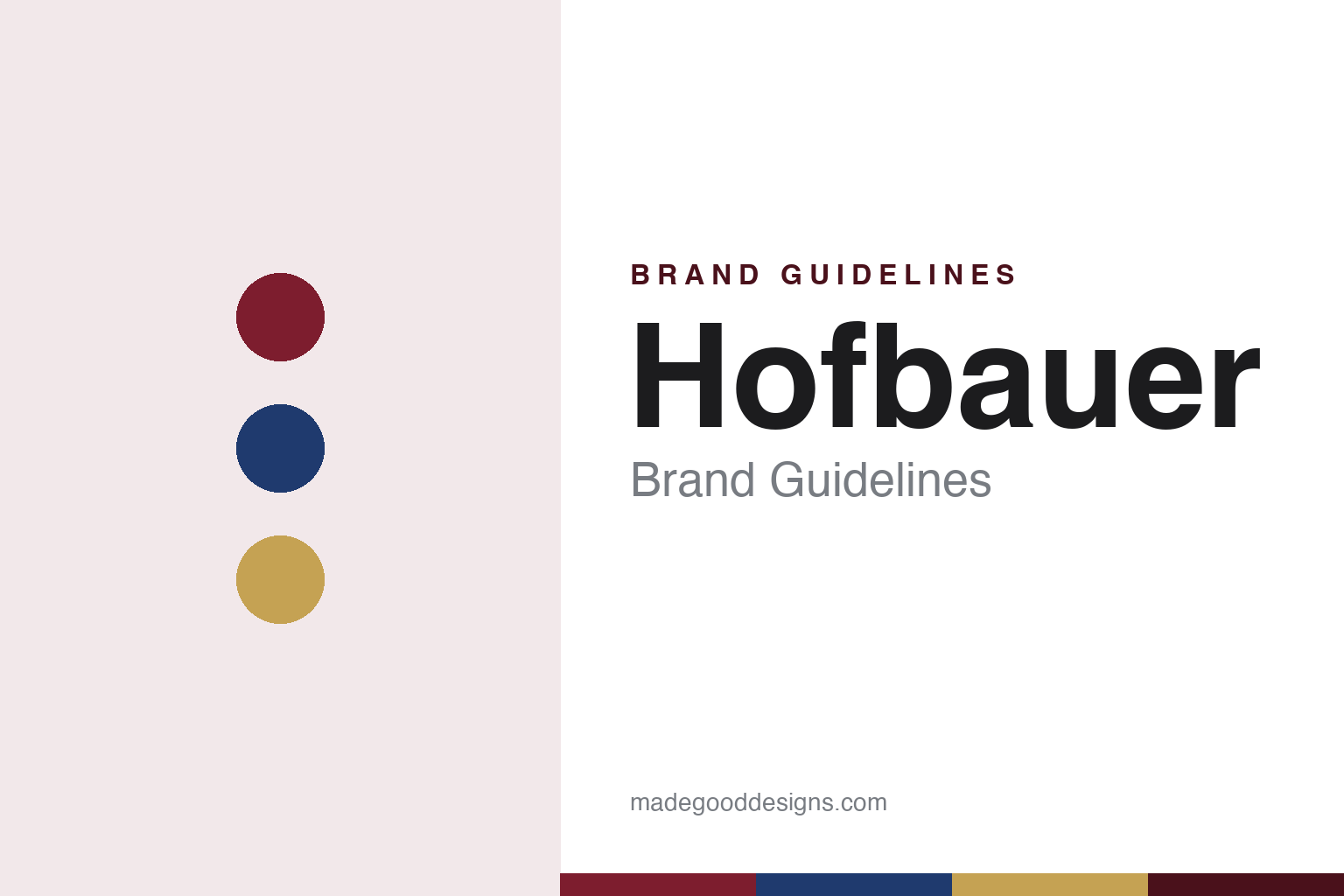
Two constants: a Hofbauer claret, blue and gold palette and a Viennese didone register. Abstract homage — not a Hofbauer product or mark; no box, wrapper or logo is reproduced.
Margareten, 1882
A confectioner’s shop in Vienna’s fifth district.
Hofbauer is a Viennese confectionery brand that has belonged to the Swiss chocolate maker Lindt & Sprüngli since 1994. The company says its history begins in 1882, when Carl Hofbauer and his wife Juliane opened a Konditorei, a confectioner’s shop, in Margareten, Vienna’s fifth district. Carl Hofbauer was born in 1855 in the Weinviertel, the wine country north of Vienna, and was a trained confectioner, the company says; it gives the business a Latin motto, “in qualitate robur” — “in quality lies our strength.”
Most of the family history after that comes from German Wikipedia, in an article that cites no sources, so we give it as that article’s account. It says the business soon opened further shops, ran short of raw materials in the First World War, and in 1918 passed to the founder’s son Ludwig, who with his wife Engelberta turned it into a wholesale manufacturer; chocolate “Maroni” and toffee date from that period. Engelberta Hofbauer ran the company during the Second World War, when it had about 150 employees, and production stopped until 1948 because raw materials were scarce in occupied Austria. From the 1950s it supplied specialist shops and confectioners, and in the 1960s it exported to Germany, Italy, Britain and the United States, the article says.
In 1972 Hofbauer bought a rival Viennese maker, Küfferle, founded in the 1860s and known for its Katzenzungen — “cats’ tongues,” thin chocolate tablets — and its chocolate umbrellas, German Wikipedia says. According to that account, Hofbauer kept its own name for specialist retailers and used Küfferle to supply supermarkets and grocery chains. Both names survive as brands today.
Colour
Pralines with a map of Vienna.
Hofbauer’s range is built around Vienna. Its website groups boxed pralines as “Geschenke mit Wiener Charme” — gifts with Viennese charm — and ties individual chocolates to landmarks. The company says the shape of its Fidelio praline echoes the roof of St Stephen’s Cathedral and that its Secession praline is decorated with the golden leaf dome of the Secession building, where Gustav Klimt and Koloman Moser showed their work; it pairs its Esterházy marzipan praline with the story of how the architect of the City Hall tower outwitted Emperor Franz Joseph. A Schönbrunn Collection takes its name from the imperial palace.
Two lines are long-standing staples. Rohkost — fruit such as apricots, plums and pineapple coated in dark chocolate — and the Für Verwöhnte (“for the pampered”) praline assortments were both repackaged in 2015, the Austrian retail magazine Cash reported, with Rohkost moving into a carry-bag pack. The website also sells Marc de Schlumberger truffles, filled with a cream made with grape-marc spirit, and seasonal St Nicholas, Krampus, Christmas and Easter assortments.
Like several Austrian makers, Hofbauer sells Mozartkugeln, the pistachio-marzipan and nougat chocolates invented in Salzburg in 1890. Lindt & Sprüngli says the Hofbauer and Küfferle brands are famous for their “Mozart truffles” and chocolate umbrellas. German Wikipedia describes the Hofbauer version as a nougat core inside pistachio marzipan with a flat base, in dark chocolate (“Hofbauer red”) or milk chocolate (“Hofbauer blue”), so that the colour signals the variety; the website lists both. The company introduces its Mozartkugel with the opening of the Vienna State Opera in 1869, with Mozart’s Don Giovanni.
Typography
Chocolate and confectionery.
The seven brands in this group all make chocolate, and they come from three countries: Mary, Dumon and Chocolat Jacques from Belgium, Manner, Mirabell and Hofbauer from Austria, and Sarotti from Germany. Chocolate brands reach shoppers in different ways, from a chocolatier’s own shop counter to a bar or a box on a supermarket shelf.
An old chocolate brand can carry two histories at once. One is the story of a founder, a workshop and a city, which a brand may keep telling on its packs and its website long after the founding family has gone. The other is the story of ownership: who bought the business, who bought it after that, and which group’s factory the chocolate comes from now. The two need not line up: a name tied to one town can be made somewhere else, or by a company based in another country.
Each guide separates what independent sources record from what the company says about itself — who founded it, who owns it now, where its cocoa comes from and where its chocolate is made — and marks plainly what rests only on the company’s own word.
Aa
A high-contrast didone for a Viennese confiserie. (Specimen set in Bodoni Moda, a serif STAND-IN; NOT the Hofbauer logo.)
Hofbauer
A Lindt brand made in Lower Austria.
The modern company took shape in the early 1990s. German Wikipedia says Hofbauer built a new factory at Gloggnitz, in southern Lower Austria, which opened in 1993; the town’s own German Wikipedia article describes it as a chocolate and confectionery factory of Lindt & Sprüngli, listed as F. L. Hofbauer AG, in the Stuppach industrial area. A year later Lindt & Sprüngli bought the business. Lindt’s own history says its new Austrian subsidiary “acquired the well-known Viennese confectionery companies Hofbauer and Küfferle in 1994,” and the Wiener Zeitung gave the same date in 2011, as did Cash in 2015.
Today the Hofbauer website is operated by Lindt & Sprüngli (Austria), based in Vienna. On its careers page the Austrian company describes itself as an independent subsidiary of the group with more than 300 employees, a head office in Vienna and a production site in Lower Austria, and gives Gloggnitz as its Lower Austrian location; it handles the Lindt brand in Austria alongside the two traditional names, Hofbauer and Küfferle. The pages we checked do not say which Hofbauer products are made at Gloggnitz and which elsewhere, so we do not draw that line. The parent group says it makes chocolate in 12 factories in Europe and the United States and buys cocoa through suppliers who work with farmers under its own farming programme.
Hofbauer is a city brand kept alive inside a multinational: the Vienna story, the landmark pralines and the Mozartkugel remain, while the business behind them is Swiss-owned.
For a design guide, Hofbauer shows how a brand can use a city’s architecture as its packaging story. Compare Manner, another Viennese confectioner, and Mirabell, the Salzburg Mozartkugel brand. For this guide we use claret, imperial blue and gold with a serif, an unofficial interpretation; no product or logo is reproduced.
Explore & save
Keep Hofbauer’s identity on hand — save it to a board in the Made Good inspiration library.
Hofbauer identity set
Pin the Hofbauer claret, blue and gold palette and the Viennese didone register to your own board.