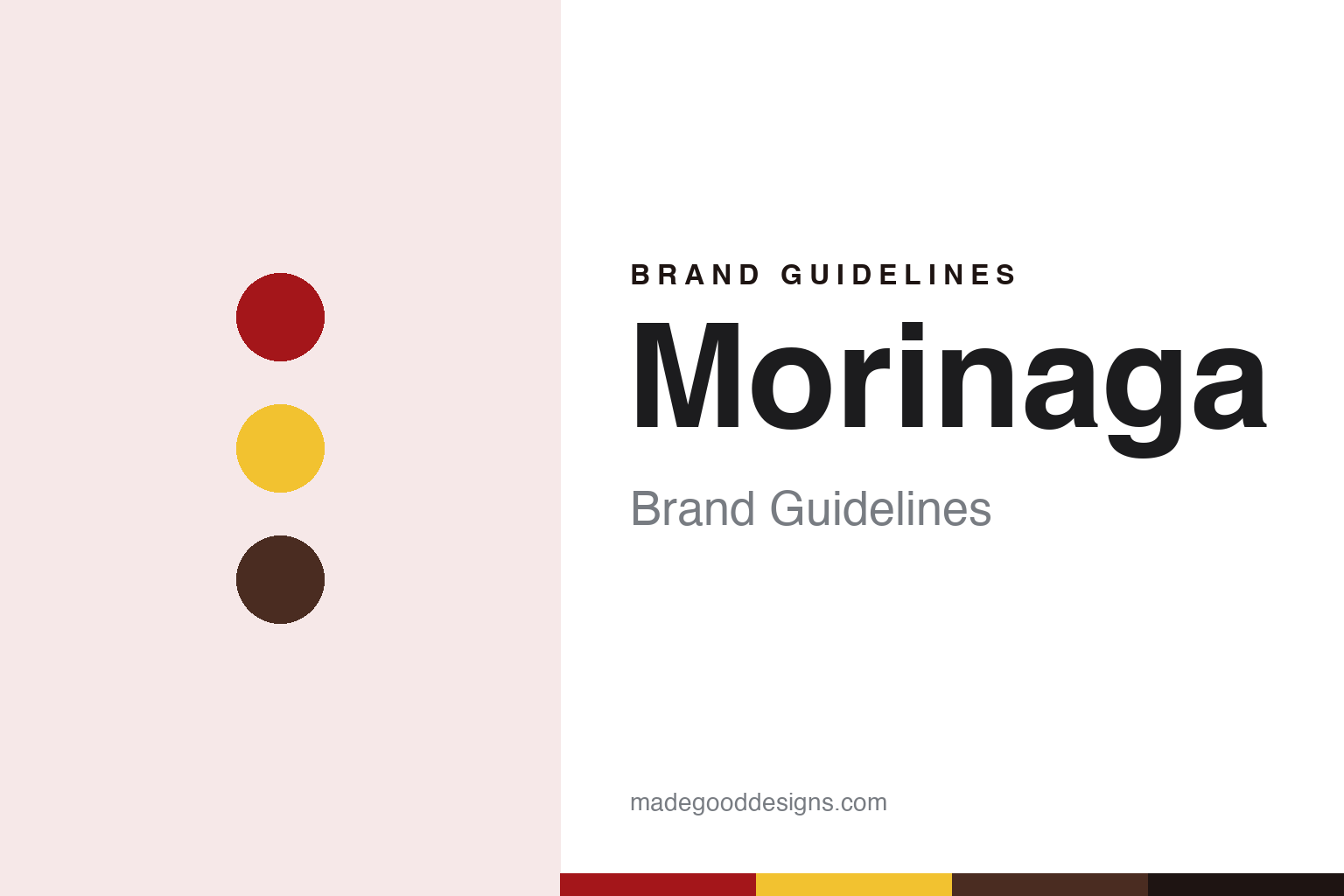
Morinaga Brand Guidelines
The Tokyo confectioner behind the Angel Mark.
Aa
Two constants: a Morinaga red, yellow and cocoa palette and a Mincho serif register. Abstract homage — not a Morinaga product or mark; no wrapper, angel or logotype is reproduced.
A two-tsubo workshop
Western sweets, a partner and an angel.
Morinaga began in Tokyo in 1899. The company says Taichiro Morinaga came home that year from the United States intending to bring Western confectionery to Japan, and started making it in a workshop of just two tsubo, about 6.6 square metres. He called the business Morinaga’s Western Confectionery Shop; Japanese Wikipedia says its first product was marshmallows, and English Wikipedia gives the founding date as 15 August 1899.
The business grew after Taichiro was joined by a partner, Hanzaburo Matsuzaki, who took charge of management; Japanese Wikipedia dates his arrival to 1905. That same year the company registered the Angel Mark. Morinaga says Taichiro took the idea from the name of the marshmallow he was making most often at the time, “Angel Food”; Japanese Wikipedia adds that he was a Christian.
The firm was incorporated in 1910 as Morinaga Shoten and took the name Morinaga & Co. in 1912, Japanese Wikipedia says. In 1913 it used the name “milk caramel” for the first time, according to the company, and in 1914 it began selling its caramels together in a pocket-sized box instead of individually. The company says the milk caramels “in the yellow box” have been the popular choice of generations of Japanese buyers ever since.
Japanese Wikipedia traces a long period of restructuring. During the Second World War the company absorbed affiliates including the original Morinaga milk business, and in 1943 it was renamed Morinaga Shokuryo Kogyo. In April 1949 Morinaga Milk Industry became independent, and that October the confectioner returned to the name Morinaga & Co. The two remain separate companies: in February 2017 the Nikkei reported plans to combine them under a holding company, and at the end of March Morinaga Milk announced that the talks had ended. The confectioner has been listed on the Tokyo Stock Exchange since May 1949 and has no controlling parent; its largest shareholders are trust banks, according to its 2026 securities report as summarised by Japanese Wikipedia.
Colour
Bean-to-bar in 1918, the company says.
Chocolate is where Morinaga’s claims are boldest. The company says that at a time when chocolate was an imported luxury, Taichiro imported the latest production equipment and brought in technicians from overseas, and that in 1918 Morinaga began selling domestically produced milk chocolate made from the cacao bean — “Japan’s First Domestically Produced Chocolate,” in its own words. English Wikipedia gives the same date, citing a 2014 paper by Tatsuya Mitsuda in the journal Food & History; Japanese Wikipedia describes 1918 as the start of integrated production of milk chocolate. A year later, the company says, it launched Milk Cocoa, Japan’s first drinking cocoa.
The products that followed are now familiar in Japan. The company’s history lists Hi-Crown chocolate in 1964; Chocoball in 1967, launched with its Kyoro-chan character; Koeda in 1971; the Choco Monaka ice-cream wafer in 1972; and DARS, launched as Solid DARS in 1993. Japanese Wikipedia notes that Chocoball’s “toy can” prize campaign, begun in 1969, still runs. Carré de Chocolat followed in the early 2000s — in 2003 by the company’s timeline, 2002 by Japanese Wikipedia’s. The company also says it developed a baked chocolate, BAKE, with its own technology, and holds several patents for the baking process.
Morinaga is also tied to Japan’s Valentine’s Day. The company says that in 1960 it ran a large mass-media campaign pairing chocolate gifts with the holiday, “cueing the establishment of Valentine’s Day in Japan”; Japanese Wikipedia is more cautious, presenting the campaign as one of the theories for how the custom of giving chocolate spread. English Wikipedia says that in 2009 the company launched gyaku-choco, “reverse” chocolate for men to give to women.
On sourcing, Morinaga’s public history is brief. It says that in 2007 it formed a business alliance with Barry Callebaut, the Zurich-based cocoa and chocolate group, and that in 2013 its “1 Chocolate for 1 Smile” campaign and a DARS milk chocolate used cacao partly harvested in designated regions of Ghana where Morinaga provides aid. We found no fuller account of where its beans come from in the sources we checked.
Typography
Chocolate in Japan and Latin America.
The seven brands in this group all sell chocolate, and they come from three countries: Royce’, Meiji and Morinaga from Japan, Garoto, Cacau Show and Kopenhagen from Brazil, and Ibarra from Mexico. Each guide looks at one name on its own terms, at home first and abroad second.
Chocolate brands reach people in different ways, and the differences show in their design. A mass-market confectioner sells bars and boxes through supermarkets and corner shops, where a wrapper has a moment to be recognised on a crowded shelf. A gift brand sells mainly through its own shops and counters, where the box, the ribbon and the shop itself carry much of the identity. A maker of a traditional product — a tablet bought for the kitchen rather than as a treat — may keep the same carton for decades, so that the package itself becomes the brand. Many firms do more than one of these things at once.
Each guide separates what independent sources record from what the company says about itself — who founded it, who owns it now, where its cocoa comes from and where its chocolate is made — and marks plainly what rests only on the company’s own word.
Aa
A Mincho serif — for a mark built around an angel. (Specimen set in Shippori Mincho, a serif STAND-IN; NOT the Morinaga logo.)
Morinaga
An angel registered in 1905.
The Angel Mark is the constant in Morinaga’s identity. The company says it “has evolved seven times since its birth” in 1905; the current version was announced in 1986, and Japanese Wikipedia dates it to July of that year, when the company introduced a corporate-identity programme. The lettering has changed more often. According to Japanese Wikipedia, the Japanese logotype uses an older form of the character 永 in the name; the English logo was a near-script lowercase “morinaga” from 1949 to 1974 and then slightly wide Gothic capitals, “MORINAGA,” until 1986. Since then the capitals have been set beneath the angel, or beside it on some products.
Production is in Japan. The company lists factories at Tsurumi in Yokohama — the site that also holds its research centre and MORIUM, the Morinaga Angel Museum it opened in 2022 — and at Oyama in Tochigi, Mishima in Shizuoka and Anjo in Aichi, with its head office in Minato, Tokyo. Japanese Wikipedia adds plants run by a subsidiary, Takasaki Morinaga, in Gunma. The company has had hard years too: in 1984 it was drawn into the Glico-Morinaga case, a criminal extortion campaign against food makers, and Japanese Wikipedia records that its products were taken off shop shelves and its television advertising suspended for a time.
For a design guide, Morinaga shows how one mark — an angel registered in 1905 — can carry a company through more than a century of caramel boxes, chocolate bars and changing logotypes. Compare Meiji, the Tokyo confectioner it is most often compared with, Japanese Wikipedia notes, and Royce’, a younger Japanese chocolate maker. For this guide we use angel red, caramel yellow and cocoa brown with a serif, an unofficial interpretation; no product or logo is reproduced.
Explore & save
Keep Morinaga’s identity on hand — save it to a board in the Made Good inspiration library.
Morinaga identity set
Pin the Morinaga red, yellow and cocoa palette and the Mincho serif register to your own board.