Samuel van Hoogstraten treated a picture as a device. A canvas could be a doorway, a pinboard, a window with a man leaning out of it, or the inside of a wooden box that only makes sense through a peephole. He trained in Rembrandt’s Amsterdam workshop, then spent three decades testing how far paint, light and geometry could persuade a viewer that a flat surface was something else.
That makes him a useful artist for anyone who designs for a fixed viewpoint: a screen, a shop window, a stage, a mural at the end of a corridor. For more reusable images, browse the MGD museum inspiration collection.
Who was Samuel van Hoogstraten?
The National Gallery, London, and the Leiden Collection both record that he was born in Dordrecht in 1627 and first trained with his father, Dirck van Hoogstraten, who died in December 1640. He then went to Amsterdam to study with Rembrandt; the National Gallery places the move shortly after his father’s death, while Piet Bakker’s biography for the Leiden Collection puts it around 1643. In the workshop he met Carel Fabritius.
By 1648 he was back in Dordrecht. The Leiden Collection and the RKD’s online study of the artist both give 16 May 1651 as the day he left for Vienna, where Emperor Ferdinand III received him on 6 August and rewarded an illusionistic still life with a gold chain and medallion. He travelled on to Rome in 1652, returned to Vienna in 1653, and was home in Dordrecht by 1656, where he married Sara Balen and took a post at the Mint of Holland.
A second trip took him to London. The RKD study dates his departure to May 1662; the Leiden Collection has him there until 1667, the National Gallery until 1666. He joined the painters’ confraternity Pictura in The Hague in January 1668, according to the Leiden Collection, and settled again in Dordrecht in the early 1670s. His treatise, Inleyding tot de hooge schoole der schilderkonst (Introduction to the High School of the Art of Painting), was published in Rotterdam in 1678 by his brother François. He died in Dordrecht on 19 October 1678.
The Leiden Collection names Godefridus Schalcken, Arent de Gelder and the biographer Arnold Houbraken among his pupils, and Nicolaes Maes as a possible one; our guide to Nicolaes Maes follows that Dordrecht thread.
Key works, from Vienna to London
Letter-rack still life (1651), Prague Castle Picture Gallery. Painted straps hold letters, a rosary and playing cards against a flat board. The RKD study identifies this, with a high degree of probability, as the picture that fooled the emperor.
Old Man at the Window (1653), Kunsthistorisches Museum, Vienna. Signed and dated, on canvas, about 111 by 86.5 cm. A man leans his head out of a stone-framed window. The museum records it in imperial possession since 1653.
A Peepshow with Views of the Interior of a Dutch House (about 1655–60), National Gallery, London. A wooden cabinet painted inside and out, with a peephole at each end. The National Gallery counts six surviving Dutch perspective boxes and calls this the only one with two peepholes.
The Slippers, Musée du Louvre, Paris. A view through open doorways into the rooms of a Dutch house, with nobody in sight. The Kunsthistorisches Museum’s exhibition texts date it broadly to 1650–75.
View in a Corridor, also called A View through a House (1662), Dyrham Park, Gloucestershire. A life-size doorway opening onto a tiled hall, painted in London for Thomas Povey. Samuel Pepys singled out a perspective picture at Povey’s house in his diary for 19 January 1663, an entry the National Trust links to this canvas.
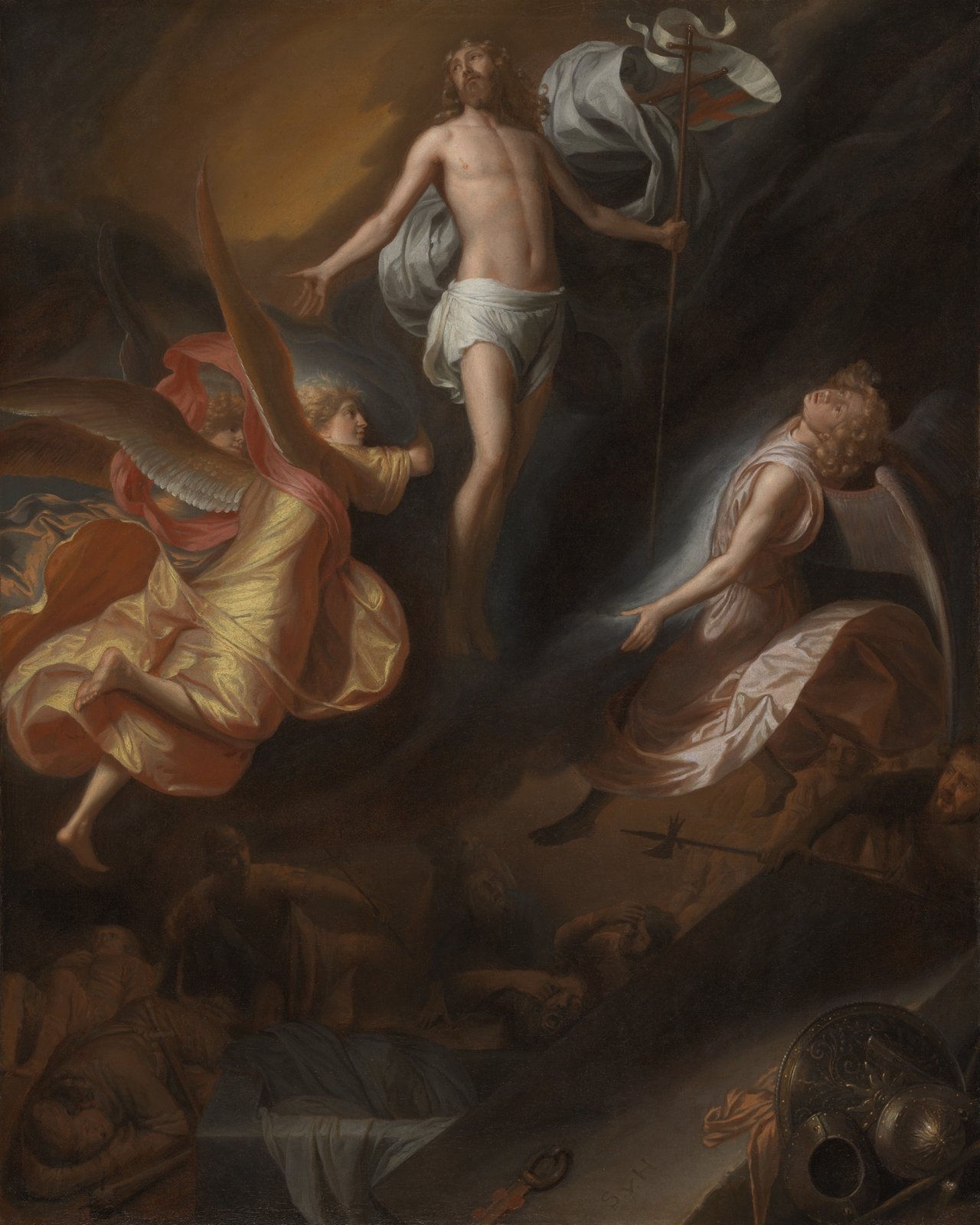
Resurrection of Christ (c. 1665), Art Institute of Chicago, and The Annunciation of the Death of the Virgin (c. 1670), Metropolitan Museum of Art. Two later religious canvases.
What to look at in a Samuel van Hoogstraten picture
- A fixed eye point. The peepshow only resolves from the peephole. Seen from the open side, the National Gallery notes, it is a jumble of crooked tiles and misshapen chairs.
- Thresholds. Doors, windows, sills and frames mark the line between the viewer’s space and the picture’s. In the Dyrham corridor the door frame is life-size, so the painted floor seems to continue the real one.
- Shallow space for objects, deep space for rooms. The letter racks work because everything sits within a finger’s depth of the board. The corridor views do the opposite, stacking doorway behind doorway.
- Raking light on edges. The RKD study points out that sharp side light picks out the edges of his forms, a device he discusses in his treatise under the Dutch word schamping.
- The signature as a prop. The emperor’s gold medallion reappears in later letter racks as a personal trademark, the Leiden Collection observes.

Light and palette in the Chicago Resurrection
The Art Institute of Chicago’s Resurrection of Christ, an oil on canvas about 81 by 65 cm, is built on a diagonal. The figure of Christ, wrapped in white drapery and holding a banner, rises at the top centre; angels in gold and pink robes sweep in from left and right; soldiers and a pile of armour sit in near darkness along the bottom edge, so the eye climbs from shadow to the palest area.
Measured from the museum’s scan of this painting, the dominant tones are deep browns: #211a15, #412e20 and #563e2a, with a warm mid-brown at #6f533b and a pale tan at #937c62. The bright fabrics occupy a small share of the surface. A few light shapes read as radiant when most of the field is dark and close in hue. You can sample your own reference scans with the MGD image colour picker.
The small Jacob and Esau in the same museum, which the Art Institute attributes to him, is pen and brown ink with brush and brown wash on a sheet under 16 cm wide. A tree trunk divides the page and the two figures sit in the shade to its right.
Technique: how the illusions were built
The perspective box is oil on wood, 58 by 88 by 60.5 cm. According to the National Gallery, the open side was originally covered with translucent oiled paper to let in soft light, and the scenes are painted across several inner faces so that the joins vanish from the peephole. Outside, allegorical figures with Latin scrolls name three motives for making art: love, money and glory.
The flat illusions depend on scale and shallow depth: the RKD study describes objects and figures shown full-size in the shallowest possible space. It adds that his Hofburg view once had a real clockwork behind the painted tower, so that sound backed up the picture.
His early drawings stay close to Rembrandt’s workshop practice: the Metropolitan Museum of Art dates a small pen, ink and wash Adoration of the Shepherds to the early 1640s. For the wider context, see our guides to Rembrandt, to his fellow pupil Carel Fabritius and to Dutch Golden Age painting.
The treatise: a studio manual from 1678
The Leiden Collection describes the Inleyding as the most extensive seventeenth-century Dutch painting treatise to appear after Karel van Mander’s Schilder-boeck of 1604. The National Gallery notes that it includes reminiscences of Rembrandt’s studio, and that it also criticises his naturalism.
For designers the interest is that he wrote the method down: illusion as a set of teachable rules about light, edge, scale and viewpoint.
How designers can borrow Samuel van Hoogstraten’s ideas
- Design for one viewpoint, then check the others. Forced-perspective murals and floor graphics follow the peepshow rule.
- Use a threshold. A painted or printed frame, sill or doorway gives the viewer a place to stand.
- Keep trick-the-eye objects shallow. Letter-rack layouts, with paper, ribbon and small tools pinned to a board, are convincing because the depth is tiny. Flat-lay photography depends on the same limit. Our guide to trompe l’oeil goes further into the genre.
- Match real scale. A life-size door or envelope carries more conviction than a perfectly rendered one at the wrong size.
- Let one light source rule. Consistent shadows in a single direction hold an illusion together.
Frequently asked questions
What is Samuel van Hoogstraten known for?
For perspective and illusion: the peepshow box in the National Gallery, London, the Old Man at the Window in Vienna, painted letter racks, the life-size corridor view at Dyrham Park, and his 1678 treatise on painting.
Was Samuel van Hoogstraten a pupil of Rembrandt?
Yes. The National Gallery and the Leiden Collection both record that he trained in Rembrandt’s Amsterdam workshop in the 1640s, at the same time as Carel Fabritius, after first learning from his father in Dordrecht.
How does the Hoogstraten perspective box work?
The interior of a Dutch house is painted in distorted form across the inner faces of a wooden cabinet. Looked at through either of the two peepholes, the distortions cancel out and the rooms appear three-dimensional.
Where can I see his work?
The National Gallery in London, the Kunsthistorisches Museum in Vienna, the Dordrechts Museum, Dyrham Park in Gloucestershire, the Louvre, the Metropolitan Museum of Art and the Art Institute of Chicago all hold works. The Art Institute of Chicago flags the two works shown here as public domain.