Govert Flinck learned to paint so much like Rembrandt that one of his self-portraits carried a forged Rembrandt signature until 1926. Then he changed direction. In the 1640s he gave up heavy shadow for even light, clean contour and clearer colour, and Amsterdam’s merchants and burgomasters rewarded him with portraits, civic guard groups and chimneypieces for the new Town Hall. His name is also spelled Govaert, the form used by the Art Institute of Chicago and the Cleveland Museum of Art.
Adapting a house style to a client is everyday work for designers. For reusable images from museum collections, browse the MGD museum inspiration collection.
Who was Govert Flinck?
Piet Bakker’s biography for the Leiden Collection gives his birth as 25 January 1615 in Kleve, a German city near Nijmegen. His father, a merchant, first apprenticed him to a cloth dealer. The Leiden Collection and the Web Gallery of Art both follow the early biographer Arnold Houbraken: the Mennonite preacher and painter Lambert Jacobsz persuaded the family to let him train, and around 1629 took him to his workshop in Leeuwarden, where he met Jacob Backer.
Both moved to Amsterdam, where Flinck spent about a year with Rembrandt. The Web Gallery of Art places this in or around 1633; the Leiden Collection, citing more recent research on the dealer Hendrick Uylenburgh, prefers late 1634 or early 1635, and adds that Flinck took over from Rembrandt in Uylenburgh’s workshop soon afterwards. His earliest dated works are from 1636.
The National Gallery, London, sums up the rest: his early work is close to Rembrandt, but he later abandoned Rembrandt’s chiaroscuro for a brighter and lighter colouring and won major commissions for the Amsterdam Town Hall. He became a citizen of Amsterdam in 1652 and died there on 2 February 1660.
Key works by Govert Flinck
Isaac Blessing Jacob (c. 1638), Rijksmuseum, Amsterdam. A biblical scene on canvas, about 115 by 140 cm. The Rijksmuseum notes that both the technique and the way of telling the story come from Rembrandt.
Self Portrait aged 24 (1639), National Gallery, London. Oil on wood. The National Gallery records that cleaning in 1926 uncovered Flinck’s signature and the date beneath a forged Rembrandt signature.
Portrait of the Governors of the Kloveniersdoelen (1642) and the company of Captain Albert Bas (1645), Rijksmuseum. Two group portraits for the headquarters of an Amsterdam civic guard. The 1645 canvas, about 339 by 243 cm, hung in the same hall as Rembrandt’s Night Watch.
Bearded Man with a Velvet Cap (1645), Metropolitan Museum of Art, New York. Oil on wood, from the year of the Bas company.
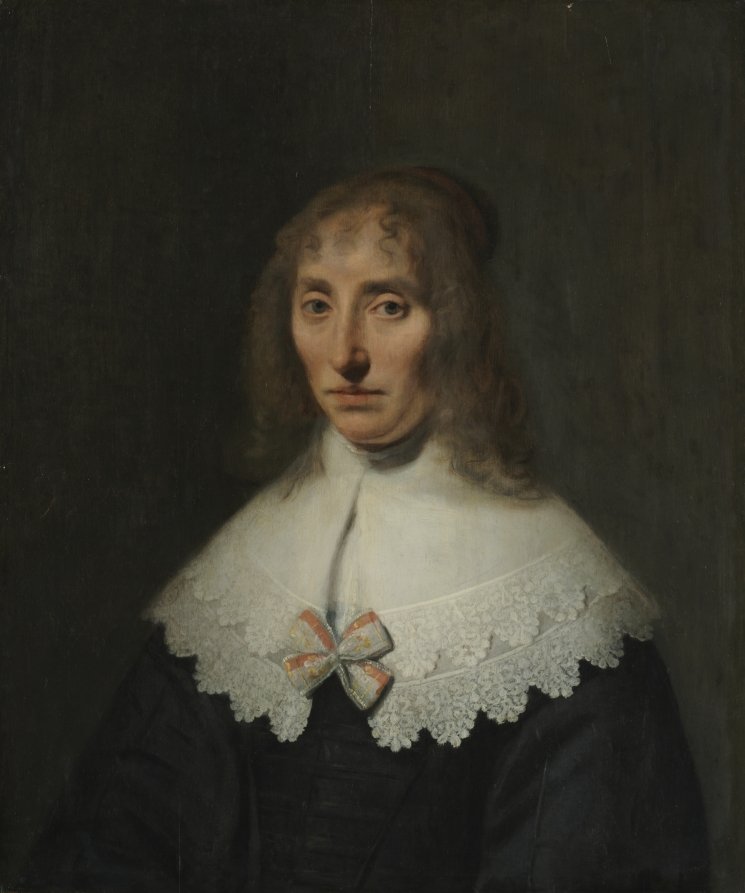
Portrait of a Woman (1646), Cleveland Museum of Art. Oil on wood, signed and dated at the left.
Allegory on the Memory of Frederik Hendrik (1654), Rijksmuseum. Painted for Amalia van Solms, the stadholder’s widow, for Huis ten Bosch.
Manius Curius Dentatus Refusing the Gifts of the Samnites (1656) and Solomon Praying for Wisdom (1658), Royal Palace, Amsterdam. Chimneypieces for the Town Hall on Dam Square, now the Royal Palace, which states that they still hang where they were installed.
What to look at in a Flinck portrait
The Cleveland Portrait of a Woman shows the mature portrait formula. The sitter is placed centrally, half-length, looking straight out. A broad white collar edged with scalloped lace spreads across the shoulders and forms a pale triangle that carries the eye up to the face. Everything else is quiet: a black dress, a dark cap, a plain dark background.
- One light, softly graded. Light from the left models the face in small steps, without deep cast shadows.
- A pale shape as a base. The collar works like a plinth for the head. Its lace edge is the only busy contour in the picture.
- A single accent. A small striped bow at the centre of the collar brings in the only warm colour apart from the skin.
- Fine detail where it matters. The lace and hair are drawn closely; the dress is left as a near-flat dark mass.
The Cleveland Museum of Art quotes the German painter Joachim von Sandrart, a contemporary, who judged Flinck’s portraits more exact and more pleasing as likenesses than Rembrandt’s.
Palette: black, white and one warm note
Measured from the museum’s scan of the Cleveland panel, the picture is overwhelmingly dark and neutral: near-blacks at #1c1d19 and #28271f fill the dress and background, with a grey-olive at #878069 and a pale stone tone at #a8a58f in the collar, and a muted brown at #5c4e3a in the hair. The portrait gets its presence from value contrast, a white shape on a dark field, and keeps colour for the face and the bow.
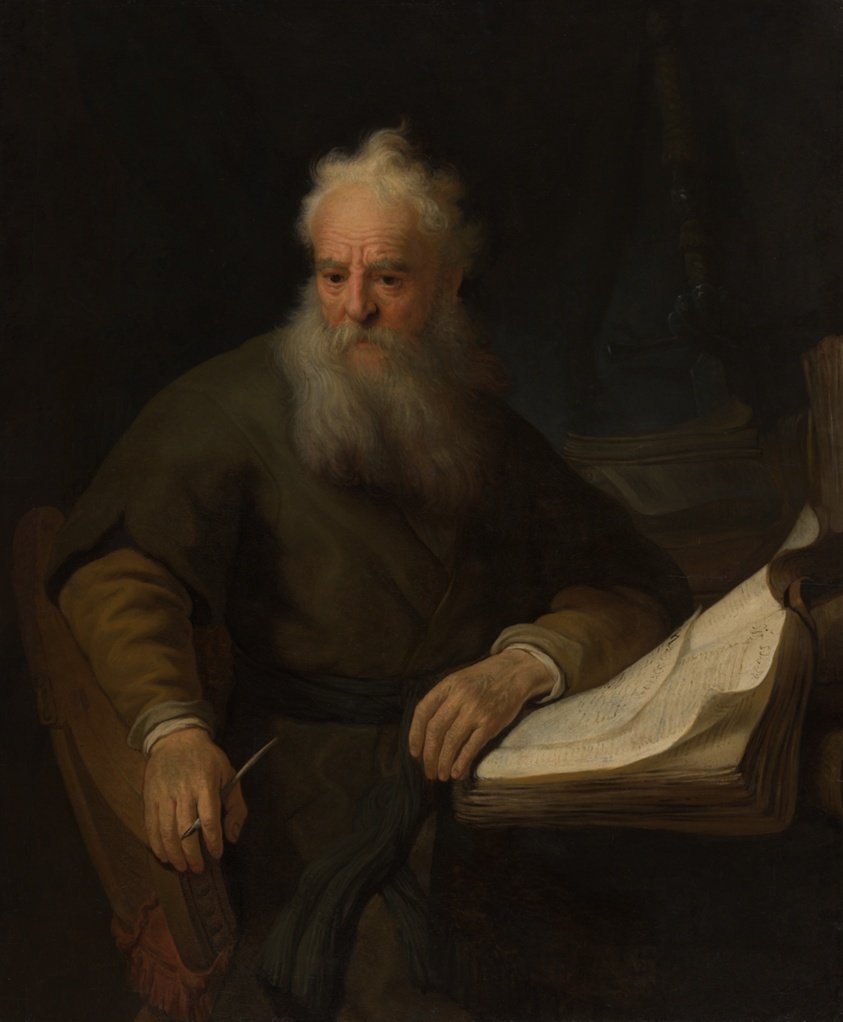
The Saint Paul the Apostle in Chicago, which the Art Institute lists as attributed to Flinck and leaves undated, shows a darker, Rembrandt-like approach: measured from the museum’s scan, it runs from #15110d and #2e2112 up to a lighter brown at #856946, with the lit face and an open book as the only pale areas. To build a scheme from either picture, load a scan into the MGD colour palette generator.
Technique: drawing, panel and canvas
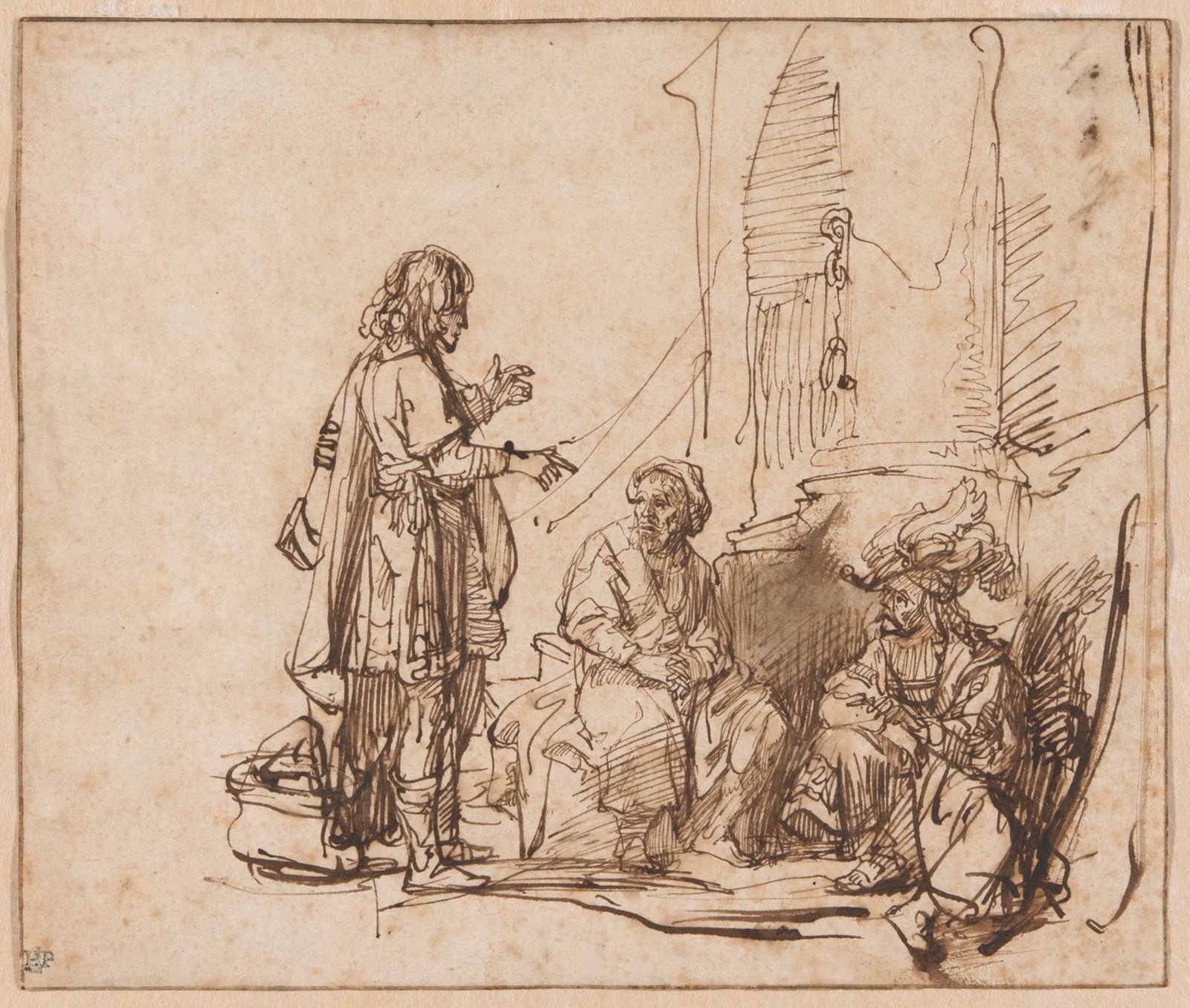
Flinck’s drawings show the workshop habits he started from. The Art Institute of Chicago’s Joseph Interpreting the Prisoners’ Dreams, dated about 1638, is pen and brown ink with brush and brown wash on a sheet roughly 17 by 21 cm. Three figures are set down in quick contour; parallel hatching stands in for shadow; a pillar and a hanging chain are enough to say prison. The Metropolitan Museum of Art holds a black chalk study, A Woman Asleep, dated 1633–36.
The London self-portrait, the New York Bearded Man and the Cleveland portrait are all oil on wood; the public commissions are large canvases sized to their walls. The Rijksmuseum explains that the tall, narrow format of the Bas company was fixed by its place beside a fireplace, and that Flinck answered it by arranging the guardsmen in a circle around the captain.
The change of manner was deliberate. The Leiden Collection relates that Amsterdam’s elite came to prefer a Flemish-influenced style in the early 1640s, and that Flinck studied Rubens and Van Dyck on a trip to Antwerp, probably around 1645. For the starting point, see our guide to Rembrandt; for the Flemish models and the wider period, see Baroque art and Dutch Golden Age painting.
The Town Hall commissions
The 1656 picture of the Roman consul Dentatus turning down gold, and the 1658 picture of Solomon kneeling to ask for wisdom, were chosen as examples of conduct for the men who met beneath them, as the Royal Palace explains. Fellow Rembrandt pupil Ferdinand Bol painted the companion piece to the Dentatus.
In November 1659 Flinck was commissioned to paint twelve canvases for the building’s gallery, according to the Leiden Collection and the Web Gallery of Art. He died a few months later. The Royal Palace records that other artists were then brought in, among them Rembrandt and Jan Lievens.
How designers can borrow Govert Flinck’s ideas
- Build portraits on value first. Convert a headshot to greyscale. If a pale collar, shirt or card behind the face does not separate it from the background, no colour grade will fix it.
- Ration the accent. One small warm element in a black, white and grey layout, placed on the central axis, does the work of the bow in the Cleveland portrait.
- Let the site set the format. The Bas company took its proportions from a wall. Start a mural or banner from the fixed dimensions, then find the arrangement that suits them.
- Match the manner to the audience. Keep more than one lighting and colour approach ready, and choose by brief.
- Sketch the staging before the finish. The Chicago drawing settles who stands, who sits and where the dark goes in a few lines.
Frequently asked questions
Who was Govert Flinck?
A Dutch painter born in Kleve in 1615 who trained in Leeuwarden and with Rembrandt in Amsterdam, then became a sought-after portraitist and history painter there. He died in Amsterdam in 1660.
How did Flinck’s style differ from Rembrandt’s?
His early pictures follow Rembrandt closely. From the 1640s, as the National Gallery puts it, he abandoned Rembrandt’s chiaroscuro for a brighter and lighter colouring.
Is it Govert or Govaert Flinck?
Both spellings are in use. The National Gallery, the Rijksmuseum and the Metropolitan Museum of Art use Govert; the Leiden Collection, the Art Institute of Chicago and the Cleveland Museum of Art use Govaert.
Where can I see paintings by Govert Flinck?
The Rijksmuseum and the Royal Palace in Amsterdam hold the large group portraits and Town Hall pictures. Works are also in the National Gallery in London, the Metropolitan Museum of Art, the Cleveland Museum of Art and the Art Institute of Chicago.