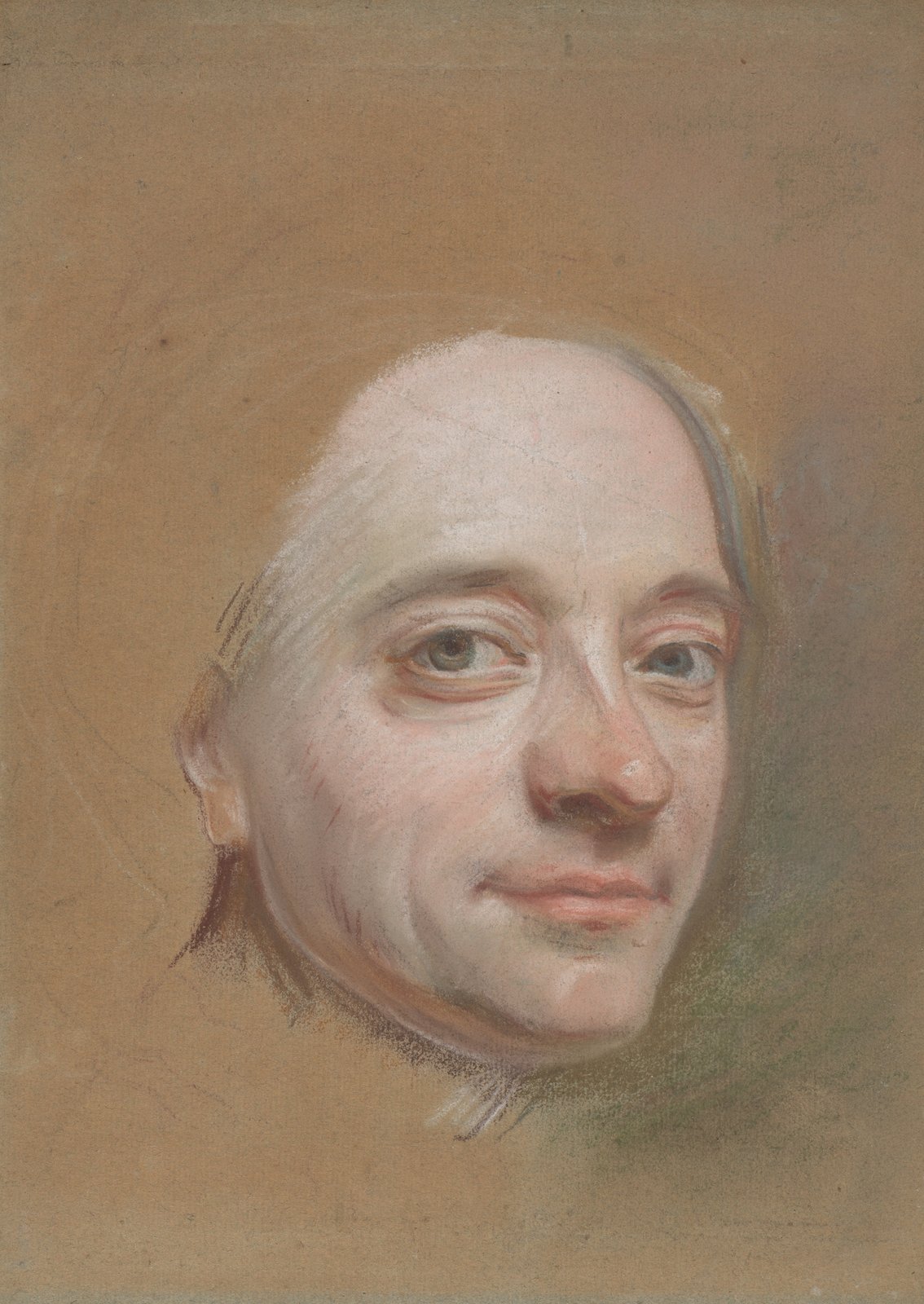
Maurice Quentin de La Tour made his career from one subject and one medium: the human face, drawn in sticks of dry colour. His finished portraits can be as grand as any oil painting of the period, but the works that teach designers most are the small head studies he called préparations. In them the face floats alone on a sheet of coloured paper, with no costume, no furniture and no background.
His sheets are lessons in focal point, in letting a ground colour do the work of a mid-tone, and in stopping before a drawing is overworked. You can browse more cleared portraits and drawings in the MGD museum inspiration collection.
Who was Maurice Quentin de La Tour?
The Metropolitan Museum of Art records him as French, born in Saint-Quentin in 1704 and dying there in 1788; Britannica gives the date of death as 17 February 1788. He moved to Paris as a young man in the 1720s. The Encyclopædia Universalis says he first learned to draw in his home town and then entered the Paris studio of a painter named Spoede, a friend of Watteau.
Pastel was newly fashionable. The Venetian pastellist Rosalba Carriera had visited Paris around 1720, and the National Gallery in London suggests that her success may have influenced La Tour’s choice of medium. He was approved (agréé) by the Académie royale in 1737, which let him exhibit at the Salon, and was received as a full member in 1746. Britannica adds that he became a councillor of the Académie in 1751 and held the post of portraitist to the king from 1750 to 1773.
According to Apollo magazine, he showed at almost every Salon for three decades after 1737. His sitters ranged from Louis XV and the royal family to Voltaire, Rousseau and d’Alembert, and to painters and musicians of his own circle. Universalis records that in 1782 he endowed charitable foundations in Saint-Quentin and founded a school of drawing there. The contents of his studio stayed in the town and became the core of the Musée Antoine Lécuyer.
His work sits inside the wider culture of Rococo art and design: light colour, intimate scale and a taste for charm over grandeur.
Key works by Maurice Quentin de La Tour
The works below are dated and attributed in museum records.
- Self-Portrait, c. 1737. Pastel on greenish-tan laid paper, 32.4 by 24.1 cm, Art Institute of Chicago.
- Portrait of Gabriel Bernard de Rieux, 1739–1741. Pastel and opaque watercolour on blue paper laid down on canvas, J. Paul Getty Museum. A monumental portrait of a Paris magistrate among books, porcelain and a globe.
- Jacques Dumont, called Le Romain, c. 1742. Black and white chalk with pastel, 30.8 by 20.8 cm, Cleveland Museum of Art. A head study of a fellow painter.
- Préparation for a Portrait of Louis XV, c. 1745. Pastel on blue paper with an arched top, 32.7 by 24 cm, Metropolitan Museum of Art.
- Jean Charles Garnier d’Isle, c. 1750. Pastel and gouache on blue paper laid down on canvas, 64.5 by 54 cm, Metropolitan Museum of Art.
- The Marquise de Pompadour, about 1752–1755, Musée du Louvre. A full-length pastel roughly 1.75 metres tall. Apollo reports that it was his only submission to the Salon of 1755.
- Portrait of Claude Charles Deschamps, 1779. Pastel on tan laid paper, 31.7 by 23.3 cm, Art Institute of Chicago. A late portrait.
What to look at in La Tour’s portraits
The face as the only subject
In the Chicago Self-Portrait the head has no neck, no collar and no frame. It sits slightly right of centre and takes up about a third of the sheet. This is a focal point in its simplest form: one area of detail surrounded by quiet.
Toned paper as the mid-tone
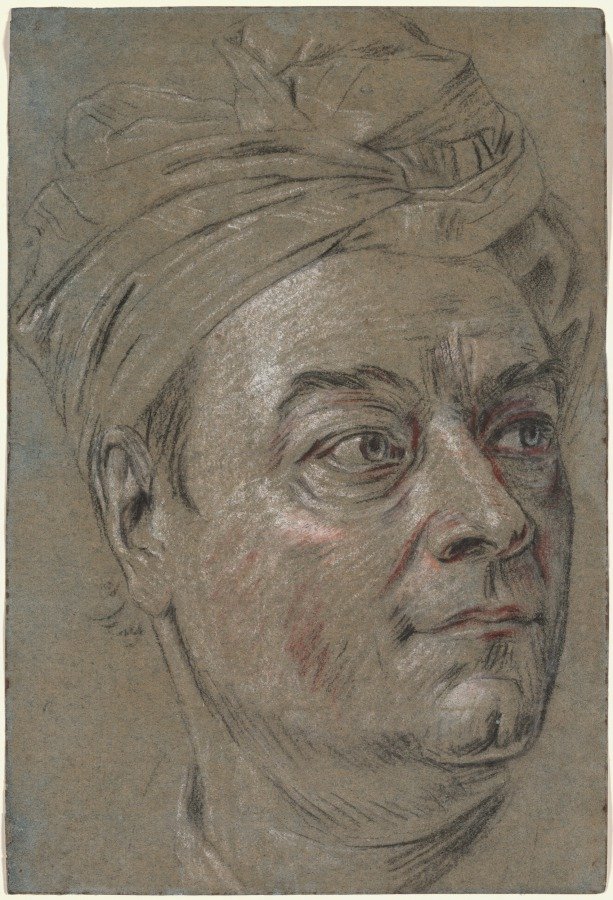
La Tour drew on blue, blue-gray, tan and greenish papers, as the museum records above show. The paper is the middle value of the drawing, and it shows through as shadow, background and half-tone. In the Cleveland study of Dumont le Romain most of the sheet is untouched; black chalk sets the structure, white chalk picks out the forehead, nose and cap, and a few touches of red warm the cheek and lips. Three colours carry the whole head.
The smile and the turned eye
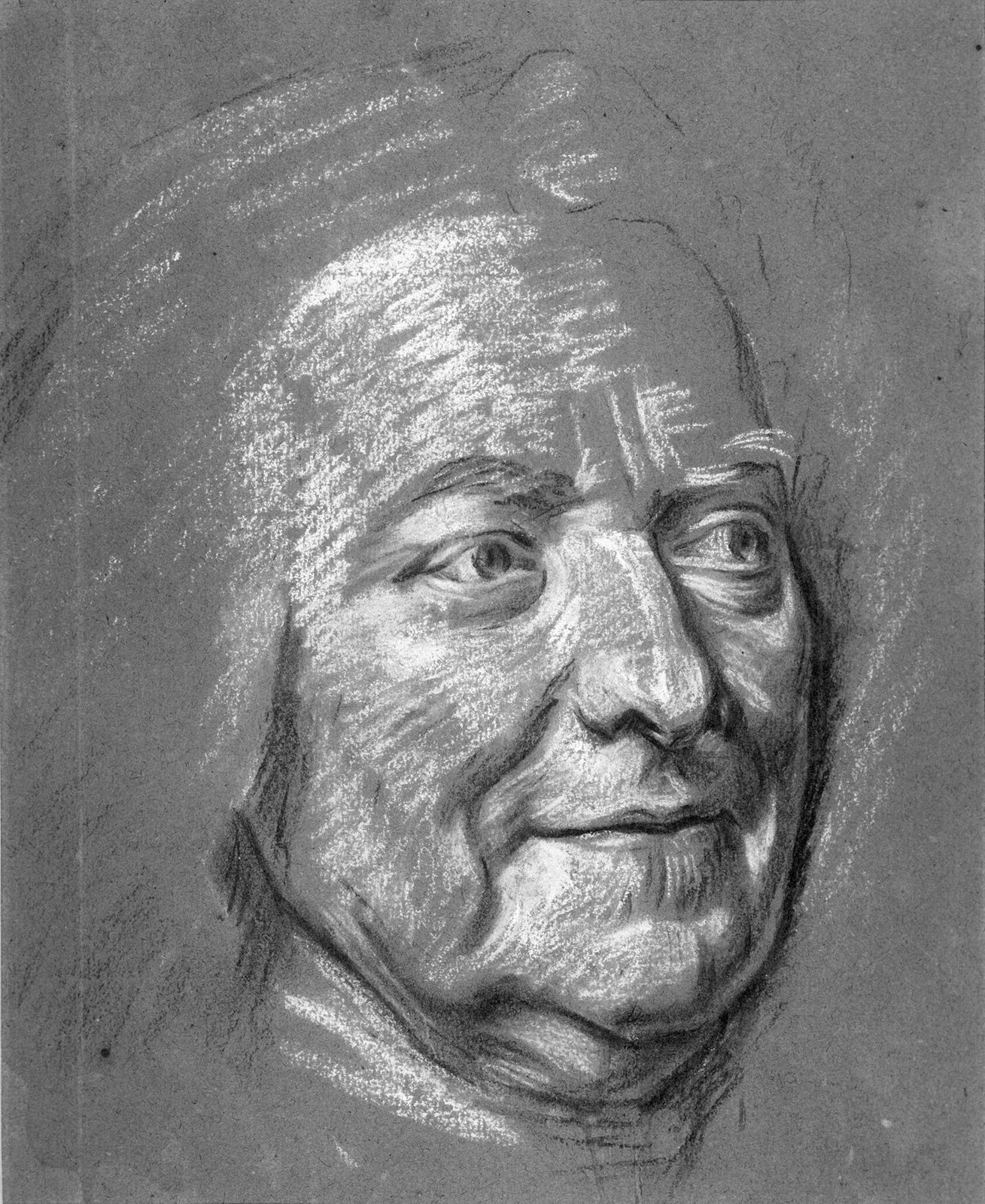
Apollo notes that many of La Tour’s sitters smile, which was unusual in portraiture, and that he talked with them as he worked. In the Chicago study of Louis de Silvestre the head is turned three-quarters and the eyes glance sideways, as if the sitter were caught in the middle of a conversation.
Stroke direction
In the Silvestre study the white chalk on the forehead and cap runs in parallel diagonal hatches that follow the turn of the form. The marks stay visible, so the drawing reads as both a face and a record of the hand that made it.
Finished portraits: status in the details
The large exhibition portraits work differently: in the Getty’s de Rieux the furniture, library and globe tell the viewer who the sitter is. Universalis remarks that the studies kept in Saint-Quentin are often livelier than the heavily reworked finished portraits.
Technique: how the pastels were made
Apollo describes pastel as pigment, a filler such as chalk or clay, and a binder such as gum arabic, formed into sticks. Because the sticks cannot be mixed like wet paint, a pastellist needs many tints of each colour.
La Tour’s method, as Universalis describes it, started with a study of the head, which he then worked up into the finished portrait. Museum records show the supports: laid paper in blue or tan for the studies, and blue paper laid down on canvas for larger works. The Met’s Garnier d’Isle and the Getty’s de Rieux list gouache or opaque watercolour alongside the pastel.
Sheet size was a limit, so big portraits were built from several sheets joined together. For the Louvre’s Pompadour, Apollo counts seven sheets, while the Louvre’s own description gives at least eight, including a separate sheet for the face. Apollo adds that finished pastels were put under glass.
For a parallel approach to the same medium, see our guide to Jean-Étienne Liotard, the Swiss pastellist who was La Tour’s contemporary.
Colour: palettes measured from the scans
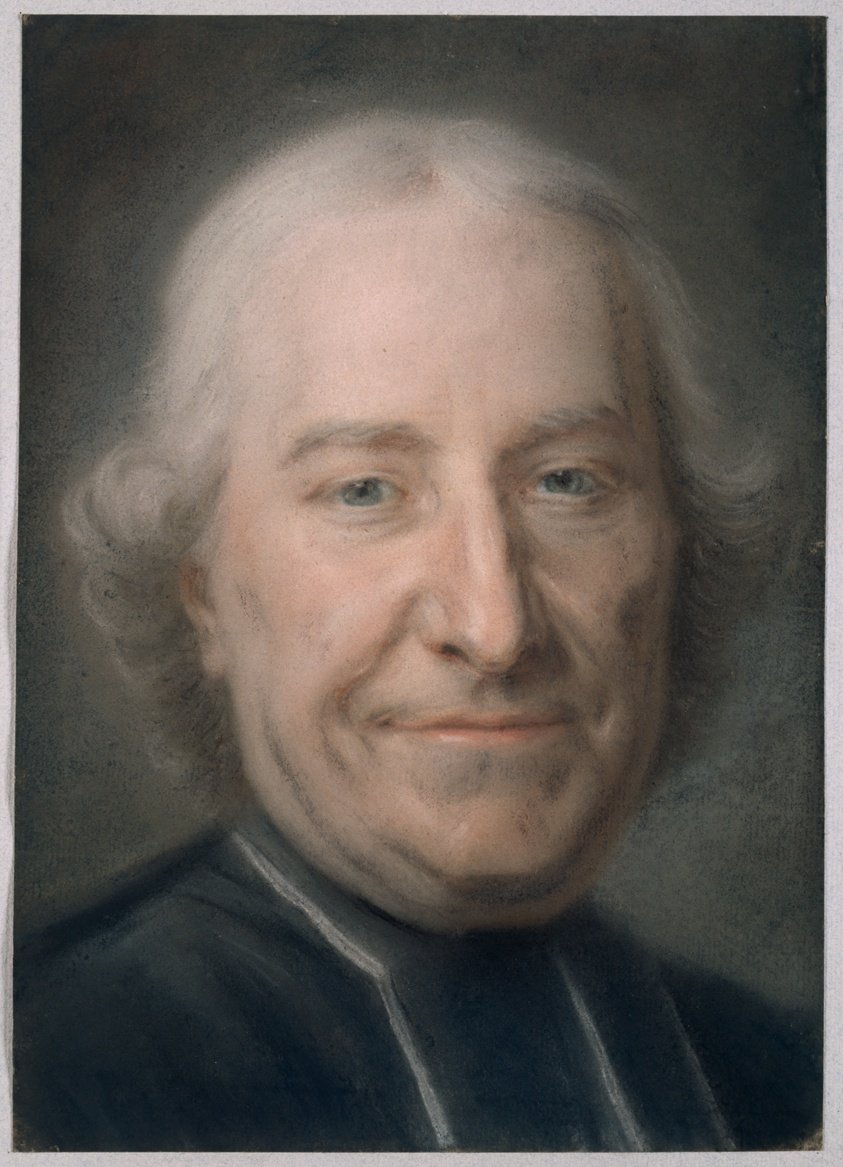
These values were measured from the museums’ scans of the works shown here. They describe the digital images, not the original pigments.
- Self-Portrait (Art Institute of Chicago scan): warm tan paper at #93785D and #9C7E5F, a deeper brown at #806C58 and pale flesh at #BCA697.
- Portrait of Claude Charles Deschamps (Art Institute of Chicago scan): near-black blue at #1E2529, dark olive grey at #3C3D38, flesh at #AC9385 and a pale pink-grey at #CAB7B1. A dark ground makes the face the only light area.
- Jacques Dumont, called Le Romain (Cleveland Museum of Art scan): grey-brown paper at #7A7160 and #665E51 with chalk highlights near #AAA192.
To pull your own values from a portrait scan, use our image colour picker.
How designers can borrow from Maurice Quentin de La Tour today
- Start on a mid-tone. Set a tan, grey or blue-grey background and add only darks and lights. White becomes an accent instead of a default.
- Give the face the detail budget. In portrait-led layouts, keep the sharpest edges and strongest contrast around the eyes. Let clothing and background fall away into flat tone.
- Vignette without a frame. Try author portraits that dissolve into the page colour instead of sitting in boxes.
- Limit the palette. Black, white and one warm accent on a toned ground are enough for the Cleveland study. Test a three-colour scheme in our colour palette generator.
- Keep the hatching. Visible, directional strokes make an image feel made by hand.
- Use props as captions. Add two or three objects that carry meaning, and keep them less sharp than the face.
Where to see his work
The Musée Antoine Lécuyer in Saint-Quentin holds the studio collection, including many préparations. The Louvre holds the Pompadour portrait and the J. Paul Getty Museum holds Gabriel Bernard de Rieux. The Art Institute of Chicago, the Cleveland Museum of Art and the Metropolitan Museum of Art also hold pastels and chalk studies.
Frequently asked questions
What is Maurice Quentin de La Tour known for?
He is known for pastel portraits of eighteenth-century French society, from Louis XV and the Marquise de Pompadour to Voltaire and Rousseau, and for lively head studies called préparations.
What is a préparation?
It is a study of the sitter’s head, drawn from life in chalk and pastel on toned paper, that La Tour made before working up a finished portrait. Many survive in Saint-Quentin.
Why did La Tour work in pastel instead of oil?
Pastel was fashionable in Paris after Rosalba Carriera’s visit around 1720, and the National Gallery in London suggests her success may have influenced him.
Are Maurice Quentin de La Tour’s works public domain?
He died in 1788, and the Art Institute of Chicago, the Cleveland Museum of Art and the Metropolitan Museum of Art flag their works by him as public domain or CC0 in their collection data.