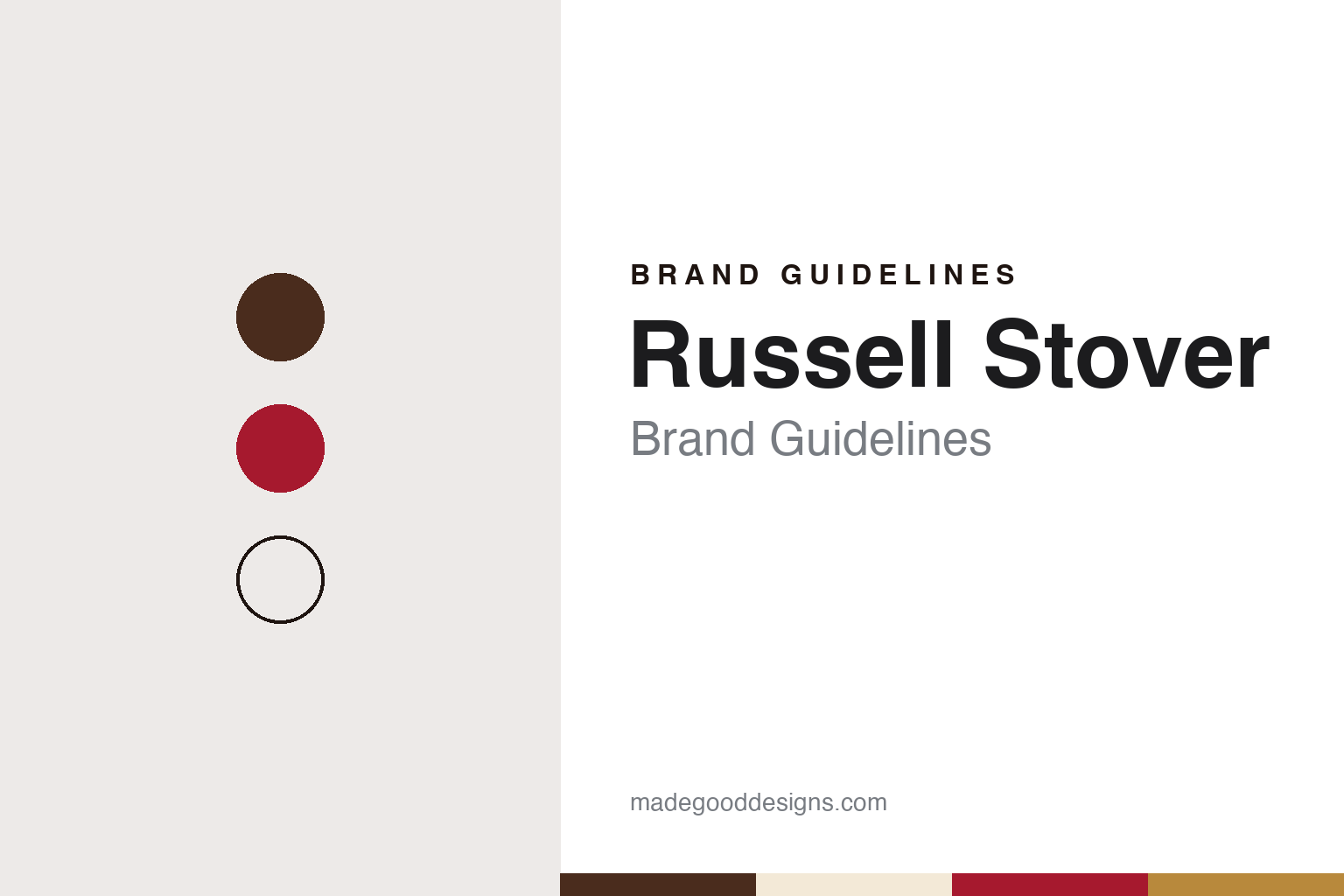
Russell Stover Brand Guidelines
The Denver bungalow candy firm that became a Kansas City boxed-chocolate giant.
Aa
Two constants: a cocoa brown, cream and ribbon red palette and a heritage serif register. Abstract homage — not a Russell Stover product or mark; no box, chocolate or logo is reproduced.
Mrs. Stover’s Bungalow Candies
A couple, a Denver home and a box of chocolates.
Russell Stover began in 1923 in Denver, Colorado, where Russell and Clara Stover started selling boxed chocolates under the name Mrs. Stover’s Bungalow Candies, The New York Times reported in 2014. Russell Stover already had one food business behind him: English Wikipedia says that in 1921 he had partnered with Christian Kent Nelson, an Iowa schoolteacher, on the chocolate-coated ice-cream bar sold as the Eskimo Pie, and that the Stovers later sold their share for $25,000 and moved to Denver.
The company gives the credit for its chocolates to Clara Stover. Its website says she “originally crafted our chocolates and founded the company,” and that Russell Stover chocolates are “still handcrafted in small batches, using original recipes created by company founder, Clara Stover, in the kitchen in her Denver bungalow home.” We give those as the company’s own claims; they are part of how the brand presents itself rather than something we could check.
The business did not stay in Denver for long. The company says it “has called Kansas City home since 1932,” and its headquarters remains in Kansas City, Missouri. English Wikipedia says the firm took the name Russell Stover Candies in 1943. In 1960 the Stover family sold the business to Louis L. Ward, who, the Times wrote, “expanded the Russell Stover brand across the United States”; English Wikipedia gives the price as $7.5 million, paid by Ward and a partner. Ward led the company until 1993, when his sons Scott and Thomas Ward took over, and after his death in 1996 the family continued to run the business, the Times reported.
Colour
Whitman’s, Pangburn’s and a famous box.
Under the Wards, Russell Stover grew by buying other American candy names. In 1993 it bought Whitman’s, the Philadelphia brand that Stephen F. Whitman started in 1842 as a small “confectionery and fruiterer” shop, from the food group Pet Inc., according to English Wikipedia; Russell Stover’s own history dates the Whitman’s Sampler assortment to 1912. In 1999 it added Pangburn’s, a pecan, caramel and honey candy the company describes as “born in Texas.” By 2014, the Times reported, Russell Stover ran four chocolate factories in the United States, employed about 2,700 people and had 35 retail outlets, with annual revenue of about $500 million according to Lindt.
The box has long been part of the brand’s public image. When Lindt agreed to buy the company, the Times noted that its gift boxes had been “made famous” by the film Forrest Gump, in which the title character eats chocolates from one while waiting at a bus stop. The company says it makes “most of our boxes here, too,” and that “all of our products are designed by local Kansas City artists” — claims we report as the company’s.
The best-documented design project is a recent one. In March 2019 Packaging World reported that Russell Stover had worked with the brand strategy firm Retail Voodoo to redesign more than 35 products in its sugar-free line under the idea “Everyone Deserves Chocolate.” The new system, the magazine wrote, “follows the overall master brand with color and typography, but with a clean, white background and a simple ribbon” to separate the range from the core line, with large product photography meant to suggest the brand’s hand-made heritage. The magazine reported that the changes reversed a three-year sales decline within 12 months, and quoted Marjolaine DeClaviere, Russell Stover’s vice-president of marketing, as saying the line now had “great impact on shelf.”
Typography
Design and documentation.
The seven brands in this group are all American: Ethel M, See’s Candies, Russell Stover, Fannie May, Lake Champlain Chocolates, French Broad Chocolates and Endangered Species Chocolate. Together they cover much of the range of American chocolate and candy, from the gift box bought for a holiday to the single bar picked up at a grocery checkout.
American boxed chocolate grew up around the shop front. Many of the country’s candy companies began as a single kitchen or store selling to local customers, and some built chains of their own shops, while others moved into drugstores, supermarkets and seasonal aisles. The assorted box, with its printed lid and its paper map of fillings, became a familiar gift, and regional makers came to be known as much for a place as for a product. More recently, small makers have added bean-to-bar chocolate, cafés and factory tours, and bar brands have used the wrapper itself to carry a story or a cause.
Each guide separates what independent sources record from what the company says about itself — who founded it, who owns it now, where its cocoa comes from and where its chocolate is made — and marks plainly what rests only on the company’s own word.
Aa
A heritage serif for a boxed-chocolate brand. (Specimen set in Libre Caslon Text, a serif STAND-IN; NOT the Russell Stover logo.)
Russell Stover
A Kansas City company inside a Swiss group.
On 14 July 2014 the Swiss chocolate maker Lindt & Sprüngli announced an agreement to buy Russell Stover from the Ward family. Its chairman, Ernst Tanner, called it the “biggest and most important strategic acquisition to date” in the group’s history, and the Times reported that the deal would make Lindt the third-largest chocolate manufacturer in North America, alongside the Ghirardelli business it already owned in San Francisco. Terms were not disclosed at the time; in March 2015 The Kansas City Star reported that Lindt had paid $1.6 billion. Russell Stover kept its Kansas City headquarters and now runs as a subsidiary of the Lindt group, with Whitman’s and Pangburn’s among its brands.
Its manufacturing has since narrowed. In January 2020 the Kansas City Business Journal reported plans to expand the factories at Iola and Abilene, Kansas, and Corsicana, Texas, and to close the plant at Montrose, Colorado; The Denver Post reported in June 2020 that the Montrose closure had been brought forward, and the Montrose Daily Press later put the jobs lost there at about 300. The company now says: “We have 3 factories: 2 located in Kansas and 1 in Texas,” and that its chocolates are “Made in America with globally sourced ingredients,” naming cream and milk from Oklahoma, pecans from Texas and Georgia and almonds from California. It also lists 13 retail locations. We give the sourcing details as the company’s claims.
For a design guide, Russell Stover shows how a mass-market chocolate brand can lean on a founder’s story, a familiar gift box and a clear family of sub-brands rather than on single origins. Compare Guittard, a family-owned American chocolate maker, and See’s Candies, another American boxed-chocolate house. For this guide we use cocoa brown, cream, ribbon red and gilt with a serif, an unofficial interpretation; no product or logo is reproduced.
Explore & save
Keep Russell Stover’s identity on hand — save it to a board in the Made Good inspiration library.
Russell Stover identity set
Pin the Russell Stover cocoa brown, cream and ribbon red palette and the heritage serif register to your own board.