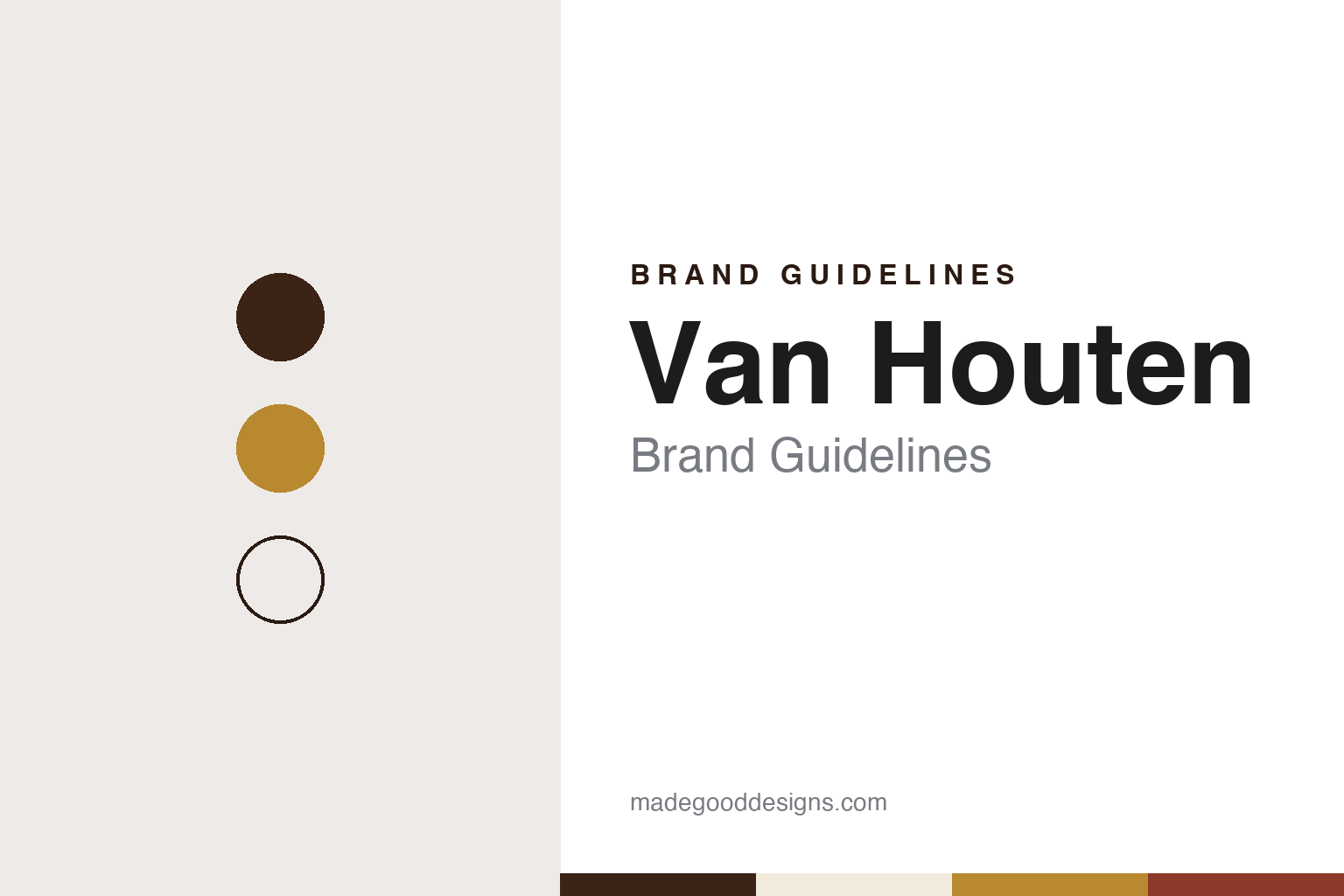
Van Houten Brand Guidelines
The Amsterdam cocoa name behind the press and “Dutching.”
Aa
Two constants: a Van Houten cocoa, gold and cream palette and a Victorian serif register. Abstract homage — not a Van Houten product or mark; no tin, logo or label is reproduced.
Leliegracht, 1815
A coffee trader, a treadmill and a patent.
Van Houten began in Amsterdam in 1815, when Casparus van Houten (1770–1858), a trader in coffee and tea, opened a small cocoa works in a building on the Leliegracht, Dutch Wikipedia says, with a mill turned by human power. At the time, cocoa beans were ground into a fine, fatty paste that was stirred into warm milk as a drink or used in baking. More than half of that paste was fat, which made the drink heavy.
In 1828 Van Houten obtained a ten-year Dutch patent on a method of pressing fat from roasted cocoa beans. The press roughly halved the cocoa butter in the paste, leaving a dry cake that could be ground into cocoa powder, and freeing pure cocoa butter that could be added back to make smoother eating chocolate. The invention is usually credited to his son Coenraad Johannes van Houten (1801–1887), but the journalist Peter van Dam, in his 2012 history of the firm, showed that the patent application stood in the father’s name, and the Dutch, German and English Wikipedia articles now follow him.
The historian William Gervase Clarence-Smith, in Cocoa and Chocolate, 1765–1914 (2003), adds a caution: cruder fat presses existed earlier, and the Van Houten press was used on any scale only from the late 1860s. J. S. Fry & Sons acquired one in 1868, he writes, and English Wikipedia says John Cadbury travelled to Weesp to buy one in 1866.
The second step was Coenraad’s. In the 1840s he treated the powder with alkaline salts, potassium or sodium carbonate, which softened its bitterness, darkened its colour and helped it mix with water. Dutch Wikipedia, citing a 1935 trade journal, dates his patent to 1846; German Wikipedia gives 1848. The method is still called “Dutching,” and alkalised cocoa is still sold as “Dutch-process.” Coenraad ran the business from 1835 and sold it under his own name, which Dutch Wikipedia counts among the earliest branded goods in the country.
Colour
From a Leiden windmill to a factory town.
The works moved as they grew. Around 1841 or 1842 — the Wikipedia articles differ — Coenraad moved production to a windmill in Leiden, and in 1850 to a former steam laundry on the Oude Gracht in Weesp, a small town east of Amsterdam, where a steam engine drove the machinery. By then the firm was exporting to England, France and Germany.
His son Casparus Johannes van Houten (1844–1901), who joined in 1865, built the brand. German Wikipedia says cocoa was packed in tins from that time, which kept it fresher and let it travel. In 1888 the firm bought land outside the town, and a new factory complex rose there between 1890 and 1897. By 1900 it employed about 1,000 people, some 40 per cent of Weesp’s working men, according to the regional history journal Tussen Vecht en Eem in 2016. In 1899 the firm received the title “Koninklijk,” royal.
Advertising was the other half of the story. Van Houten posters ran on trams in European and American cities, and in 1899 the firm made a cinema advertisement, a short film of a sleepy clerk revived by chocolate, which a 2002 exhibition at the Weesp museum presented as among the first advertising films made in the Netherlands, Dutch Wikipedia says. The local historical society says that in 1907 Van Houten spent nearly 1.5 million guilders on advertising against a turnover of 7.3 million. An 1899 poster for its cocoa and chocolate was drawn by the Dutch artist J. G. van Caspel. From 1922 to 1936 the firm published a customer magazine, Ons Eigen Tijdschrift, illustrated by Johan Briedé, who also designed bonbon boxes for the company, Dutch Wikipedia says.
In 1961 the firm had 2,500 staff, 1,300 of them outside the Netherlands, and exported to more than 70 countries.
Typography
Cocoa powder, gianduja and chocolate a la taza.
The seven brands in this group all make or sell chocolate, and they come from three countries with distinct chocolate habits: Perugina and Baratti & Milano from Italy, Valor and Blanxart from Spain, and Droste, Verkade and Van Houten from the Netherlands. Each country is known for a different way of using cocoa, and those habits shape how the brands present themselves.
In the Netherlands the story is cocoa powder: the pressed, alkalised “Dutch” cocoa that made a drink of chocolate easy to mix, sold in tins and boxes whose graphics became part of the brand. In Italy it is gianduja, chocolate blended with hazelnut paste and associated above all with Piedmont, alongside pralines and boxed gifts. In Spain it is chocolate a la taza, a thick drinking chocolate served in cafés, often with churros, alongside bars made for melting into it. The names here range from century-old firms now owned by large groups to family companies, and some survive mainly as brands.
Each guide separates what independent sources record from what the company says about itself — who founded it, who owns it now, where its cocoa comes from and where its chocolate is made — and marks plainly what rests only on the company’s own word.
Aa
A Victorian serif — for a name that sold itself on tins and posters. (Specimen set in Libre Baskerville, a serif STAND-IN; NOT the Van Houten logo.)
Van Houten
A factory that closed, and a name that did not.
The family sold in the 1960s. In February 1963 the American group W. R. Grace bought 76 per cent of the shares from the Van Mesdag family, descendants of the founders, the newspaper Trouw reported; English Wikipedia gives 1962. In April 1968 Grace sold a 51 per cent stake to the American confectioner Peter Paul, the Algemeen Handelsblad reported. Losses followed; in December 1970 De Telegraaf reported that Van Houten would close, with the rights to make and sell its products passing to the German chocolate group Leonard Monheim, maker of Trumpf, which moved production to its own German plants. The Weesp factories closed in 1971, with 573 jobs lost.
From there the trail is a brand’s, not a factory’s, and the dates are thinner. German Wikipedia says Monheim’s owner, Peter Ludwig, sold Van Houten to Jacobs Suchard in 1986, and that it came into Barry Callebaut, the Swiss cocoa and chocolate group formed in 1996; the trade site ConfectioneryNews wrote in 2021 that the brand had been owned by Barry Callebaut “since 1998,” while English Wikipedia gives 2002, so accounts differ. Hershey’s annual report for 2009 records that in March 2009 it bought the Van Houten Singapore consumer business from Barry Callebaut, with an exclusive licence of the Van Houten name in Asia and the Middle East for retail and duty-free sales. In 2011 Barry Callebaut sold its European consumer business to the Belgian Baronie group, and Dutch and German Wikipedia say the Van Houten consumer brand went with it; Baronie’s own brands page, checked in October 2026, does not list it.
Today the name is most visible as a Barry Callebaut drinks brand for vending machines, cafés and baristas: the old vanhoutendrinks.com address now leads to Barry Callebaut’s Van Houten pages. In 2021 the brand launched what it called the first ruby chocolate drink powder, aimed at coffee bars, and said all Van Houten products were made with sustainably sourced cocoa through Barry Callebaut’s Cocoa Horizons programme, ConfectioneryNews reported; we give that as the company’s claim. We could not establish where Van Houten powders are made today.
For a design guide, Van Houten shows how a name built on a process and on heavy advertising can outlive its factory by half a century. Compare Droste, another Dutch cocoa name sold on its tins, and Tony’s Chocolonely, a far younger Dutch brand. For this guide we use dark cocoa, tin gold, brick and cream with a serif, an unofficial interpretation; no product or logo is reproduced.
Explore & save
Keep Van Houten’s identity on hand — save it to a board in the Made Good inspiration library.
Van Houten identity set
Pin the Van Houten cocoa, gold and cream palette and the Victorian serif register to your own board.