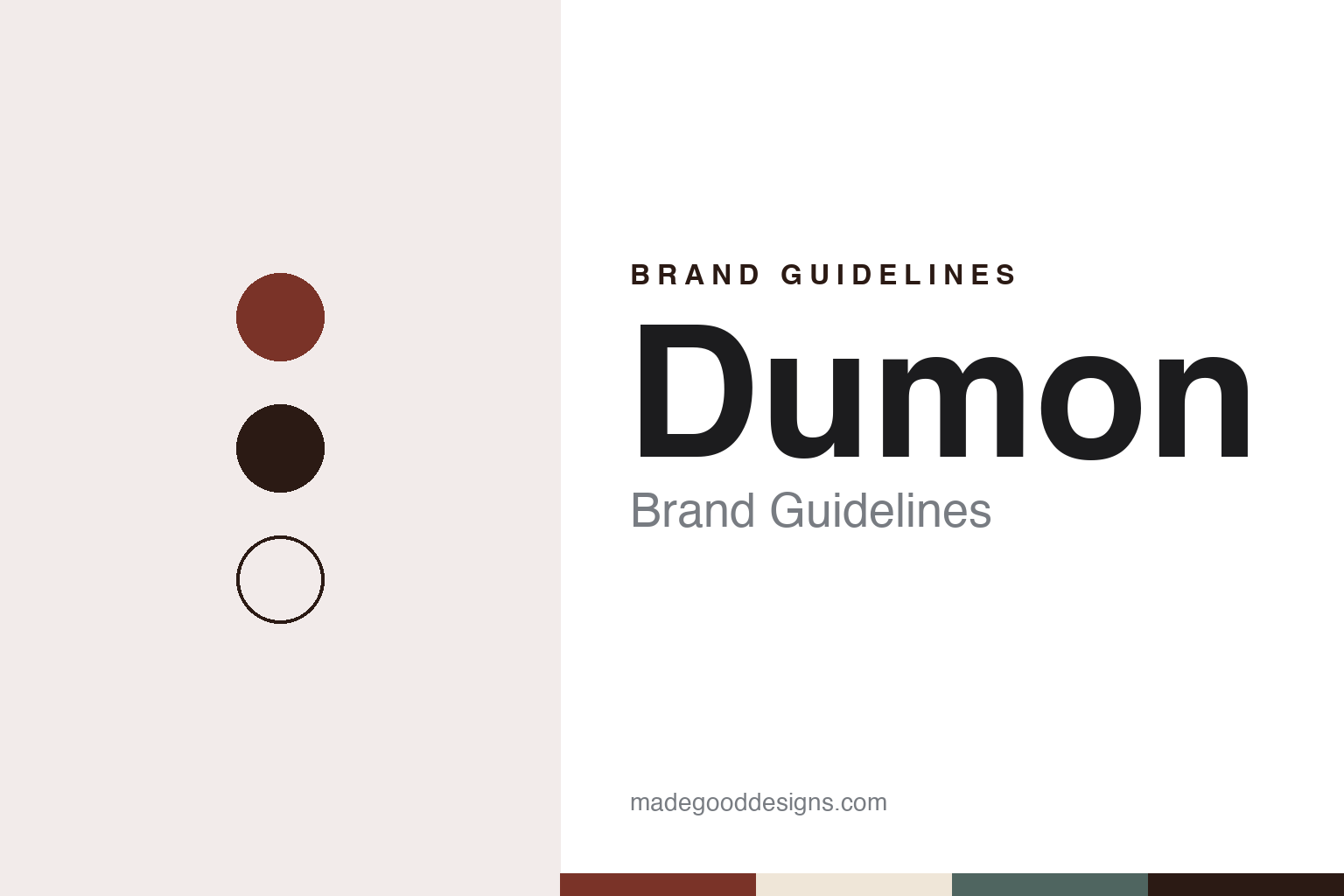
Dumon Brand Guidelines
A Torhout workshop and three shops in medieval Bruges.
Aa
Two constants: a Dumon Bruges brick, canal green and cream palette and a contemporary sans register. Abstract homage — not a Dumon product or mark; no chocolate, box, logo or packaging is reproduced.
A garage in Torhout
Stephan Dumon makes truffles for the bakers next door.
Chocolatier Dumon is usually found in Bruges, but it began in Torhout, a town about 20 kilometres to the south-west. The company says its story “starts back in 1992,” when Stephan Dumon, a chef-chocolatier trained at Bruges’s Ter Groene Poorte school, began making artisan truffles on a small scale for bakeries and pastry chefs near Torhout.
Neighbours soon asked to buy from him directly, the company says, so a small, part-time shop was set up in the garage. That account, which runs on the company’s website from at least 2016 to 2026, is the only detailed history of the business we found, and we give its dates as the company’s own; we found no Wikipedia article and no independent dated profile in the sources we could reach.
The move into Bruges was a family affair. In 1996, the company says, Stephan Dumon’s mother opened her own shop on the Eiermarkt, a small square in the centre of the city, and it became “a landmark for tourists from all over the world visiting Bruges.” In 1999 his brother opened a second shop, in the Walstraat, near the De Halve Maan brewery and the Beguinage. The company names neither of them; its 2016 website said the Eiermarkt shop was by then run by Stephan’s sister, Nathalie Dumon.
Colour
Illy coffee, Kortrijk and new owners.
The business grew with its workshop. In 2004, the company says, it enlarged the Torhout workshop and renewed the shop there. In 2008 it opened a third Bruges shop, on Simon Stevinplein, a square named after the 16th-century Bruges mathematician whose statue stands there. The company describes the shop as a “whole new concept” that paired its chocolates with the Italian coffee brand Illy and introduced a new range of pralines “with a modern twist in a contemporary shape.”
The production side changed hands in 2010. In the company’s words, “Since 2010, new ownership of production by mr Jelle Descamps guarantees the preservation of the taste of our fine fresh chocolates in Bruges and abroad.” The website does not say what became of the Dumon family’s stake, or how the shops and the workshop are divided, and we did not find a registry summary that would tell us; we report only the company’s statement. The same year a shop opened in Kortrijk, to the south.
The company has looked abroad too. Its website, as archived in 2013, listed Dumon in Hong Kong and Spain as well as in Bruges, Kortrijk and Torhout; in 2016 it listed a Hong Kong sales office and partners in Brno in the Czech Republic, at Wetherby in West Yorkshire and in Kassel in Germany. By 2025 the Hong Kong and Kassel entries had gone, and a stockist at Heestert, near Kortrijk, had been added. In 2013 the website’s title offered “Belgium’s finest artisan chocolates” — in its own words — “in Bruges and other chocolate capitals.”
Dumon says it has twice been recognised by the restaurant guide Gault&Millau, which it says included it in 2013 and 2016 in its shortlist of top chocolatiers and pastry chefs in Belgium and Luxembourg; we have not seen the lists.
Typography
Chocolate houses and their groups.
The seven brands in this group all make chocolate, and they come from three countries: Mary, Dumon and Chocolat Jacques from Belgium, Manner, Mirabell and Hofbauer from Austria, and Sarotti from Germany. Chocolate brands reach shoppers in different ways, from a chocolatier’s own shop counter to a bar or a box on a supermarket shelf.
An old chocolate brand can carry two histories at once. One is the story of a founder, a workshop and a city, which a brand may keep telling on its packs and its website long after the founding family has gone. The other is the story of ownership: who bought the business, who bought it after that, and which group’s factory the chocolate comes from now. The two need not line up: a name tied to one town can be made somewhere else, or by a company based in another country.
Each guide separates what independent sources record from what the company says about itself — who founded it, who owns it now, where its cocoa comes from and where its chocolate is made — and marks plainly what rests only on the company’s own word.
Aa
A contemporary sans — fresh pralines in a medieval town. (Specimen set in Inter Tight, a sans STAND-IN; NOT the Dumon logo.)
Dumon
A workshop built in six months.
Dumon makes its chocolates itself. Its website said in 2013 that “all of our chocolates are in-house made in our workshop,” and in October 2014, the company says, production moved to a new workshop and shop in Torhout, built in less than six months. It describes the building as designed to cut its energy use, with insulation, heat pumps, geothermal heating, solar panels, rainwater recovery and LED lighting; we give that as the company’s description. The website does not say where its chocolate couverture comes from. Since at least 2013 it has offered a “virtual tour”: 360-degree photographs of the shop and workshop, published on Google Maps.
Its range, as the website has presented it, is organised in a few lines: the Classics; the Selection, which it calls “a contemporary chocolate line with experimental blends”; Choc-o-bars; and seasonal chocolates and figurines, with an ice-cream line added by 2020. Its chocolates are sold as fresh: the company advises keeping them cool and dry, between 16 and 18°C, and suggests a wine fridge rather than a refrigerator — though “unlike the wine,” it adds, “our chocolates won’t age well.” For customers abroad it ships its classic range in assorted boxes of 15 to 60 pieces, and in Belgium it runs a webshop for collection in Torhout or Bruges.
The name needs care online. dumon.be is the website of Restaurant Dumon, a restaurant at Wakkerzeel, near Haacht in Flemish Brabant, with no connection to the chocolatier, whose own address is chocolatierdumon.be.
For a design guide, Dumon shows a family business that took its name from a small town into a tourist city, shop by shop. Compare Mary, the Brussels house that also has a shop in Bruges, and Wittamer, another Belgian house built around its own shops. For this guide we use a Bruges brick red, a canal green and cream with a sans, an unofficial interpretation; no product or logo is reproduced.
Explore & save
Keep Dumon’s identity on hand — save it to a board in the Made Good inspiration library.
Dumon identity set
Pin the Dumon Bruges brick, canal green and cream palette and the contemporary sans register to your own board.