Altoids Brand Guidelines
The “curiously strong” London mint in a metal tin.
Aa
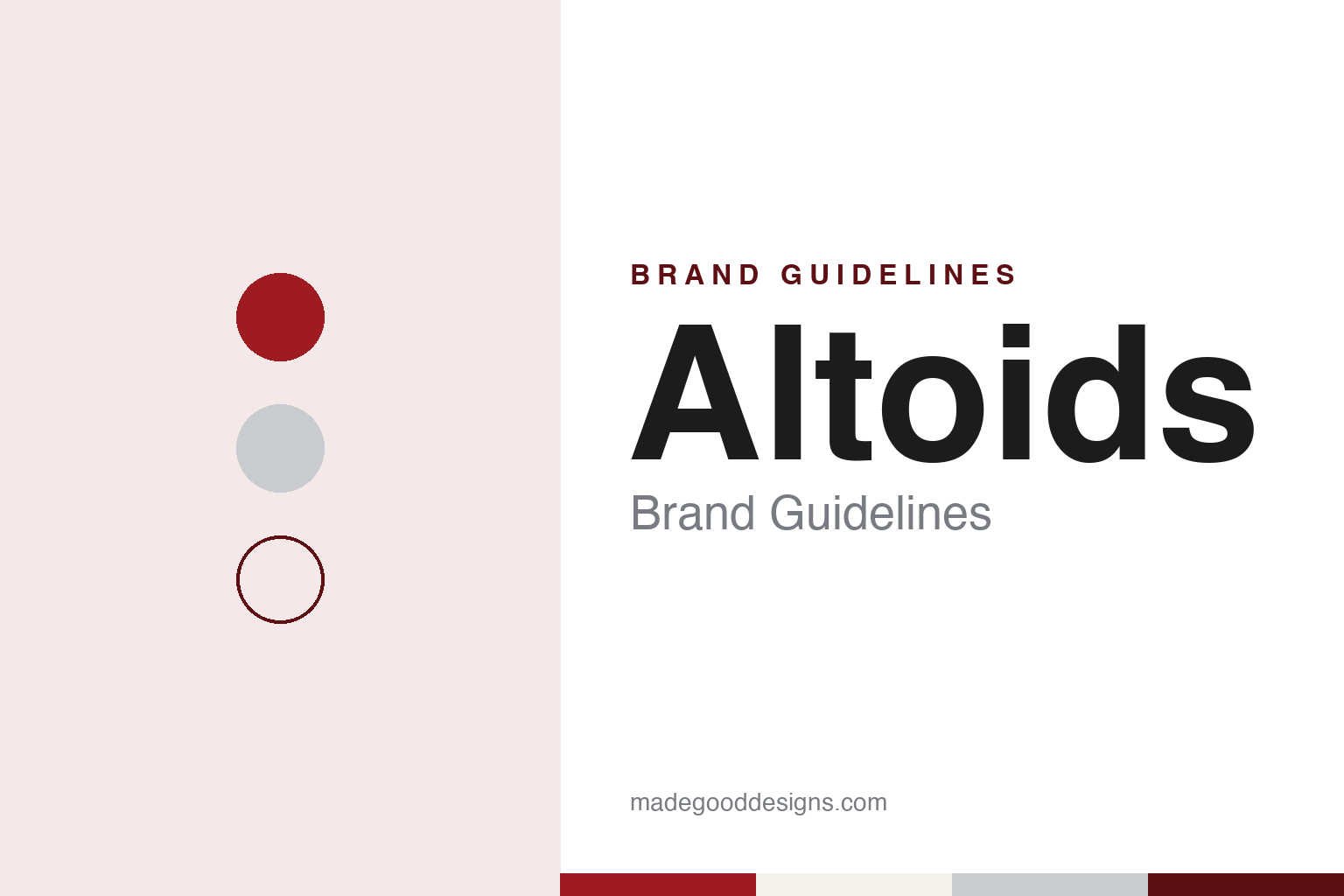
Two constants: an Altoids red, silver and paper white palette and a Victorian display serif register. Abstract homage — not an Altoids product or mark; no tin, logo or mint is reproduced.
Smith & Co.
A Georgian peppermint lozenge and a family of “-oids.”
Altoids says it was born in 1780, and that its inventor was Smith Kendon of Smith & Co., a London firm. English Wikipedia describes the brand as created by the London-based Smith & Company in the 1780s. The International Directory of Company Histories, citing company sources, gives the date of the recipe as 1783, so the two dates are worth noting. Its key ingredient was peppermint oil, used in an unusually high concentration, and the brand’s own history says the lozenge was first intended to relieve intestinal discomfort rather than to freshen breath.
Smith & Co. traded on medical-sounding names. The International Directory says the firm also sold Zenoids, Cyphoids and Notoids alongside Altoids, and that the Altoids name was supposedly coined by joining the Latin alt to the Greek oids. It adds that as late as the 1920s the brand’s advertising still made claims about the stomach, and that the phrase “curiously strong” gained currency in its marketing at around that time. Today the brand uses it in the line “The Original Celebrated Curiously Strong Mints,” English Wikipedia says.
In the nineteenth century the brand became part of Callard & Bowser. The International Directory says that company was formed in England in 1837 by Daniel Callard and his brother-in-law, J. Bowser, and that it took in Smith & Company through a merger. Callard & Bowser was better known for its toffees and butterscotch; it later bought William Nuttall of Doncaster, and for a time Altoids was sold under the Nuttall name.
Colour
From a cardboard carton to a hinged tin.
For most of its life Altoids came in a card box. The brand’s website said in 2011 that for over a hundred years the mints were packed in small rectangular cardboard cartons of about the same size as today’s tins, and that the tins were introduced in the 1920s to protect the mints and to stay neatly closed in pockets and handbags. The company says Americans were introduced to Altoids in 1918; the International Directory says the mints were first sold in the United States in the Seattle market during the 1920s, the same decade the tin arrived.
Altoids stayed obscure on both sides of the Atlantic until the late 1980s, when, the International Directory says, it built a word-of-mouth following in Seattle. In 1991 its owner relaunched it in Britain as Nuttall’s Altoids, with the tagline “A Little Tin Of Intriguingly Different Strongmints,” the trade magazine Marketing reported. The tin was designed to resemble a snuff box, and the paper inside carried the embossed words “established 1780 in the reign of George III.”
The campaign that made the brand came from Chicago. In 1994, the International Directory says, the brand manager Mark Sugden persuaded the new parent company to hire Leo Burnett, whose campaign ran from 1995. With a budget of about $1 million and no television, the agency used posters in bus shelters and subways and ads in alternative weekly papers, with a quirky, deadpan humour; lines included “Not recommended for the faint of tongue” and “Mints so strong, they come in a metal box.” Business Week wrote about it in 1997 under the headline “A Curiously Strong Campaign.” By the summer of 1998, the Wall Street Journal reported, Altoids was America’s third-largest breath-mint brand.
The tin also took on a life of its own. English Wikipedia lists its reuse as a container for small household items, survival and first-aid kits and electronics projects; the BeagleBone single-board computer was shaped with rounded corners to fit inside one. In 2023 The Guardian published a gallery of the painter Remington Robinson’s miniature landscapes painted inside the lids. In 2007 the brand launched the Altoids Award for emerging artists with the New Museum in New York; the first winners were chosen by Paul McCarthy, Cindy Sherman and Rirkrit Tiravanija, e-flux reported.
Typography
Design and documentation.
The seven brands in this group all make mints, pastilles, throat sweets or chews, and they come from the Netherlands, Italy, Britain and Switzerland: Mentos, Tic Tac, Altoids, Polo, Fisherman’s Friend, Ricola and Fruittella. Sugar confectionery brands in general sit at many different points in the trade, from family firms that still carry a founder’s surname to names that now belong to much larger confectionery groups, and a single brand can be sold everywhere from a station kiosk to a supermarket checkout.
A sweet brand’s identity is usually carried less by a single sweet than by a pack, a name and the moment it promises, because the company behind the name may have changed hands, moved its factory or grown far beyond the town where it started. That makes the questions behind each name worth asking plainly: who started it, who owns it now, and where its sweets are actually made and packed.
Each guide separates what independent sources record from what the company says about itself — its founding story, its owners over time, where its sweets are made and how its packaging has changed — and marks plainly what rests only on the company’s own word.
Aa
A high-contrast display serif for a brand that leans on its Georgian date. (Specimen set in Playfair Display, a serif STAND-IN; NOT the Altoids logo.)
Altoids
From Guinness and Kraft to Wrigley and Mars.
Callard & Bowser changed hands many times. It was bought by the brewer Arthur Guinness Son & Co. in the early 1950s — in 1951 according to English Wikipedia, 1953 according to the International Directory. In 1982 Guinness sold it to the American group Beatrice Foods, and in 1988 it returned to British ownership when United Biscuits bought it for £21.5 million in cash, UPI reported. United Biscuits grouped it with Terry’s of York as the Terry’s Group, which ran the 1991 relaunch.
In 1993 Callard & Bowser was sold to Kraft Foods and folded into its Suchard business, the International Directory says. Kraft raised the Altoids advertising budget as sales grew, and the brand added wintergreen and cinnamon mints, sour sweets in round tins, chewing gum and breath strips. In November 2004 Kraft agreed to sell Altoids and Life Savers to the Wm. Wrigley Jr. Company; English Wikipedia gives the price as $1.48 billion, and the International Directory says the deal closed in June 2005. Mars acquired Wrigley in 2008, and Altoids is now a Mars Wrigley brand; the Callard & Bowser name was largely dropped.
Production moved with the owners. In the early 2000s the mints were made at Callard & Bowser’s plant in Bridgend, Wales, the International Directory says. English Wikipedia, citing Prepared Foods in 2005 and the Chattanooga Times Free Press in 2012, says production has since moved to the Mars Wrigley plant in Chattanooga, Tennessee, closer to the American market where most of the mints are sold. Under Wrigley the range kept changing: the sours and the gum were discontinued around 2010, English Wikipedia says, and in 2014 Wrigley’s Eclipse mints were renamed Altoids Arctic. As of June 2022, English Wikipedia says, the mints came in peppermint, wintergreen, spearmint, cinnamon and strawberry, alongside the small square sugar-free Smalls.
For a design guide, Altoids shows how an old pack, a Georgian date and a dry tone of voice can turn a commodity mint into a cult object, largely through the tin and posters rather than television. Compare Terry’s, its stablemate in the Terry’s Group, and Skittles, another Mars Wrigley sweet. For this guide we use a deep lozenge red, a tin silver and a paper white with a serif, an unofficial interpretation; no product or logo is reproduced.
Explore & save
Keep Altoids’s identity on hand — save it to a board in the Made Good inspiration library.
Altoids identity set
Pin the Altoids red, silver and paper white palette and the Victorian display serif register to your own board.