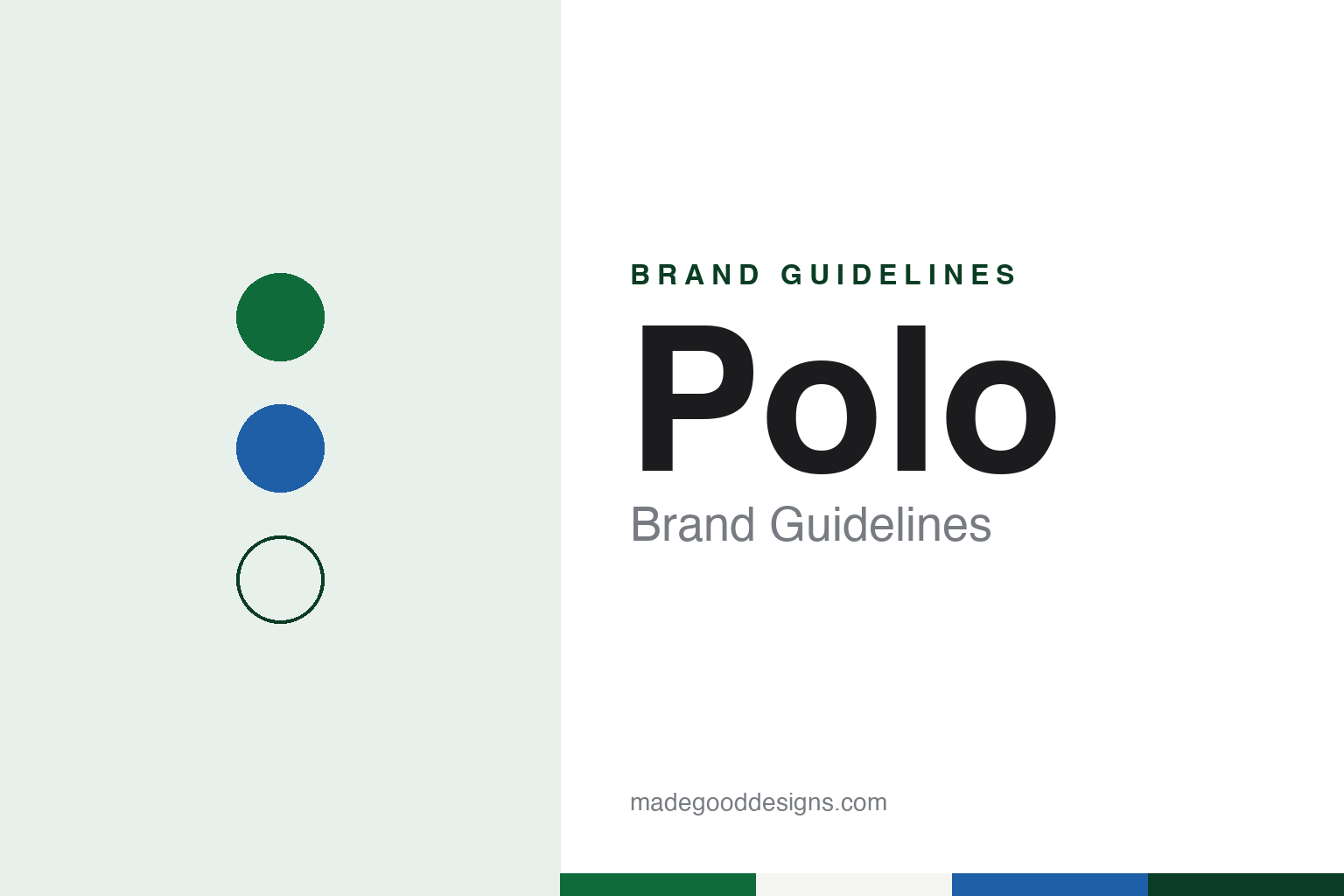
Polo Brand Guidelines
Rowntree’s “mint with the hole”, made in York since 1948.
Aa
Two constants: a Polo green, blue and mint white palette and a heavy grotesque sans register. Abstract homage — not a Polo product or mark; no pack, logo or mint is reproduced.
George Harris
A pre-war idea, shelved by sugar rationing.
Polo was made by Rowntree’s of York. Nestlé UK, which now owns the brand, says it was conceived by George Harris, the Rowntree’s executive behind many of the firm’s biggest launches of the 1930s, among them KitKat, Smarties and Aero. The idea dates to the late 1930s, Nestlé says: before the war Harris had been inspired by the American mint Life Savers, a ring designed to look like a lifebelt, and decided to make something similar in Britain. The Second World War and sugar rationing put the project on hold.
In 1948, Nestlé says, Harris revived it, and the first Polos were made that year at the Rowntree’s factory in York. The Independent told the story differently in 2004: during the war, it said, Rowntree made Life Savers under licence for American troops stationed in Britain, and when the licence was withdrawn the company came up with its own holed mint — in 1947, by its account. Nestlé and The Guardian both give 1948 as the launch year.
The name is explained by a story rather than a document. Nestlé says that, according to company legend, Harris chose “Polo” because it derived from “polar,” which he thought suggested the cool freshness of mint. The sweet itself is a pressed peppermint ring, about 19 mm across with an 8 mm hole, according to English Wikipedia, with the word POLO embossed twice on one face.
Colour
The hole, the pack and the ads.
The hole is the brand. Nestlé calls Polo “the mint with the hole”, and it stresses that there is no leftover middle: each Polo is pressed with the hole already in it. The pressing force, Nestlé said in 2018, is 75 kilonewtons, which it compared to two elephants jumping on the mint, and the York plant can make up to 22,000 sweets a minute.
The pack has stayed close to its roots. English Wikipedia describes the standard tube as a roll of about 23 mints in foil-backed paper, bound by a green and blue paper wrapper carrying the word POLO, with the two Os drawn as images of the mint itself. It says spearmint comes in a turquoise wrapper and that the Extra Strong version came in black.
Advertising made the shape famous. Nestlé says many people remember the brand’s television and print ads of the 1980s and 1990s, including ones known as the “Mint with a Halo” and “Conveyor Belt,” often voiced by the actor Peter Sallis. English Wikipedia says a 1995 campaign by Aardman Animations showed animated Polos on a factory production line. On 1 April 1995, Nestlé says, the brand announced that, under a fictitious European regulation, it would no longer make mints with holes. In 1998 the brand put its name to a PolyGram compilation album, Cool Grooves, which English Wikipedia says reached No. 12 in the UK compilation chart that September.
The shape also went to court. After the Trade Marks Act 1994, English Wikipedia says, Nestlé applied to register the shape of the mint on its own — a white ring without lettering — and the application was opposed by Kraft, the owner of Life Savers, and by Mars. In July 2004 the Court of Appeal dismissed Nestlé’s appeal against an earlier High Court ruling that would have limited the mark to a white mint of standard size, The Guardian reported. Lord Justice Mummery’s ruling was short: “This is an appeal with a hole in the middle. It is dismissed.”
Typography
Design and documentation.
The seven brands in this group all make mints, pastilles, throat sweets or chews, and they come from the Netherlands, Italy, Britain and Switzerland: Mentos, Tic Tac, Altoids, Polo, Fisherman’s Friend, Ricola and Fruittella. Sugar confectionery brands in general sit at many different points in the trade, from family firms that still carry a founder’s surname to names that now belong to much larger confectionery groups, and a single brand can be sold everywhere from a station kiosk to a supermarket checkout.
A sweet brand’s identity is usually carried less by a single sweet than by a pack, a name and the moment it promises, because the company behind the name may have changed hands, moved its factory or grown far beyond the town where it started. That makes the questions behind each name worth asking plainly: who started it, who owns it now, and where its sweets are actually made and packed.
Each guide separates what independent sources record from what the company says about itself — its founding story, its owners over time, where its sweets are made and how its packaging has changed — and marks plainly what rests only on the company’s own word.
Aa
A heavy grotesque sans for a brand built on one short word and a shape. (Specimen set in Archivo Black, a sans STAND-IN; NOT the Polo logo.)
Polo
From Rowntree to Nestlé, still in York.
Polo stayed with Rowntree when the company merged with John Mackintosh & Co. of Halifax in 1969 to form Rowntree Mackintosh. In 1988, after Jacobs Suchard of Switzerland had bought a stake in a dawn raid, Nestlé won control of the company with an offer valuing it at £2.55 billion, and in 1991 Rowntree’s became part of Nestlé UK; our Rowntree’s guide tells that story in full.
The mint has not moved. Nestlé said in 2018 that Polo is made at its York site, which had been its home for seventy years, alongside KitKat, Aero, Milkybar and Yorkie. In February 2026, launching two new sugar-free mints, a Sugar-Free Extra Strong and a Berry Mint flavour, Nestlé UK said both would be made in York, “the home of POLO for more than 70 years.” The Guardian reported in 2004 that 38 million Polos were produced every day, one in five of them spearmint; in 2018 Nestlé gave the York plant’s capacity as more than 32 million sweets a day.
The range has widened and narrowed. English Wikipedia says Rowntree and Nestlé have sold spearmint, fruit, sugar-free and other versions, some of them short-lived, and that Polo is sold in Europe, the Middle East and Africa and in South and Southeast Asia. Nestlé marked the brand’s seventieth anniversary in 2018 by opening Instagram and Facebook accounts.
For a design guide, Polo shows how a product shape can do the work of a logo, carried by a plain wrapper, a single line of copy and decades of advertising. Compare Rowntree’s, the York firm that created it, and Altoids, another British-born peppermint. For this guide we use a deep green, a wrapper blue and a mint white with a sans, an unofficial interpretation; no product or logo is reproduced.
Explore & save
Keep Polo’s identity on hand — save it to a board in the Made Good inspiration library.
Polo identity set
Pin the Polo green, blue and mint white palette and the heavy grotesque sans register to your own board.