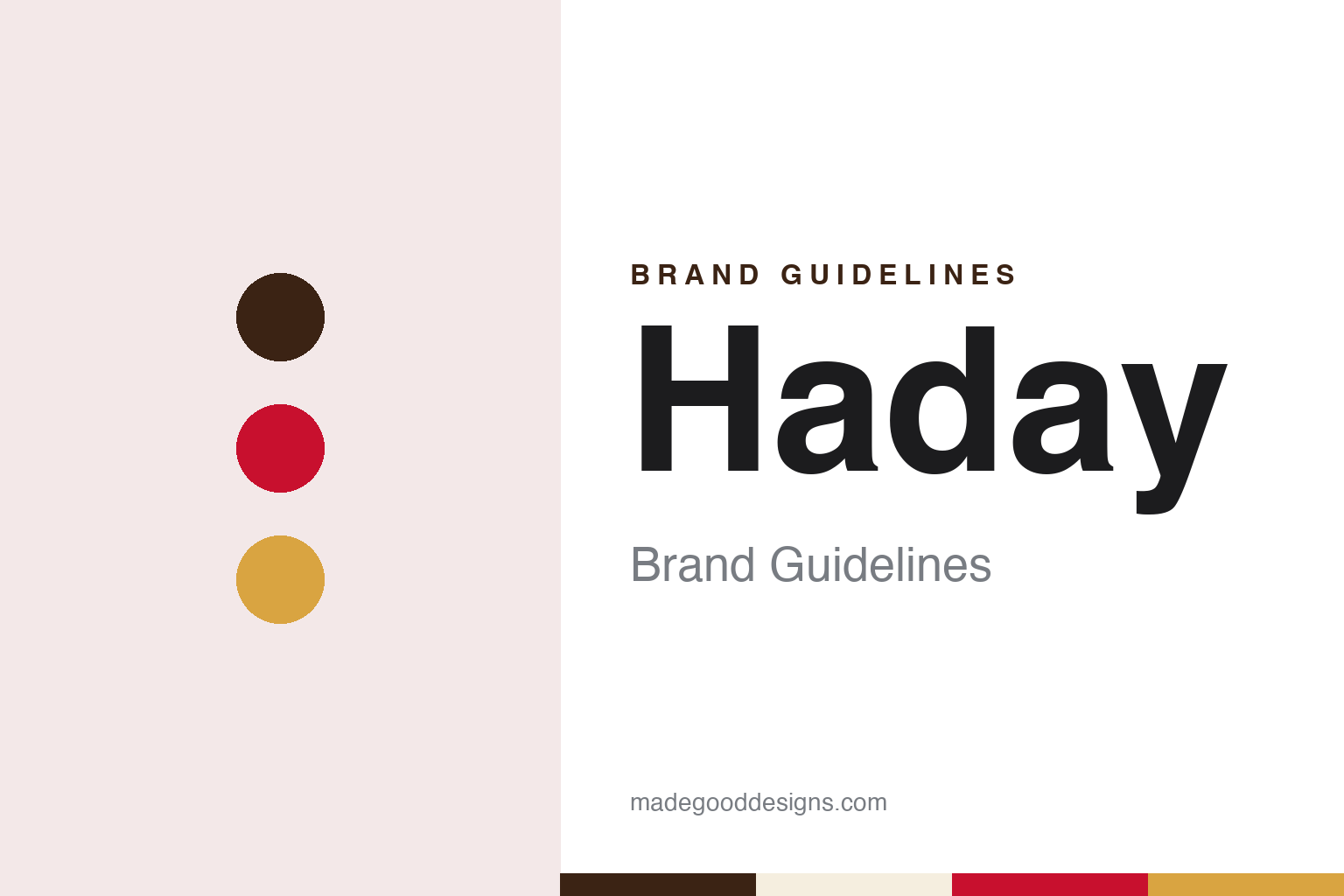
Haday Brand Guidelines
The Foshan soy sauce brewed under the sun.
Aa
Two constants: a soy brown, red and sun gold palette and a heritage serif register. Abstract homage — not a Haday product or mark; no bottle, label or logo is reproduced.
Twenty-five sauce shops
Foshan’s old sauce gardens become one factory.
Haday is the brand name used outside China by Foshan Haitian Flavouring & Food Co., the soy sauce maker of Foshan, in Guangdong province; in Chinese the company and its sauces are called Haitian (海天). English Wikipedia describes it as the largest manufacturer of soy sauce in the world and traces its roots to a group of sauce factories in Foshan in the seventeenth century. The company itself goes further back: it describes Haday as “craft, since 1582,” says it brewed its first crock of soy sauce in an old Foshan sauce shop more than 400 years ago, and calls its craftsmanship one that dates from the Ming dynasty. Chinese Wikipedia says Foshan’s sauce gardens flourished in the Ming and Qing periods, and names the Maolong sauce garden as the earliest of them, dating it to either the Qianlong reign of the Qing or the Wanli reign of the Ming.
The modern company dates from 1955. That year, the company and Chinese Wikipedia agree, 25 Foshan sauce makers were merged in a public–private partnership into a single soy sauce factory under the Haitian name; Chinese Wikipedia says it was later renamed the Zhujiang Soy Sauce Factory for a time. A year later, the company says, it launched the Mushroom Dark Soy Sauce that it still sells.
The factory then modernised step by step. In 1961, the company and Chinese Wikipedia say, it began fermenting soy sauce in concrete pools rather than in the traditional earthenware crocks, which made production at scale possible. In 1971, the company says, it put China’s first vacuum bottling machine for soy sauce into use, and from 1973 it cultivated its own strains of the Aspergillus mould used in fermentation, the basis of what it now calls its “Haitian strains” patent.
Colour
Oyster sauce, exports and a household name.
Haday’s second pillar arrived in 1984, when, the company says, it launched Haday Oyster Sauce, which went on to become a familiar product in Chinese homes. By 1988, it says, Haitian led the Chinese condiment industry in production scale and sales volume. English Wikipedia, which names Kikkoman and Lee Kum Kee as its main competitors, says that in 2010 the company held 16 to 19 per cent of the Chinese soy sauce market.
The brand went abroad in 1993, the company says, with its first exports to North America and Southeast Asia. In 1999 it bought prime-time advertising around the CCTV evening news, which the company credits with making Haitian a well-known seasoning brand in Chinese households. In 2006 China’s Ministry of Commerce recognised Haday as a “China Time-Honored Brand”, a title the company still uses on its website.
Behind the brand the company kept changing shape. In late 1994, Chinese Wikipedia says, Haitian was one of the first state enterprises in Foshan chosen to pilot reform, and it was converted from a state-owned factory into a Sino-foreign joint venture. In 2007 it became privately owned: English Wikipedia says it was bought out by its employees from the Foshan government, and Chinese Wikipedia says it acquired all the foreign-held shares and became an employee-owned private company. Pang Kang is its chairman, English Wikipedia says.
The range has since spread well beyond soy sauce. English Wikipedia lists oyster sauce, hoisin, shrimp sauce and vinegar, and the company says it sells more than 1,400 products, including cooking wine and compound seasonings. Chinese Wikipedia records two acquisitions: a fermented bean curd maker in Kaiping, Guangdong, in June 2014, and the Danhe vinegar company of Zhenjiang, Jiangsu, in 2017.
Typography
Design and documentation.
The seven brands in this group all make food or drink, and all of them come from mainland China, from groups founded in Taiwan, or from Hong Kong: Haday, Wahaha, Master Kong, Want Want, White Rabbit, Totole and Vitasoy. Chinese food and drink brands in general sit at many different points in the trade, from firms that still carry a founder’s family at the top to names that now belong to much larger groups, and a single brand can be sold everywhere from a corner shop to a supermarket shelf abroad.
A food or drink brand’s identity is usually carried less by a single product than by a pack, a name and the meal or snack it promises, because the company behind the name may have changed hands, moved its factories or grown far beyond the city where it started. That makes the questions behind each name worth asking plainly: who started it, who owns it now, and where its products are actually made and packed.
Each guide separates what independent sources record from what the company says about itself — its founding story, its owners over time, where its products are made and how its packaging has changed — and marks plainly what rests only on the company’s own word.
Aa
A heritage serif for a brewer that dates its craft to the Ming dynasty. (Specimen set in Noto Serif, a serif STAND-IN; NOT the Haday logo.)
Haday
Sun-brewed vats, a lighthouse factory and two listings.
Haday is made in China. Its largest site is at Gaoming, in Foshan, where, the company says, the first phase of a production base with an annual capacity of one million tonnes opened in 2005. Chinese Wikipedia lists further production bases in Suqian in Jiangsu, Nanning in Guangxi, Wuhan in Hubei and in Zhejiang, and the company says it is supported by six factories and several overseas subsidiaries. It says it brews its soy sauce “under the sun” by a traditional technique, in open-air fermentation, while using modern technology to control the process.
The Gaoming plant is also the brand’s showroom. In 2013, the company says, it opened the factory to visitors as “Yummy’s Sunshine Castle,” and it says the site has since welcomed more than 2.8 million people. In 2025, the company says, the Gaoming factory was recognised by the World Economic Forum as a “Lighthouse Factory,” the first in the soy sauce industry, for smart and sustainable production; the company had earlier been named a national “green factory” in 2017, it says.
The company went public in 2014 on the Shanghai Stock Exchange; Chinese Wikipedia dates the listing to 11 February that year. In 2025 it added a listing on the main board of the Hong Kong Stock Exchange, the company says, and English Wikipedia records its Hong Kong H-share line. Its head office remains in Foshan. Today the company says Haday products are chosen by more than 80 per cent of Chinese households and are sold in more than 100 countries.
For a design guide, Haday shows how a brand built on old Foshan sauce shops can present a factory, a fermentation yard and a ministry heritage title as its story. Compare Lee Kum Kee, the oyster sauce house it competes with, and Pearl River Bridge, another Guangdong soy sauce exporter. For this guide we use soy brown, a deep red and a sun gold with a heritage serif, an unofficial interpretation; no product or logo is reproduced.
Explore & save
Keep Haday’s identity on hand — save it to a board in the Made Good inspiration library.
Haday identity set
Pin the Haday soy brown, red and sun gold palette and the heritage serif register to your own board.