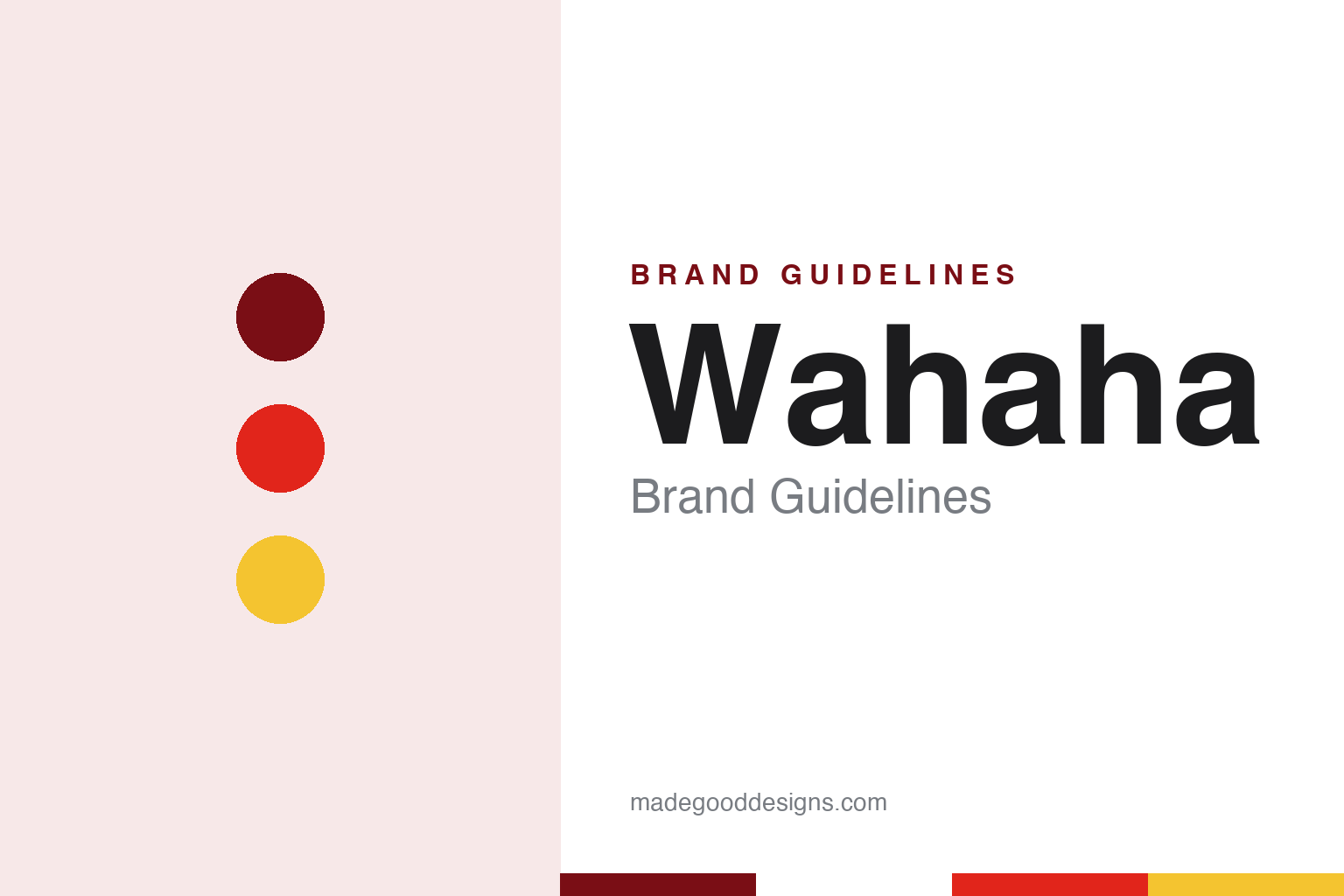
Wahaha Brand Guidelines
The Hangzhou school shop that became a drinks giant.
Aa
Two constants: a Wahaha red, sunny yellow and milk white palette and a rounded friendly sans register. Abstract homage — not a Wahaha product or mark; no bottle, label or logo is reproduced.
A school shop
A salesman, two retired teachers and a children’s drink.
Wahaha began in Hangzhou, in Zhejiang province, in 1987. English Wikipedia says its founder, Zong Qinghou, then 42, took over a small shop run by a school in the city’s Shangcheng District, selling milk and soft drinks, and that he borrowed money with two retired schoolteachers to begin making milk drinks of his own. English Wikipedia describes the company’s origin as the sales department of a Shangcheng District school.
The product that made the name came a year later. Chinese Wikipedia says that in 1988 the business developed what it calls China’s first nutrition drink made specifically for children, and chose its name through a public naming competition. The winning name, Wahaha (娃哈哈), came from a well-known children’s song set to a Xinjiang folk melody. The drink was launched on 20 October 1988, Chinese Wikipedia says, with an advertising line that promised children that a bottle of Wahaha would make their meals taste good. English Wikipedia says the drink was a breakthrough because it was aimed at the families of only children.
On 17 April 1989 the business was renamed the Hangzhou Wahaha Nutritional Food Factory, Chinese Wikipedia says. In 1991 it took over the much larger, loss-making Hangzhou Canned Food Factory, and Chinese Wikipedia says the cannery, which had been losing money, was returned to profit within three months. By 1990, it says, Wahaha’s sales had passed 100 million yuan.
Colour
Calcium milk, water and a cola.
English Wikipedia says the years from 1992 to 1994 brought less successful experiments, including a sour plum drink and alcoholic drinks, most of which did not last. The lines that lasted came in the middle of the decade. In 1996, Chinese Wikipedia says, Wahaha launched its AD Calcium Milk, a milk drink, and its purified water; it says AD Calcium Milk sold 1.07 billion bottles in 1997.
In May 1998 Wahaha took on the international cola brands with Future Cola, known in Chinese as Feichang Kele, Chinese Wikipedia says. Another drink, Nutrition Express, followed in 2004 and 2005, it says, alongside other lines.
The same years brought the partnership that shaped Wahaha’s later history. On 28 March 1996, English Wikipedia says, Wahaha signed a joint venture agreement with the French food group Danone and Peregrine Investments of Hong Kong, which together held 51 per cent of five initial joint venture companies, with Wahaha and its employees holding the remaining 49 per cent, and Danone became the majority partner after Peregrine collapsed in 1998. The relationship broke down publicly in April 2007, with arbitration and lawsuits on both sides, and on 30 September 2009 the two sides settled: Danone sold its 51 per cent stake to Wahaha, English Wikipedia says.
English Wikipedia counts some 60 manufacturing bases, around 150 subsidiary companies and about 60,000 employees in the group, which remains headquartered in Hangzhou, the city where it began.
Typography
Design and documentation.
The seven brands in this group all make food or drink, and all of them come from mainland China, from groups founded in Taiwan, or from Hong Kong: Haday, Wahaha, Master Kong, Want Want, White Rabbit, Totole and Vitasoy. Chinese food and drink brands in general sit at many different points in the trade, from firms that still carry a founder’s family at the top to names that now belong to much larger groups, and a single brand can be sold everywhere from a corner shop to a supermarket shelf abroad.
A food or drink brand’s identity is usually carried less by a single product than by a pack, a name and the meal or snack it promises, because the company behind the name may have changed hands, moved its factories or grown far beyond the city where it started. That makes the questions behind each name worth asking plainly: who started it, who owns it now, and where its products are actually made and packed.
Each guide separates what independent sources record from what the company says about itself — its founding story, its owners over time, where its products are made and how its packaging has changed — and marks plainly what rests only on the company’s own word.
Aa
A rounded friendly sans for a brand named after a children’s song. (Specimen set in Baloo 2, a sans STAND-IN; NOT the Wahaha logo.)
Wahaha
A founder’s company in Hangzhou.
Zong Qinghou led the company from the school shop of 1987 until his death, more than 36 years later, and English Wikipedia names the children’s drink, aimed at the parents of single children, as the company’s breakthrough product. He died in Hangzhou on 25 February 2024, aged 78, the Singapore Chinese-language newspaper Lianhe Zaobao reported that day, and the South China Morning Post and China News Service also reported his death.
The founder’s own background was far from business. English Wikipedia says Zong was born in Suqian, in Jiangsu, grew up poor in Zhejiang and had to leave middle school; as one of China’s sent-down youth he worked for years at a salt farm in Zhoushan, off the Zhejiang coast, educating himself there with communist texts and Soviet novels. He returned to Hangzhou in 1979, when his mother, a schoolteacher, retired, and took menial jobs at local schools before the school shop of 1987. He went on to sit as a delegate to the National People’s Congress from 2002 to 2018, English Wikipedia says, and it describes him as running Wahaha in an autocratic style, building it into China’s largest beverage maker through aggressive expansion and tight cost control.
Wahaha’s name has stayed the one picked in 1988 for a children’s drink, and it has since been carried onto milk drinks, bottled water and a cola. English Wikipedia describes the company as a group of manufacturing bases across China, with its head office still in Hangzhou, the city where the school shop opened in 1987.
For a design guide, Wahaha shows how a name taken from a children’s song can stretch from a nutrition drink to water and cola while keeping one cheerful voice. Compare Master Kong, the instant-noodle and drinks brand, and Vitasoy, the Hong Kong soy milk brand. For this guide we use Wahaha red, a sunny yellow and milk white with a rounded sans, an unofficial interpretation; no product or logo is reproduced.
Explore & save
Keep Wahaha’s identity on hand — save it to a board in the Made Good inspiration library.
Wahaha identity set
Pin the Wahaha red, sunny yellow and milk white palette and the rounded friendly sans register to your own board.