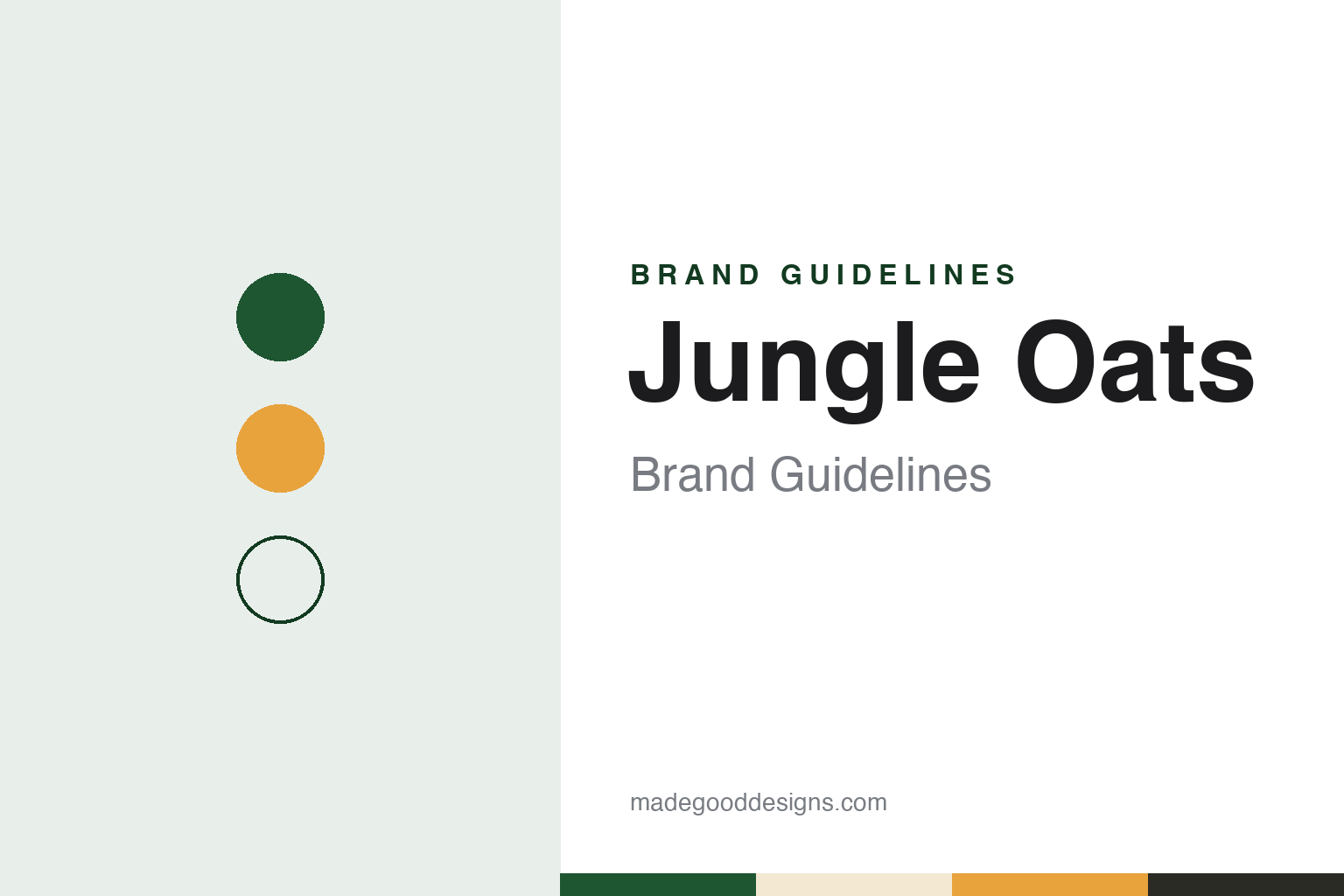
Jungle Oats Brand Guidelines
The Tiger Oatery porridge behind Tiger Brands.
Aa
Two constants: a jungle green, tiger amber and rolled-oat cream palette and a heavy grotesque sans register. Abstract homage — not a Jungle Oats product or mark; no pack, logo or tiger is reproduced.
The Tiger Oatery
A German immigrant, a small mill and a first product.
Jungle Oats is the oldest brand in the house that became Tiger Brands, which English Wikipedia, citing Bloomberg, calls South Africa’s largest food company. Tiger Brands says that for Jungle “it all started in 1920 at the Tiger Oatery, the first factory that launched the Tiger Brands Group,” and that the oats were made there from home-grown grain. Its 2025 integrated annual report repeats the date: Jungle, it says, has been around since 1920.
The man behind the oatery was Jacob Frankel. English Wikipedia’s article on his great-grandson, the investor David Frankel, citing Tiger Tapestry, a 1988 company history by Rudy Frankel, says Jacob Frankel emigrated from Germany to South Africa in 1915 and in 1920 founded the Tiger Oatery, a small milling company; his son Rudolph Leo Frankel later led it as it grew into Tiger Brands. English Wikipedia’s Tiger Brands article says Jacob Frankel founded Tiger Oats Limited in 1921 “with help from Joffe Marks,” and Tiger Brands’ own timeline says the business began in 1921 as a family firm in Newtown, Johannesburg.
Accounts of the brand’s first years differ in detail. A Jungle Oats history page that Tiger Brands published around 2010 said Jungle had been on sale “since 1925,” and English Wikipedia, citing that page, also gives 1925 as the launch year, while the company today uses 1920. The same older page credited a Mr Redler, then governing director of the Tiger Oats Company, with the vision for a mill that would help farmers, quoting his words “It can be and shall be done.” English Wikipedia places the first mill at Moorreesburg in the Western Cape and says a second mill opened at Maitland, Cape Town, in 1930, when demand outgrew the first; the old Moorreesburg mill was abandoned in about 1987. The company’s 2010 page called Maitland “the current site” and credited the brand’s nutty taste to its own milling process.
Colour
A tiger on the box and a hero on the radio.
The brand has long shared its emblem with its maker. English Wikipedia illustrates its Tiger Brands article with a Jungle Oats box from the 1920s beside one from 2010, captioned as showing how the use of the Tiger Oats logo on the pack changed over ninety years. The parent company kept the big cat in its own name when Tiger Oats became Tiger Brands, and in 2025 it introduced a refreshed corporate logo, which its integrated annual report presents as a corporate brand evolution.
Jungle Oats’ best-remembered advertising was a radio serial. English Wikipedia, citing Robert Alan Rock’s 2007 book Quo Vadis Advertising?, says the science-fiction hero Jet Jungle was created in 1972 by the advertising agency of the show’s sponsors, Jungle Oats and Black Cat peanut butter, and that the agency wrote the first series for Springbok Radio. The writer and actor Brian O’Shaughnessy took over the scripts and the title voice from the second year. Jet Jungle flew a Vertijet from an island headquarters called Orion’s Peak with a black leopard named Jupiter, and the serial ran on Springbok Radio until 1985, with a return on Radio South Africa in 1991 and 1992.
The show grew well beyond the airwaves. English Wikipedia records a children’s fan club with newsletters carrying a black-and-white comic strip, a short-lived colour Sunday comic, and a Jet Jungle action figure made by the American toy company Mego in the 1970s. It notes that television broadcasts only came to South Africa in 1976, and it quotes the theme song’s refrain, “Jet Jungle is the man to get!”
Today the range sits under the line “The Taste of Goodness” on the brand’s website, jungleoats.co.za, which lists Jungle Oats, Jungle Instant Oats, Oatso Easy and Jungle Energy Bars alongside recipes such as overnight oats.
Typography
Design and documentation.
The seven brands in this group are all food and drink brands, and all of them come from South Africa: Mrs Ball’s, Ouma, Jungle Oats, All Gold, Five Roses, Joko and Iwisa. South African food and drink brands in general sit at many different points in the trade, from names that still carry a founder’s or a family’s story to names that now belong to much larger food groups, and a single brand can be sold everywhere from a corner shop to a supermarket shelf.
A food or drink brand’s identity is usually carried less by a single product than by a pack, a name and the meal or cup it promises, because the company behind the name may have changed hands, moved its factory or grown far beyond the town where it started. That makes the questions behind each name worth asking plainly: who started it, who owns it now, and where its products are actually made and packed.
Each guide separates what independent sources record from what the company says about itself — its founding story, its owners over time, where its products are made and how its packaging has changed — and marks plainly what rests only on the company’s own word.
Aa
A heavy grotesque sans for a sturdy breakfast box. (Specimen set in Archivo Black, a sans STAND-IN; NOT the Jungle Oats logo.)
Tiger Brands
From a family mill to a listed food group.
Jungle Oats has never left the company that created it, though that company has changed shape many times. Tiger Brands’ timeline says Tiger Oats and Milling Company Limited was incorporated and listed on the Johannesburg Stock Exchange in 1944. In 1982 the industrial group Barlow Rand took a majority stake through CG Smith Limited, and CG Smith was unbundled from Barlow Rand in 1993. In 1998 Tiger Oats bought ICS Holdings, the Imperial Cold Storage group, and after a run of acquisitions that included the drug maker Adcock Ingram, it was renamed Tiger Brands; the company dates the change to 2000.
The group later spun off businesses as well as buying them. Its timeline lists the separate listing of its animal-feed and poultry operations as Astral Foods in 2001, of the Spar grocery wholesaler in 2004 and of Adcock Ingram in 2008. Tiger Brands celebrated its centenary in 2021, counting from the 1921 start of Tiger Oats, and in 2025 it sold its baby wellbeing business and its Langeberg & Ashton fruit-canning operation.
Tiger Brands is listed on the JSE and has its head office in Midrand, Gauteng; English Wikipedia puts it at Waterfall City. Tjaart Kruger became chief executive in November 2023. The company says it runs 34 manufacturing plants in South Africa, in seven of the nine provinces, and exports to 22 countries, mostly in Africa. Jungle Oats sits in its Grains division alongside brands such as Tastic rice and Fatti’s & Moni’s pasta. In March 2020 the trade site Food Business Africa reported that Jungle Oats was marking 100 years with the opening of a new mill.
For a design guide, Jungle Oats shows how one breakfast brand can carry a company’s founding story, its tiger emblem and a radio hero across a century. Compare Mrs Ball’s, the chutney that Tiger Brands also owns, and Scott’s Porage Oats, the Scottish oat brand with its own long-running mascot. For this guide we use a jungle green, a tiger amber and a rolled-oat cream with a heavy grotesque sans, an unofficial interpretation; no product or logo is reproduced.
Explore & save
Keep Jungle Oats’s identity on hand — save it to a board in the Made Good inspiration library.
Jungle Oats identity set
Pin the Jungle Oats jungle green, tiger amber and rolled-oat cream palette and the heavy grotesque sans register to your own board.