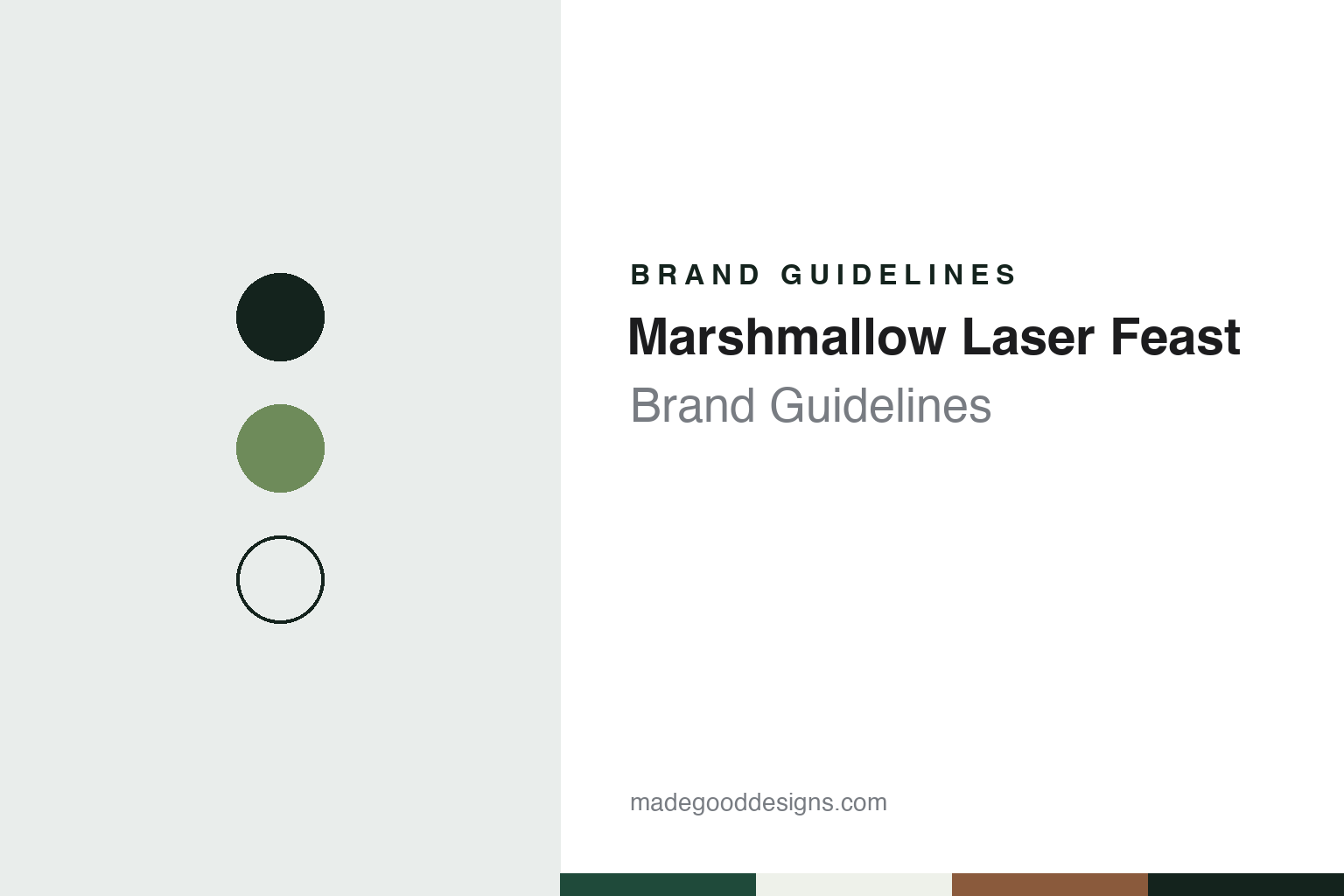
Marshmallow Laser Feast Brand Guidelines
The London collective that moved from lasers to forests.
Aa
Two constants: a forest green, moss and bark palette and a soft serif register. Abstract homage — not a Marshmallow Laser Feast work or mark; no installation, logo or still is reproduced.
MLF
Three studios, one odd name.
Marshmallow Laser Feast, often shortened to MLF, is a London studio formed in 2011. Its creative director, Ersin Han Ersin, told the design magazine STIR in December 2020 that it was conceived that year by Memo Akten, Robin McNicholas and Barney Steel, who were each working in their own studios and collaborating on projects together. English Wikipedia’s article on Akten gives the same year and says he was the studio’s creative and technical director. Today the studio calls itself an “experiential artist collective.”
Its line-up changed within a few years. Akten left in 2014 to concentrate on doctoral research, according to English Wikipedia, and Ersin told STIR that he joined in 2015 as director and partner. In 2020 he put the team at about 12 people, adding that it expands and shrinks with the scale of each project and draws on a wider circle of designers, makers, engineers, programmers, scientists, game-engine specialists and spatial-audio engineers.
The early work was built in real time with lasers, light and projection. In April 2013 Vice introduced the studio, then Akten, McNicholas and Steel, through Laser Forest, an interactive musical instrument commissioned for the STRP Biennale in Eindhoven: more than 150 rods set up in an empty factory space, which visitors could tap and strum to set off both sounds and laser beams. The same article listed other projects of the period, among them quadcopters turned into a kind of organ of light, a supercar painted with light and a living room transformed by projection into a cityscape and an ocean. McNicholas told Vice that the studio tried to bring out “an emotional, human side to the tech” in each project.
Colour
From lasers to forests, breath and fast food.
From there MLF moved into virtual reality and the natural world. In the Eyes of the Animal was commissioned by Abandon Normal Devices and Forestry Commission England’s Forest Art Works and shown at Grizedale Forest in the north of England in 2015, according to the studio. It lets a viewer see woodland through the senses of other species; STIR named the mosquito, the dragonfly and the owl, and the studio’s own page adds a frog. The studio says the piece was built from Lidar scans, drone footage, CT scans and photogrammetry, set to a binaural soundscape of field recordings from the forest, with a vibrating backpack adding a sense of touch. It lists later showings at YCAM in Japan in 2016 and the Design Museum in London in 2017.
We Live in an Ocean of Air opened at the Saatchi Gallery in London on 7 December 2018 and ran until 5 May 2019, the studio says. STIR described it in 2020 as an installation built around a giant tree, in which visitors wearing headsets see the movement of air between human breath and the tree rendered as fields of points. The studio lists later presentations at the PHI Centre in Montreal in 2021–22 and the ArtScience Museum in Singapore in 2022, and the Australian Centre for the Moving Image in Melbourne showed a video edition, made with Natan Sinigaglia and James Bulley, in its Works of Nature exhibition from November 2023, where it was projected back to back on a single tall screen.
Sweet Dreams took a different turn. It ran from July to September 2024 at Factory International’s Aviva Studios in Manchester, English Wikipedia says, commissioned by the British Film Institute and Factory International and directed by Simon Wroe. The venue described a walk-through adventure mixing animation, cinema and interaction, set in the headquarters of a fictional fast-food firm, the Real Good Chicken Company, with art direction by the French artist mcbess and voices by Munya Chawawa, Morgana Robinson and Reggie Watts. Visitors moved through a series of rooms with screens, sculpture, lighting and sound. Part of the work was shown at the Ars Electronica festival in Linz in September 2025, according to English Wikipedia.
Typography
Design and documentation.
Exhibition, museum and experience-design studios rarely sell a product with their name on it. What they publish instead is a body of work: galleries, visitor centres, pavilions and installations, each credited to the studio by the museum, the client or the trade press. A guide to their identity therefore starts with how they present that work, and with the names and wordmarks on their own websites.
Several of these practices are named after their founders or partners, and some shorten a longer name to initials: Ralph Appelbaum Associates calls itself RAA on its own site. Their websites show a wordmark, a project list and a few pages on the practice. Founders and partners appear in a professional role, as creative directors or principals, and team pages can list designers, content developers and model-makers alongside them, as Casson Mann’s does.
The project case study is the core format. A typical page names the client and the opening date, then shows the gallery graphics, wayfinding, display furniture, projections and interactive installations that make up the scheme; Casson Mann’s pages call this mix its scenography. Independent coverage, in titles such as Museums Journal, Blooloop and national newspapers, is the surest way to date and credit a project, because a single building can involve more than one design firm: English Wikipedia credits the conversion of the IKEA Museum in Älmhult to both WilkinsonEyre and Ralph Appelbaum Associates.
Corporate pages fill in the rest: office locations, practice history, renamings and, where it has happened, a change of ownership. This guide sets out what dated sources say about each studio, keeps company statements attributed, and leaves out awards and any claims about what an exhibition does for its visitors.
Aa
A soft serif for a studio with a playful name. (Specimen set in Fraunces, a serif STAND-IN; NOT the Marshmallow Laser Feast logo.)
Marshmallow Laser Feast
A playful name over research-led work.
MLF presents its work through galleries as well as commissions. Its website says it is represented by bitforms gallery and that works are available at Gazelli Art House, and it lists institutions where it has exhibited, among them ACMI, Aviva Studios, the Barbican Centre, the Phi Centre, the Royal Botanic Gardens at Kew, the Sundance Film Festival and SXSW. It describes collaborators ranging “from coders to poets, chemists to ventriloquists,” and says its work appears in public spaces, galleries, museums, parks and nature reserves.
The name joins a sweet, a laser and a feast, and the studio’s own pages shorten it to MLF. Ersin set out the studio’s process to STIR in 2020: each project begins with a core idea, sometimes a scientific one such as photosynthesis or transpiration, moves through research, interviews, fundraising and technical prototypes, and ends in production, when the team grows several times over to finish the architectural design, visitor journey and touring plan. The studio’s recurring subjects, by its own account, are breath, trees, animal senses and the body, and its tools include Lidar, photogrammetry, game engines and spatial audio.
The works named in this guide trace that path: a laser instrument in a factory in 2013, a forest seen through animal senses in 2015, a giant tree and the air around it from 2018, and a fictional fast-food company in 2024.
For a design guide, Marshmallow Laser Feast shows how a playful name can sit over research-led work on science and nature, and how one piece can travel as a headset experience, a video edition and a gallery edition. Compare United Visual Artists, another London practice built on light and sound, and teamLab, the Japanese art collective. For this guide we use a deep forest green, moss, a warm bark brown and a pale mist with a serif, an unofficial interpretation; no product or logo is reproduced.
Explore & save
Keep Marshmallow Laser Feast’s identity on hand — save it to a board in the Made Good inspiration library.
Marshmallow Laser Feast identity set
Pin the Marshmallow Laser Feast forest green, moss and bark palette and the soft serif register to your own board.
Source & notes
Frequently Asked Questions
What font can I use to match the Marshmallow Laser Feast look?
This guide describes Marshmallow Laser Feast’s type as “A soft serif for a studio with a playful name”. Its type specimen is set in Fraunces from Google Fonts as a stand-in; Fraunces is not Marshmallow Laser Feast’s own lettering.
What colours are in the Marshmallow Laser Feast palette?
This guide’s Marshmallow Laser Feast palette is Forest floor #14231D, Deep canopy #1F4A3A, Moss #6E8B5A, Bark #8A5A3C and Morning mist #EEF1EA. The tones are the guide’s own unofficial interpretation, not official Marshmallow Laser Feast hex codes.
When was Marshmallow Laser Feast founded?
Marshmallow Laser Feast was founded in 2011, in London, England.
Who founded Marshmallow Laser Feast?
Marshmallow Laser Feast was founded by Memo Akten, Robin McNicholas and Barney Steel in 2011.