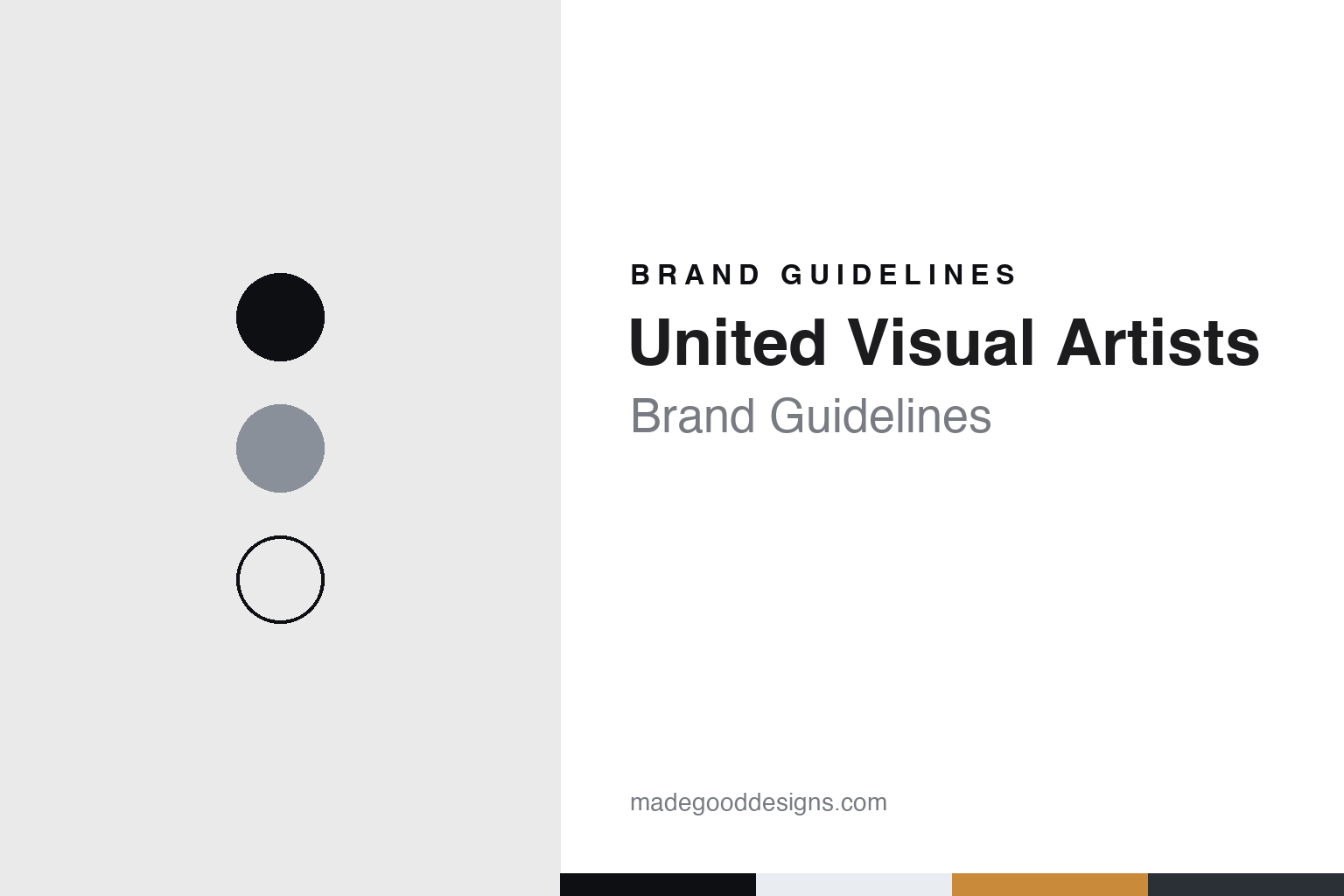
United Visual Artists Brand Guidelines
Matt Clark’s London practice of light, sound and time.
Aa
Two constants: a dark-room and cold-light palette and a spare sans register. Abstract homage — not a United Visual Artists work or mark; no installation, logo or photograph is reproduced.
UVA
One artist, many collaborators, a plural name.
United Visual Artists, usually shortened to UVA, is a London art and design practice founded in 2003. Its own website says it has been founded and led by the British artist Matt Clark since that year, and English Wikipedia names two further founders, Chris Bird and Ash Nehru. The practice describes its output as work that joins new technologies with traditional media such as sculpture, performance and site-specific installation, and it says its pieces are better understood as events in time than as material objects, with light, sound and movement as the material.
The name is plural on purpose. English Wikipedia explains that while Clark leads the team, “Artists” refers to the many collaborators he works with, and the studio’s about page credits its designers, technicians and producers by name and says that none of Clark’s projects would be possible without them. The same page says the practice works with specialists from outside the studio across the arts, culture and the sciences, naming the soundscape ecologist Bernie Krause and the cognitive scientist Mark Changizi among them.
The partnership changed shape over the following years. English Wikipedia says that around 2010 Bird and Nehru turned their attention to d3, a software tool originally developed for UVA projects, and that at the end of 2017 both stepped back from UVA as directors. The studio’s website now describes the practice as founded and led by Clark.
Music ran through the early years. English Wikipedia lists world tours with Massive Attack from 2003 to 2018, and in October 2023 Wallpaper* reported that a data installation UVA showed in its anniversary exhibition had originally been made for the band’s 100th Window tour in 2003. Other collaborators named on the studio’s website include the bands Battles and the musicians James Blake and Ben Frost, the filmmaker Adam Curtis, and the choreographer Benjamin Millepied with the Paris Opéra Ballet.
Colour
Columns, pendulums and beams of light.
UVA’s installations are commissioned by museums, galleries and festivals. The practice lists among its commissioners the Barbican’s Curve gallery, Manchester International Festival, the Royal Academy of Arts, the Serpentine Gallery, the Wellcome Trust, the Victoria and Albert Museum, YCAM in Japan and the Biennale of Sydney, and it says its work is held in the collections of the Fondation Cartier pour l’art contemporain in France and MONA in Tasmania.
Volume appeared in the garden of the V&A in London in 2006, English Wikipedia says: a field of 48 columns that give off light and sound in response to the movement of people walking among them, later shown in cities including Hong Kong, Paris and Melbourne.
Momentum filled the Barbican’s Curve gallery in 2014. The Guardian reported on 12 February 2014 that the 90-metre installation placed 12 moving pendulums with changing white lamps in a darkened gallery, throwing shadows and planes of light across walls and floor to a soundtrack, and that it would run from 13 February until 1 June. Clark told the paper it was “designed to mess with your perception of both time and physical space.”
Our Time followed in 2016, made for the Dark Mofo festival in Hobart. It’s Nice That described it in June 2016 as 21 motion-controlled LED pendulums, each carrying a speaker and mounted on counterweighted two-axis robot arms, with a sub-bass speaker at floor level and a light haze that makes the beams visible. The work entered MONA’s collection, and in February 2018 Dezeen reported that Burberry had borrowed it from the museum for its autumn/winter 2018 show at the Dimco Building in London, Christopher Bailey’s last collection for the label. For the finale UVA added an archway of about 3,000 rainbow-coloured lasers, which the studio called an “architectural intervention of pure light.”
In early 2026 the façade of Gaudí’s Casa Batlló in Barcelona carried Hidden Order, projected on 31 January and 1 February according to the building’s contemporary-art programme. The programme describes an audiovisual choreography of light, movement and geometry with an original sound composition, made with the choreographer Fukiko Takase and the composer Daniel J. Thibaut.
Typography
Design and documentation.
Exhibition, museum and experience-design studios rarely sell a product with their name on it. What they publish instead is a body of work: galleries, visitor centres, pavilions and installations, each credited to the studio by the museum, the client or the trade press. A guide to their identity therefore starts with how they present that work, and with the names and wordmarks on their own websites.
Several of these practices are named after their founders or partners, and some shorten a longer name to initials: Ralph Appelbaum Associates calls itself RAA on its own site. Their websites show a wordmark, a project list and a few pages on the practice. Founders and partners appear in a professional role, as creative directors or principals, and team pages can list designers, content developers and model-makers alongside them, as Casson Mann’s does.
The project case study is the core format. A typical page names the client and the opening date, then shows the gallery graphics, wayfinding, display furniture, projections and interactive installations that make up the scheme; Casson Mann’s pages call this mix its scenography. Independent coverage, in titles such as Museums Journal, Blooloop and national newspapers, is the surest way to date and credit a project, because a single building can involve more than one design firm: English Wikipedia credits the conversion of the IKEA Museum in Älmhult to both WilkinsonEyre and Ralph Appelbaum Associates.
Corporate pages fill in the rest: office locations, practice history, renamings and, where it has happened, a change of ownership. This guide sets out what dated sources say about each studio, keeps company statements attributed, and leaves out awards and any claims about what an exhibition does for its visitors.
Aa
A spare sans for a studio known by three letters. (Specimen set in Inter Tight, a sans STAND-IN; NOT the United Visual Artists logo.)
United Visual Artists
Twenty years marked in the dark.
For its twentieth year UVA staged Synchronicity, which opened on 12 October 2023 in the underground rooms of 180 Studios on the Strand in London. Wallpaper* reported that the show held eight works, five of them new, and that many rooms were kept close to dark, putting sound and collaboration in front: a soundscape made with Bernie Krause from field recordings in the Central African Republic, choreography by Dana Gingras of Animals of Distinction with a score by Roger Tellier-Craig, and a new score by Massive Attack’s Robert Del Naja for the reworked data piece. Clark told the magazine the installations had been chosen for “a musicality, so it will be like walking through a series of performances.”
The studio’s public face is spare. Its website uses the three letters UVA and is organised around works, exhibitions, news and press. Its writing about itself returns to a short set of ideas — perception, time, the natural phenomena and cultural frameworks that shape how people see — and draws, it says, on sources “ranging from ancient philosophy to theoretical science.” Permanent public works by the practice stand in Toronto, Dubai, Philadelphia and London, according to its website.
The works named in this guide share a small set of means: columns, pendulums and beams; white or coloured light set against darkness; and sound composed alongside the image. Their settings move between a museum garden, a gallery, a festival, a fashion show and the front of a building.
For a design guide, United Visual Artists shows how a plural name can stand for a group while one artist leads it, and how a short acronym can carry a body of work made of light, sound and time. Compare Marshmallow Laser Feast, another London studio making immersive installations, and Moment Factory, the Montreal multimedia studio. For this guide we use a near-black, a graphite, a steel grey, a cold white and a lamp amber with a sans, an unofficial interpretation; no product or logo is reproduced.
Explore & save
Keep United Visual Artists’s identity on hand — save it to a board in the Made Good inspiration library.
United Visual Artists identity set
Pin the United Visual Artists dark-room, steel and cold-light palette and the spare sans register to your own board.
Source & notes
Frequently Asked Questions
What font can I use to match the United Visual Artists look?
This guide describes United Visual Artists’ type as “A spare sans for a studio known by three letters”. Its type specimen is set in Inter Tight from Google Fonts as a stand-in; Inter Tight is not United Visual Artists’ own lettering.
What colours are in the United Visual Artists palette?
This guide’s United Visual Artists palette is Dark room #0E0F12, Graphite #2B2F36, Steel #8A9099, Cold light #E9EDF2 and Lamp amber #C98A3A. The tones are the guide’s own unofficial interpretation, not official United Visual Artists hex codes.
When was United Visual Artists founded?
United Visual Artists was founded in 2003, in London, England.
Who founded United Visual Artists?
United Visual Artists was founded by Matt Clark, Chris Bird and Ash Nehru in 2003.