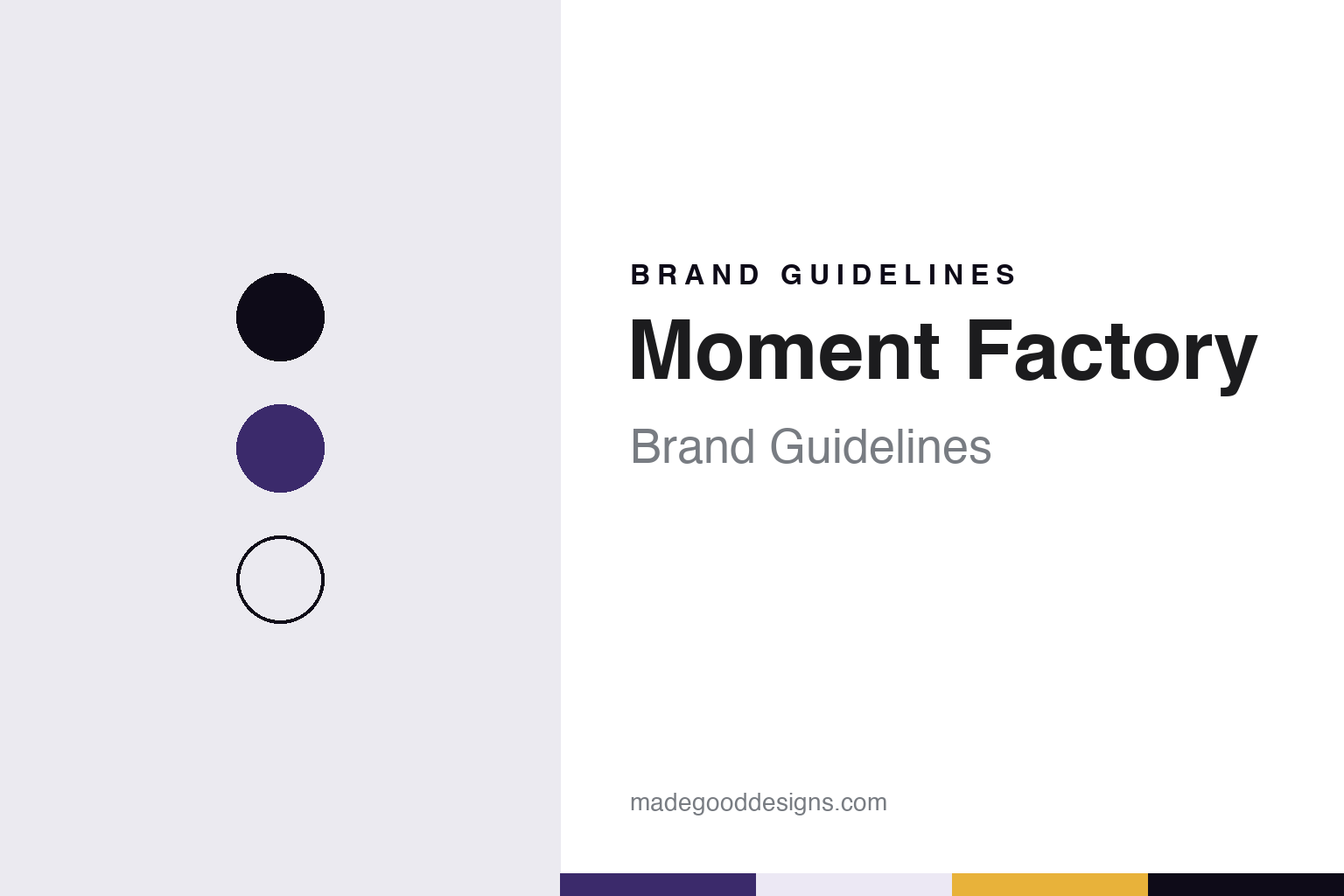
Moment Factory Brand Guidelines
The Montreal VJ collective turned multimedia studio.
Aa
Two constants: a Moment Factory violet and amber palette and a Geometric sans register. Abstract homage — not a Moment Factory show or mark; no projection, logo or graphic is reproduced.
From the VJ booth
Three video jockeys in Montreal.
Moment Factory was founded in Montreal in 2001. Three independent sources agree on its founders: Pollstar in September 2012, the design magazine Icon in May 2014 and the Université de Sherbrooke, which gave the company an honorary distinction, all name Sakchin Bessette, Dominic Audet and Jason Rodi. Icon described Bessette and Rodi as fellow VJs, or video jockeys, and said Audet was then working at the Montreal planetarium. The Sherbrooke citation says the three came from photography, multimedia and film, and began by making visuals for small events while looking for ways to stand apart from other VJs.
The company tells the same story in its own words today: Audet and Bessette, it says, met in Montreal’s rave culture, shared a passion for VJing and founded the studio in 2001.
The partnership changed within a few years. Rodi left the company — in 2006 to make films, according to Icon, or in 2007, according to the Sherbrooke citation — and Éric Fournier, formerly a senior vice-president at Cirque du Soleil, joined. The Sherbrooke citation describes the three-way leadership that followed: Fournier as executive producer, Audet in charge of technology and Bessette as creative director. Icon wrote that the studio had prospered early through its work with Cirque du Soleil, and from there moved into the United States, Las Vegas, cruise ships and corporate events.
In 2014 Icon visited the studio in a red-brick warehouse beside the railway tracks in Montreal’s Mile End, a loft it said Moment Factory had occupied since 2005. The magazine counted a staff of 120, with an average age of 30, organised in one large room with a black-curtained test lab at its centre; Pollstar had reported a staff of 85 two years earlier.
Colour
Concerts, facades and an airport.
The studio’s work spans concerts, building facades, shops and permanent installations. Icon called the Nine Inch Nails “Lights in the Sky” tour of 2008 one of its turning points: Moment Factory made an interactive show with the band that used LED lattices in front of the stage to generate images live. The custom control setup it built for that tour led it, Icon reported, to develop its own show-control software, X-Agora, which it then used in almost all its work. Pollstar quoted the company in 2012 describing X-Agora as a system that takes any signal and interactive element and puts them together to run a show, customised project by project.
The studio’s widest audience came in February 2012. Pollstar reported that Moment Factory, working with Cirque du Soleil, created the multimedia for Madonna’s Super Bowl XLVI halftime show, turning the field into a projected set, and went on to make content for 12 of the 24 songs of her MDNA Tour. Icon wrote that the halftime show became shorthand for what the studio did, quoting Bessette: “Did you see the Super Bowl? That’s the kind of stuff we do.”
Also in 2012, Icon reported, the studio projected a show onto the facade of the Sagrada Família in Barcelona, ending with an image based on Antoni Gaudí’s own drawings. And at Los Angeles International Airport it made the multimedia for the Tom Bradley International Terminal, a project that Icon said took two years and included a 22-metre animated clock tower that is physically a lift shaft; the studio was responsible for the interactive installations and the content running on them.
Pollstar put the studio’s output at 50 to 60 projects a year in 2012. The company says it has made more than 550 projects since 2001.
Typography
Design and documentation.
Exhibition, museum and experience-design studios rarely sell a product with their name on it. What they publish instead is a body of work: galleries, visitor centres, pavilions and installations, each credited to the studio by the museum, the client or the trade press. A guide to their identity therefore starts with how they present that work, and with the names and wordmarks on their own websites.
Several of these practices are named after their founders or partners, and some shorten a longer name to initials: Ralph Appelbaum Associates calls itself RAA on its own site. Their websites show a wordmark, a project list and a few pages on the practice. Founders and partners appear in a professional role, as creative directors or principals, and team pages can list designers, content developers and model-makers alongside them, as Casson Mann’s does.
The project case study is the core format. A typical page names the client and the opening date, then shows the gallery graphics, wayfinding, display furniture, projections and interactive installations that make up the scheme; Casson Mann’s pages call this mix its scenography. Independent coverage, in titles such as Museums Journal, Blooloop and national newspapers, is the surest way to date and credit a project, because a single building can involve more than one design firm: English Wikipedia credits the conversion of the IKEA Museum in Älmhult to both WilkinsonEyre and Ralph Appelbaum Associates.
Corporate pages fill in the rest: office locations, practice history, renamings and, where it has happened, a change of ownership. This guide sets out what dated sources say about each studio, keeps company statements attributed, and leaves out awards and any claims about what an exhibition does for its visitors.
Aa
A geometric sans — light thrown onto architecture. (Specimen set in Space Grotesk, a sans STAND-IN; NOT the Moment Factory logo.)
Moment Factory
Video, light, sound and architecture.
Today the company describes itself as a multidisciplinary entertainment studio that designs and produces immersive environments, combining video, sound, lighting, architecture, interactivity and special effects. It divides its work into custom projects made for clients and its own ticketed attractions, which it calls Moment Factory Originals. It still presents X-Agora as the software behind its projects, now describing it as a runtime platform for large installations, programmable spaces and touring shows.
Its leadership remains with two of its founders. The company names Dominic Audet as chief innovation officer and Sakchin Bessette as executive creative director. It gives its headquarters as Montreal, with further studios in Tokyo, Paris, New York City, Singapore, Abu Dhabi and Riyadh; English Wikipedia lists offices in Paris, Tokyo, New York and Singapore.
Its team, as English Wikipedia and the company describe it, mixes graphic and motion designers, multimedia directors, illustrators, architects, lighting designers, musicians, programmers, engineers and technicians. Icon described how that mix worked in 2014: content teams of directors, animators and illustrators on one side of the loft, programmers, lighting designers, architects and engineers on the other, and a black box in the middle where every project was tested. The magazine also noted a materials library, begun by a recent graduate, cataloguing how surfaces behave under light.
The company publishes no brand guidelines, and the colours and typeface of its identity are not documented in the sources used here, so the tones and type below are this guide’s own.
For a design guide, Moment Factory shows how a studio born in nightclubs can carry the visual habits of the VJ booth — darkness, motion and projected colour — into airports, churches and stadiums. Compare teamLab, the Tokyo art collective, and United Visual Artists, the London light-and-art practice. For this guide we use a projection violet and a lamp amber on a dark ground with a sans, an unofficial interpretation; no product or logo is reproduced.
Explore & save
Keep Moment Factory’s identity on hand — save it to a board in the Made Good inspiration library.
Moment Factory identity set
Pin the Moment Factory violet and amber palette and the Geometric sans register to your own board.
Source & notes
Frequently Asked Questions
What font can I use to match the Moment Factory look?
This guide describes Moment Factory’s type as “A geometric sans — light thrown onto architecture”. Its type specimen is set in Space Grotesk from Google Fonts as a stand-in; Space Grotesk is not Moment Factory’s own lettering.
What colours are in the Moment Factory palette?
This guide’s Moment Factory palette is Projection violet #3B2A6B, Black box #0E0B18, Haze #ECE8F4, Lamp amber #E8B23A and Paper #F8F7FB. The tones are the guide’s own unofficial interpretation, not official Moment Factory hex codes.
When was Moment Factory founded?
Moment Factory was founded in 2001, in Montreal, Quebec, Canada.
Who founded Moment Factory?
Moment Factory was founded by Sakchin Bessette, Dominic Audet and Jason Rodi in 2001.