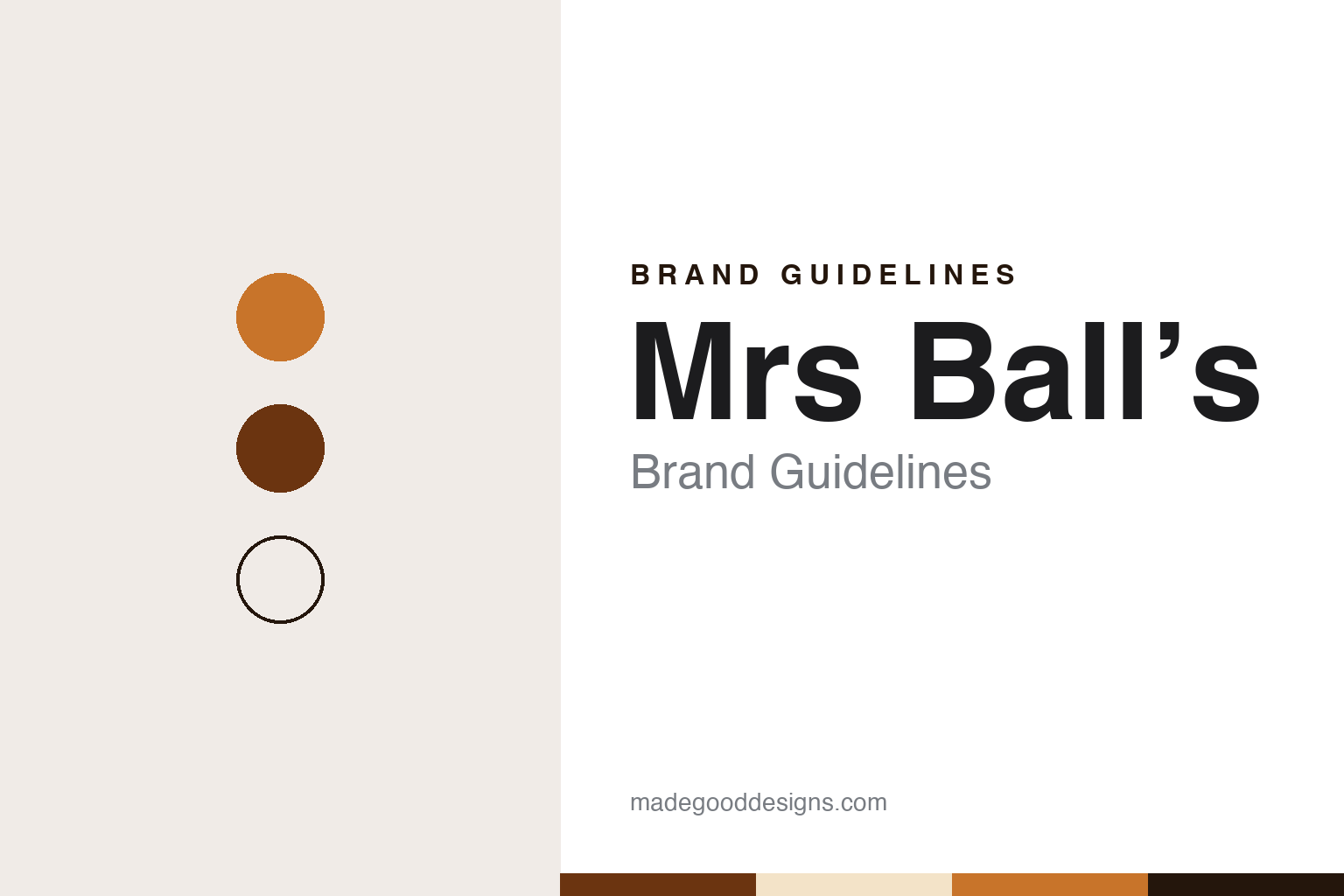
Mrs Ball’s Brand Guidelines
The Cape Town chutney in the octagonal jar.
Aa
Two constants: a Mrs Ball’s chutney brown, peach amber and cream palette and a Victorian serif register. Abstract homage — not a Mrs Ball’s product or mark; no jar, label or crest is reproduced.
The Ball kitchen
A mother’s recipe, a Cape Town kitchen and a Woodstock factory.
Mrs Ball’s chutney carries the name of Amelia Ball, born Amelia Adkins in King William’s Town, in the Eastern Cape, in 1865, according to the brand’s own history and Afrikaans Wikipedia. She married Herbert Sandleton Ball, a railway superintendent, and the couple settled in Cape Town. The recipe, the company says, was given to her as a young bride; Afrikaans Wikipedia, citing Madeleine Barnard’s 2007 book Cape Town Stories, describes it as a family recipe passed down from mother to daughter.
The recipe was on sale before Amelia made it. In 2014 the South African news site IOL reported that the chutney was first produced commercially in 1870, under a label reading “Mrs Henry Adkins Senior, Colonial Chutney Manufacturer, Fort Jackson, Cape Colony” — Amelia’s mother — and that Amelia went on making her mother’s recipe at her home in Fish Hoek, on the Cape Peninsula, until her husband met a food importer.
The company dates the Ball family’s own business to the First World War. When war broke out in 1914, its history says, the chutney was being made on a small scale and either given to friends or sold at church bazaars; demand grew until the Ball kitchen became “a makeshift production line.” Amelia and Herbert then brought in a Cape Town businessman, Fred Metter, to help them make more. A factory in Woodstock, the inner-city Cape Town district, opened in 1917 to meet demand, the company says, and as exports to Great Britain grew, a larger plant followed in Diep River, in the city’s southern suburbs. IOL also names Diep River as the factory the business moved to.
So the starting date depends on the source: 1870 for the first commercial chutney in IOL’s account, 1914 for the Ball kitchen in the company’s, and 1917 in Tiger Brands’ own list of its heritage brands, which says the chutney was “created in 1917.”
Colour
A shipwreck story, an octagonal jar and a family crest.
The brand’s best-known story is a shipwreck. Under the heading “The recipe that survived a shipwreck,” the company’s website said in 2019 that the recipe was saved when the SS Quanza was wrecked off East London in 1852, on a voyage from Canada to Australia, and that “Captain Adkins and his wife” escaped with it and settled in King William’s Town.
Afrikaans Wikipedia says that account is not true. Citing records compiled by the Ball family of Hastings, it says Amelia’s parents — Henry James Adkins, a trader from Gonubie, and Sarah Spalding — married in King William’s Town on 16 February 1852, and, citing the Wreck Site database, that the Quanza was wrecked near East London only on 26 May 1872. The wreck, it adds, was sold to Henry James Adkins for salvage. The same article says Sarah Spalding was born in Halifax, Nova Scotia, where her father was stationed with the British army.
The pack is the brand’s other story. According to the company, Fred Metter “procured both the octagonal jar and the oval label with which today’s chutney lovers are so familiar”; Afrikaans Wikipedia goes further and credits him with designing the eight-sided bottle, which it says is still used. The name “Mrs H.S. Ball’s Chutney” — Amelia’s formal married name, with her husband’s initials — and the Ball family crest at the top of the label were adopted without dispute, the company says. The trading name keeps the initials: Tiger Brands lists the brand as “Mrs H.S. Ball’s Chutney.”
In Afrikaans the condiment is blatjang, a word English Wikipedia lists among Afrikaans words of Malay-Portuguese origin; Afrikaans Wikipedia titles its article on the brand “Mrs H.S. Ball’s blatjang” and calls it a traditional South African sauce. In its 2014 list of “the brands that define Mzansi,” IOL put Mrs Ball’s beside biltong, boerewors and Ouma rusks as foods South Africans abroad seek out, called it a household name “mainly due to clever marketing,” and said bobotie, the Cape spiced-mince dish, “is unthinkable without it.”
Typography
Design and documentation.
The seven brands in this group are all food and drink brands, and all of them come from South Africa: Mrs Ball’s, Ouma, Jungle Oats, All Gold, Five Roses, Joko and Iwisa. South African food and drink brands in general sit at many different points in the trade, from names that still carry a founder’s or a family’s story to names that now belong to much larger food groups, and a single brand can be sold everywhere from a corner shop to a supermarket shelf.
A food or drink brand’s identity is usually carried less by a single product than by a pack, a name and the meal or cup it promises, because the company behind the name may have changed hands, moved its factory or grown far beyond the town where it started. That makes the questions behind each name worth asking plainly: who started it, who owns it now, and where its products are actually made and packed.
Each guide separates what independent sources record from what the company says about itself — its founding story, its owners over time, where its products are made and how its packaging has changed — and marks plainly what rests only on the company’s own word.
Aa
A Victorian serif for a chutney named after its maker. (Specimen set in Playfair Display, a serif STAND-IN; NOT the Mrs Ball’s logo.)
Tiger Brands
From Unilever’s foods business to Tiger Consumer Brands.
The family business did not stay independent. The company’s history says only that “over the years” Mrs Ball’s formed part of Unilever’s foods business, without giving dates. In April 2013, it says, Mrs Ball’s became a wholly owned subsidiary of Tiger Consumer Brands Limited, part of Tiger Brands, the South African food group whose website gives its head office as Midrand, in Gauteng.
Inside Tiger Brands the chutney sits among other long-lived South African grocery names. The group’s history page places it beside All Gold tomato sauce, which it dates to 1908, Jungle Oats (1920), Fatti’s & Moni’s pasta (1915), Black Cat peanut butter (1926) and KOO canned foods (1940). Its brand page describes Mrs Ball’s with a single line, “Everybody loves the Mrs!”, and links to the brand’s own website, mrsballs.com, whose home page carries the line “Everybody loves Mrs Balls.” In 2019 that website gave Tiger Consumer Brands’ head office as its contact and listed a separate Cape Town number for international queries.
The brand’s visual identity rests on a few documented elements rather than a published guideline: the eight-sided jar and oval label that the company credits to Fred Metter’s involvement, the Ball family crest at the top of the label, and the founder’s formal name, “Mrs H.S. Ball’s,” used as the brand.
For a design guide, Mrs Ball’s shows how a jar shape, an oval label and a founder’s formal name can carry a condiment for more than a century. Compare All Gold, the Tiger Brands tomato sauce dated to 1908, and Sharwood’s, the London mango chutney of 1889. For this guide we use chutney brown, peach amber and label cream with a serif, an unofficial interpretation; no product or logo is reproduced.
Explore & save
Keep Mrs Ball’s’s identity on hand — save it to a board in the Made Good inspiration library.
Mrs Ball’s identity set
Pin the Mrs Ball’s chutney brown, peach amber and cream palette and the Victorian serif register to your own board.