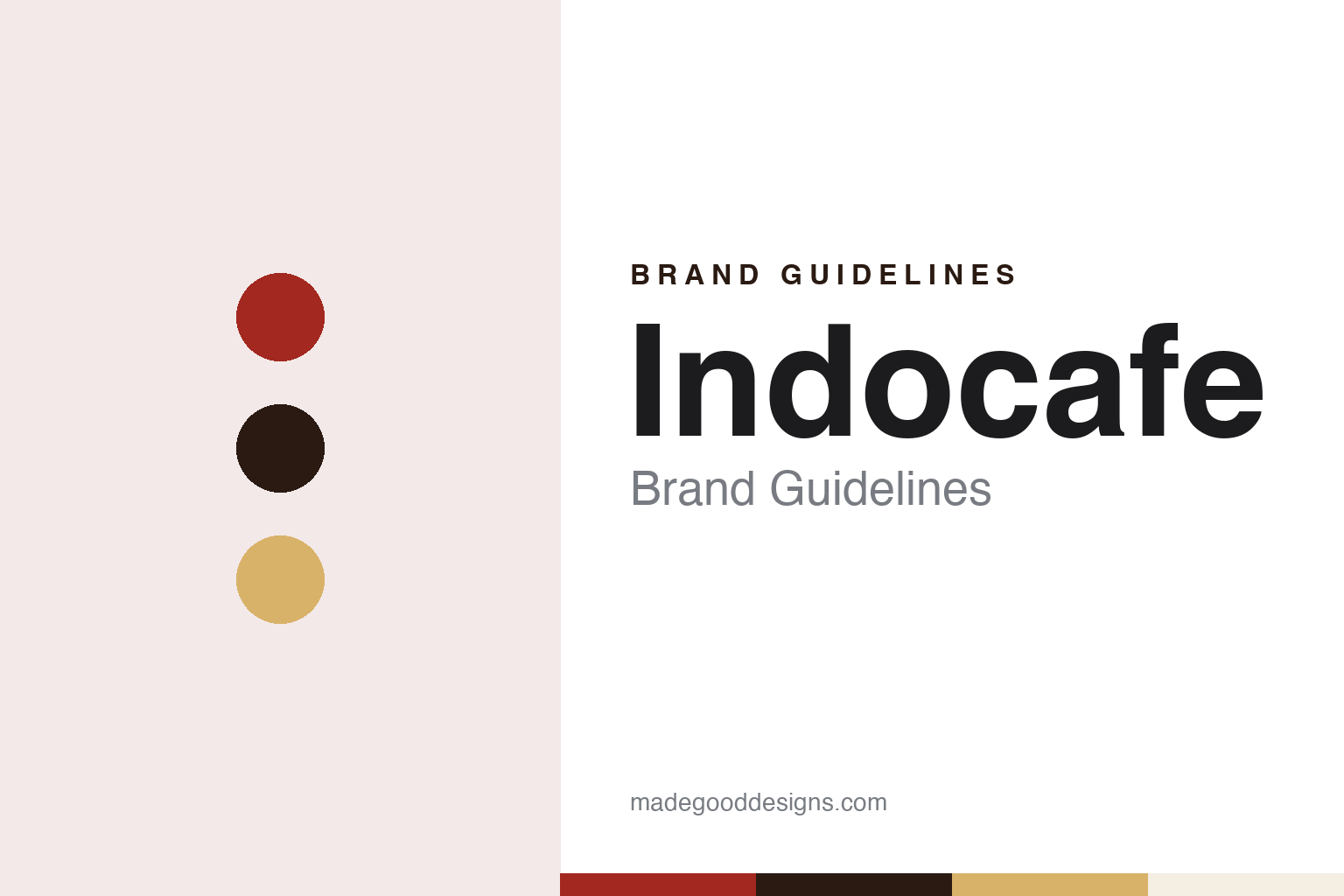
Indocafe Brand Guidelines
The Medan coffeemix that put coffee, creamer and sugar in one sachet.
Aa
Two constants: an Indocafe red, roast brown and Mandheling gold palette and a sachet grotesque register. Abstract homage — not an Indocafe product or mark; no sachet, jar or logo is reproduced.
Sari Incofood
A coffee maker on the Sumatran side of Indonesia.
Indocafe comes from North Sumatra. It is made by PT Sari Incofood Corporation, which gives its address as Medan, the provincial capital, and which Indonesian Wikipedia places at Tanjung Morawa, in Deli Serdang regency, just outside the city. The brand’s own website is marked as the property of the company.
The company dates itself to 1985. Its profile says PT Sari Incofood Corporation was established that year and grew into one of Indonesia’s leading food and drink producers and exporters, and that it has been building the business for more than 40 years. Indonesian Wikipedia gives the same year for the company and says its instant tea, MaxTea, was launched in 1985 too; the infobox of its Indocafe article also gives 1985 as the brand’s introduction.
Sari Incofood presents itself as a coffee company first. It says it selects beans from the Mandheling highlands of North Sumatra, in the Bukit Barisan mountains, and that roasting, extraction, drying and blending are done on modern machinery under close supervision, from raw material to finished pack, with a research and development team working on new products. Those are the company’s own descriptions; the certifications it lists include Indonesian food-safety registration, halal certification, ISO 22000 for food-safety management, an accredited laboratory, Indonesian national standards for its instant coffee and creamer, and organic certificates for some products.
Colour
Coffee, creamer and sugar in one sachet.
The product that defines Indocafe is Indocafe Coffeemix. Indonesian Wikipedia says the company launched it in 1989 and calls it the first 3-in-1 instant coffee in Indonesia — instant coffee, sugar and creamer measured into a single sachet — and says the move changed how Indonesians drank coffee at home. The brand’s website puts it in its own words: Indocafe Coffeemix 3 in 1, it says, was the pioneer of the 3-in-1 format, a blend of instant coffee, non-dairy creamer and sugar in a practical sachet that can be served hot or cold.
The range has grown in several directions since. The company lists Coffeemix in versions with ginseng, with ginger, and with less sugar; a black Coffee-O; Cappuccino and Caffe Latte; an Indocafe White line; a Nanyang White Coffee 3-in-1; and freeze-dried coffees under the Signature and Sumatra names. Indonesian Wikipedia marks several of these — the Special Blend, the Bold & Intense Blend and the freeze-dried Sumatra coffees among them — as export products.
A newer line leans on Indonesian geography. Indocafe’s drip-coffee pouches are named after places: Sumatra Mandheling, Java, Bali and Flores Komodo Island, alongside an organic Sumatra coffee. Ready-to-drink Origins lattes are named after the Gayo and Mandheling coffee regions, and there is even an Indocafe Ginseng Cereal.
Indocafe sits inside a larger family of brands. Sari Incofood also makes Javacafe, Westincafe, Private Club, Cloud Nine and Expresscafe coffees, House of Sumatra roasted beans, MaxTea and Teaplus teas, Indocreamer and Maxcreamer creamers, Indosereal cereals and Chococino chocolate drinks, its website says. Its flavoured Private Club coffees alone run to more than a dozen flavours, from almond and amaretto to orange and piña colada. Indonesian Wikipedia describes MaxTea as one of the country’s most popular instant teas: a sachet version of teh tarik, the frothy “pulled” milk tea of Malaysia and Singapore, made with black-tea extract from Java and Sumatra, creamer, milk and sugar.
Typography
Design and documentation.
The seven brands in this group make coffee, tea, noodles and sauces, and they come from Singapore, Indonesia, Japan, Vietnam and Malaysia: Prima Taste, Indocafe, Kopiko, Acecook, Chin-su, OLDTOWN White Coffee and BOH. Drink and food brands of this kind in general sit at many different points in the trade, from family firms that still carry a founder’s name to names that now belong to much larger food groups, and a single brand can be sold everywhere from a coffee shop counter to a supermarket shelf.
A drink or food brand’s identity is usually carried less by a single product than by a pack, a name and the cup or bowl it promises, because the company behind the name may have changed hands, moved its factory or grown far beyond the town where it started. That makes the questions behind each name worth asking plainly: who started it, who owns it now, and where its products are actually made and packed.
Each guide separates what independent sources record from what the company says about itself — its founding story, its owners over time, where its products are made and how its packaging has changed — and marks plainly what rests only on the company’s own word.
Aa
A sturdy grotesque for a brand sold by the sachet. (Specimen set in Archivo, a sans STAND-IN; NOT the Indocafe logo.)
Indocafe abroad
From Sabang to Merauke, and more than 30 countries.
Indocafe is an export brand as much as a domestic one. Sari Incofood says its products are sold across Indonesia “from Sabang to Merauke” and in more than 30 countries. The markets it names include Australia, Brunei, China, Japan, Malaysia, the Philippines, Singapore, South Korea, Taiwan and Thailand, as well as the United States, the United Kingdom and countries in the Middle East, Europe and Africa.
The company’s list of recognition is built on Indonesian brand surveys. It says it has received the Top Brand Award every year since 2010, a survey run by Frontier Consulting Group with Marketing magazine; the Indonesian Customer Satisfaction Award, based on consumer research in six large Indonesian cities by Frontier Consulting Group and SWA magazine; the Indonesia Original Brand award from SWA, for local brands that compete with foreign ones at home and abroad; the Solo Best Brand Index and Jogja Best Brand Index from the publisher of Solopos; and an Indonesia Retailer Satisfaction Award.
The name has also travelled through sport. A badminton club entered as Indocafe, from Medan, was among the teams in the Indonesian Superliga Badminton of 2007, Indonesian Wikipedia records. Online, the brand’s website runs a lifestyle feed it calls the “Mix Channel,” under the tag #BeyondFirstClass.
For a design guide, Indocafe shows how a single format — coffee, creamer and sugar measured into one sachet — can become the centre of a brand family, with newer lines named after Indonesia’s coffee islands. Compare Kapal Api, the Surabaya coffee named after a steamship, and Teh Botol Sosro, Indonesia’s bottled jasmine tea. For this guide we use sachet red, roast brown and Mandheling gold with a sans, an unofficial interpretation; no product or logo is reproduced.
Explore & save
Keep Indocafe’s identity on hand — save it to a board in the Made Good inspiration library.
Indocafe identity set
Pin the Indocafe red, roast brown and Mandheling gold palette and the sachet grotesque register to your own board.