Teh Botol Sosro Brand Guidelines
Indonesia’s jasmine tea in a glass bottle.
Aa
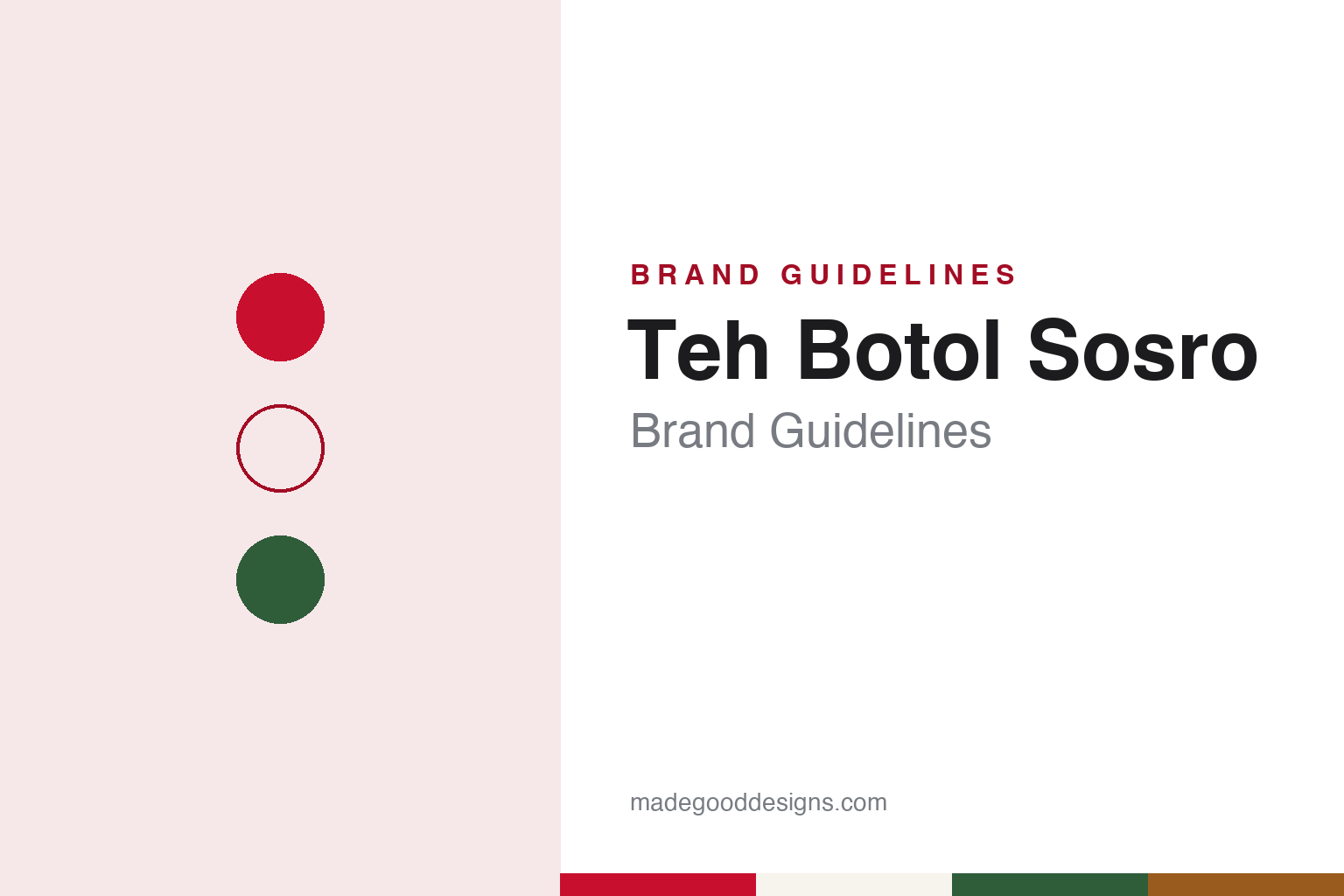
Two constants: a Teh Botol Sosro red, white and jasmine green palette and a bottle-label sans register. Abstract homage — not a Teh Botol Sosro product or mark; no bottle, label or logo is reproduced.
Teh Cap Botol
Jasmine tea from Slawi.
Teh Botol Sosro grew out of a dry-tea business. The company says the Sosro name is taken from the founding family, the Sosrodjojos, who began selling jasmine tea in 1940 in Slawi, a small town in Central Java. Their tea, a blend of green tea and jasmine flowers, was sold under the brand Teh Cap Botol and at first was distributed only around Central Java.
An older version of the company’s website names the founder as Mr Sosrodjojo, the first generation, whose market was the area around Slawi and Tegal. The business then passed to four of his sons, it says: Soemarsono, Soegiharto, Soetjipto and Surjanto Sosrodjojo. That second generation, the company says, pioneered ready-to-drink tea in glass bottles with national distribution.
The family took the tea to Jakarta, and the company’s two accounts of its history give different dates. The later version of its corporate history dates the move to 1953; the older version dates it to 1965 and says the promotion was coordinated by Soetjipto Sosrodjojo. Both describe the same campaign, called “cicip rasa”, or taste testing. Staff visited Jakarta’s markets and busy places — playing loud music to draw a crowd, the older account says — and brewed the tea on the spot. It took too long and was served too hot, and onlookers drifted away. Brewing it at the office and carrying it in large pans on open trucks failed too: the tea spilled on Jakarta’s potholed roads.
The answer was a bottle. Staff poured the brewed tea into cleaned, used glass bottles — the kind normally used for soda and soy sauce, the company says — and the samples finally worked; the method was kept for several years. Indonesian Wikipedia records a second origin story, that the idea came from schoolchildren in Slawi who carried tea to school in bottles, but describes the Jakarta account on the company’s website as the more official one.
Colour
Three bottles, 1970 to 1974.
In 1969, the company says, the idea of selling ready-to-drink tea in glass bottles took shape, and the first bottles reached the market in 1970. The new brand drew on two assets: part of the family name, and the “Cap Botol” name that was already known in Jakarta. Sosro says its bottled tea was the first ready-to-drink tea in a bottle in Indonesia and in the world — the company’s own claim.
The company’s corporate history sets out the bottle’s design changes in unusual detail. The first version, of 1970, carried the name “Tehcap Botol Soft Drink Sosrodjojo”. The second, in 1972, read “Teh Cap Botol,” with the word “Cap” set smaller so that people would see more of “Teh Botol”; “Soft Drink” was dropped, “Teh Botol” was written in red and white “to symbolize that it was a product of Indonesia,” and the family name was shortened to Sosro inside a red circle logo. The third change came in 1974, when the bottle took a new shape and the brand its present name, Teh Botol Sosro — written “Tehbotol Sosro” on the company’s website. The older history says that bottle design has stayed the same since.
Indonesian Wikipedia records the brand’s advertising lines. “Pelepas Dahaga Asli,” roughly “the original thirst-quencher,” ran from 1974 to 1990; “Apapun makanannya, minumnya Teh Botol Sosro” — “whatever the food, the drink is Teh Botol Sosro” — has run since 2003; and shorter lines such as “Asli. Alami.” and “Asli Segarnya” came between 2005 and 2014. For the Sosro name as a whole, Indonesian Wikipedia lists “Hari-Hari Teh Sosro” from 1974 and “Ahlinya Teh,” “the tea expert,” from 1999.
The glass bottle was later joined by other packs. By 2014, the company listed the returnable 220 ml glass bottle alongside Tetra Pak cartons from 200 ml to one litre, a 450 ml plastic bottle and a 150 ml pouch, as well as a Less Sugar variant. Indonesian Wikipedia says cartons of 200 ml and 250 ml arrived in the 1990s.
Typography
Indonesia’s food and drink makers.
The seven brands in this group all make food and drink, and they come from Indonesia and Vietnam: ABC, Bango, Kapal Api, Teh Botol Sosro, Vinamilk, Trung Nguyên and Mayora. Food and drink brands in general sit at many different points in the trade, from family firms that still carry a founder’s surname to names that now belong to much larger food groups, and a single brand can be sold everywhere from a roadside stall to a supermarket shelf.
A food or drink brand’s identity is usually carried less by a single product than by a pack, a name and the meal or drink it promises, because the company behind the name may have changed hands, moved its factory or grown far beyond the town where it started. That makes the questions behind each name worth asking plainly: who started it, who owns it now, and where its products are actually made and packed.
Each guide separates what independent sources record from what the company says about itself — its founding story, its owners over time, where its products are made and how its packaging has changed — and marks plainly what rests only on the company’s own word.
Aa
A condensed, bottle-label sans. (Specimen set in Archivo, a sans STAND-IN; NOT the Teh Botol Sosro logo.)
PT Sinar Sosro
A Cakung plant and three generations.
The bottling company, PT Sinar Sosro, was established with its first plant at Ujung Menteng — then part of the Bekasi area, now Cakung in East Jakarta — in 1974, according to the older company history; the later version says a bottled-tea plant was established in 1970. The company describes three generations of Sosrodjojo management: the founder in Slawi; the four sons who built national distribution from Cakung; and, from the 1990s, a third generation that developed new products and packs and took Sosro products to international markets.
Indonesian Wikipedia says the original dry tea is still made, as Teh Cap Botol loose tea and tea bags, by PT Gunung Slamat, a company in the Rekso Group. It lists tea from estates in Cianjur, Garut, Pangalengan and Tasikmalaya in West Java, and ten Sinar Sosro factories across Indonesia, among them Cakung, Tambun and Cibitung near Jakarta, Ungaran in Central Java, Gresik and Mojokerto in East Java, Bali, Deli Serdang in North Sumatra and Palembang. Alongside Teh Botol Sosro, the company makes Fruit Tea, S-Tee, Country Choice juices and Prim-A mineral water.
Competition grew as “teh botol” came close to being a generic term. Indonesian Wikipedia says rivals followed in glass bottles and later in cups and plastic bottles — from Mayora’s Teh Pucuk Harum to Coca-Cola’s Frestea — and that Sosro answered with new brands and new packs.
For a design guide, Teh Botol Sosro shows a brand built from its container: a glass bottle that gave the tea its name, red-and-white lettering chosen to say “made in Indonesia,” and a red circle around the family name. Compare Mayora, maker of the rival Teh Pucuk Harum, and Kapal Api, another family-built Indonesian drinks brand. For this guide we use a bottle red, glass white and jasmine green with a sans, an unofficial interpretation; no product or logo is reproduced.
Explore & save
Keep Teh Botol Sosro’s identity on hand — save it to a board in the Made Good inspiration library.
Teh Botol Sosro identity set
Pin the Teh Botol Sosro red, white and jasmine green palette and the bottle-label sans register to your own board.