Kapal Api Brand Guidelines
The 1927 Surabaya coffee named after a steamship.
Aa
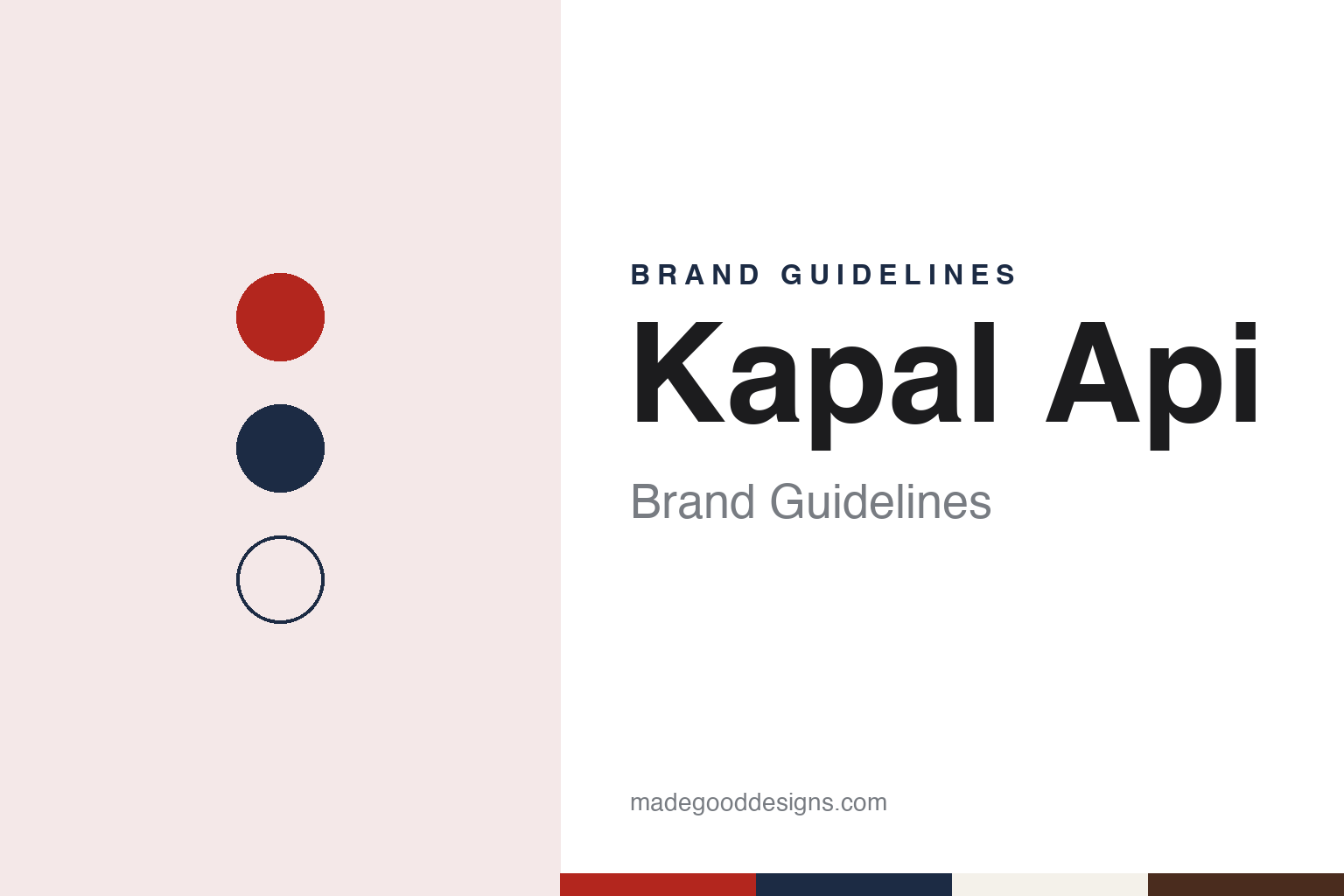
Two constants: a Kapal Api red, navy and white palette and a harbour slab serif register. Abstract homage — not a Kapal Api product or mark; no pack, ship emblem or logo is reproduced.
Hap Hoo Tjan
A coffee grinder in a port city.
Kapal Api began in Surabaya, the port city of East Java, in 1927. Indonesian Wikipedia says its founder, Go Soe Loet, was a migrant from Fujian in China who arrived in Indonesia in 1920, and that in Surabaya he and his brothers Go Bie Tjong and Go Soe Bie started a small coffee-grinding business called Hap Hoo Tjan — a name it renders in Indonesian as “Kapal Api.” The company’s own website, in a 2007 version preserved by the Internet Archive, describes its roots as “a small home industry company in Surabaya” and dates the founder’s coffee to 1927.
The two accounts differ on where the coffee was first sold. Indonesian Wikipedia places it at Tanjung Perak, Surabaya’s harbour; the company’s 2008 website says Kapal Api “began in 1927 as unbranded coffee packed in Pabean market, Surabaya.” Indonesian Wikipedia says the coffee was wrapped in paper and found a wide following, and that the brothers’ business was divided three ways in 1962, with Go Soe Loet taking the coffee-roasting plant.
The next generation turned a family roastery into a manufacturer. Indonesian Wikipedia says Go Soe Loet’s second son, Soedomo Mergonoto, sold the coffee by bicycle, then bought processing machinery, introduced new management and advertised on television before rival roasters did. The company’s 2007 website dates that change to 1970, when “the second generation emerged,” modernising machinery, skills and management and extending distribution across East Java.
The family’s coffee business was incorporated on 18 May 1979 as PT Santos Jaya Coffee Company, Indonesian Wikipedia says, and later took the name PT Santos Jaya Abadi. In 1980, according to the company, it built the factory at Sepanjang, Sidoarjo, just south of Surabaya, which it still described as its existing plant in 2007. In the 1980s, Indonesian Wikipedia says, Kapal Api’s sales spread to Indonesia’s big cities and abroad.
Colour
A steamship for a name.
The name is the brand’s central image. The company’s 2007 website translates the trade mark “Kapal Api” as “Steam Ship” and says it drew its inspiration from the steamship, “which at that time was the symbol of technological superiority and a mark of luxury.” Indonesian Wikipedia gives two further reasons for the choice: the name honoured the ship that had carried Go Soe Loet to Indonesia, and it suited the harbour where, by its account, he first sold his coffee.
Kapal Api’s range is built around ground coffee. In 2008 the company listed Kapal Api Special, a pure roast-and-ground coffee; Kapal Api Special Mix, the same coffee with sugar; Kapal Api Kopi Susu, a three-in-one coffee with milk; and a newly launched Mocha. The same website said Kapal Api had reached markets in South-East Asia and beyond, and called it Indonesia’s market leader — the company’s own description.
The company has also listed design and branding recognition. Its awards page, as captured in 2009, named an Indonesia Good Design Selection in 2002 and a Packaging Consumer Branding Award in 2005, alongside a Top Brand Award for Kapal Api in each year from 2000 to 2007 and an Indonesian Customer Satisfaction Award from 2001 to 2007. The page did not say which products the design awards were for.
Around the coffee, the family built a group. Indonesian Wikipedia lists a coffee-plantation company in Tana Toraja, South Sulawesi, founded in 1986; Excelso, the coffee brand and café chain, which it dates to 1990 and the company dates to 1991; the confectionery maker PT Agel Langgeng in 1991; the distributor PT Fastrata Buana in 1992; a soft-drinks business in 1994; and the purchase of the sweet maker PT Inasentra Unisatya in 2000. The group’s other coffee brands include ABC, Good Day, Ya! and Kapten, and its sweets include a Kapal Api coffee candy.
Typography
Indonesia’s food and drink makers.
The seven brands in this group all make food and drink, and they come from Indonesia and Vietnam: ABC, Bango, Kapal Api, Teh Botol Sosro, Vinamilk, Trung Nguyên and Mayora. Food and drink brands in general sit at many different points in the trade, from family firms that still carry a founder’s surname to names that now belong to much larger food groups, and a single brand can be sold everywhere from a roadside stall to a supermarket shelf.
A food or drink brand’s identity is usually carried less by a single product than by a pack, a name and the meal or drink it promises, because the company behind the name may have changed hands, moved its factory or grown far beyond the town where it started. That makes the questions behind each name worth asking plainly: who started it, who owns it now, and where its products are actually made and packed.
Each guide separates what independent sources record from what the company says about itself — its founding story, its owners over time, where its products are made and how its packaging has changed — and marks plainly what rests only on the company’s own word.
Aa
A slab serif for a harbour-born coffee. (Specimen set in Roboto Slab, a serif STAND-IN; NOT the Kapal Api logo.)
Kapal Api Group
Three generations, still in the family.
Kapal Api remains a family business. Indonesian Wikipedia says that from 2013 Soedomo Mergonoto began bringing the third generation of the Go family into the leadership, including his son Christeven Mergonoto, and set up the Kapal Api Global name. The group now presents itself as Kapal Api Group: its website names PT Kapal Api Global, with an office in central Jakarta, and describes PT Santos Jaya Abadi as “a multinational company that produces beverages based in Sepanjang, Sidoarjo.”
On where the coffee is made, the company’s own description points to East Java and the Sepanjang factory built in 1980, which Indonesian Wikipedia places in Taman, Sidoarjo. The group’s plantation company, PT Sulotco Jaya Abadi, produces Arabica Toraja coffee at Rantekarua in Sulawesi, the website says. The sweets and biscuits come from Agel Langgeng, whose factories Indonesian Wikipedia lists at Bekasi, Dawuan and Pasuruan.
Abroad, the website says, Kapal Api Global distributes “more than 100 products to 68 countries.” At home, Excelso has 126 cafés in major Indonesian cities, according to the same site.
For a design guide, Kapal Api shows how a single image in a name — a steamship, chosen as a sign of modern technology and luxury — can carry a coffee from a Surabaya market to an export range. Compare Trung Nguyên, a Vietnamese coffee brand, and Indomie, another Indonesian staple. For this guide we use a roast red, harbour navy and steam white with a slab serif, an unofficial interpretation; no product or logo is reproduced.
Explore & save
Keep Kapal Api’s identity on hand — save it to a board in the Made Good inspiration library.
Kapal Api identity set
Pin the Kapal Api red, navy and white palette and the harbour slab serif register to your own board.