White Rabbit Brand Guidelines
The Shanghai milk candy that began as ABC Mickey Mouse.
Aa
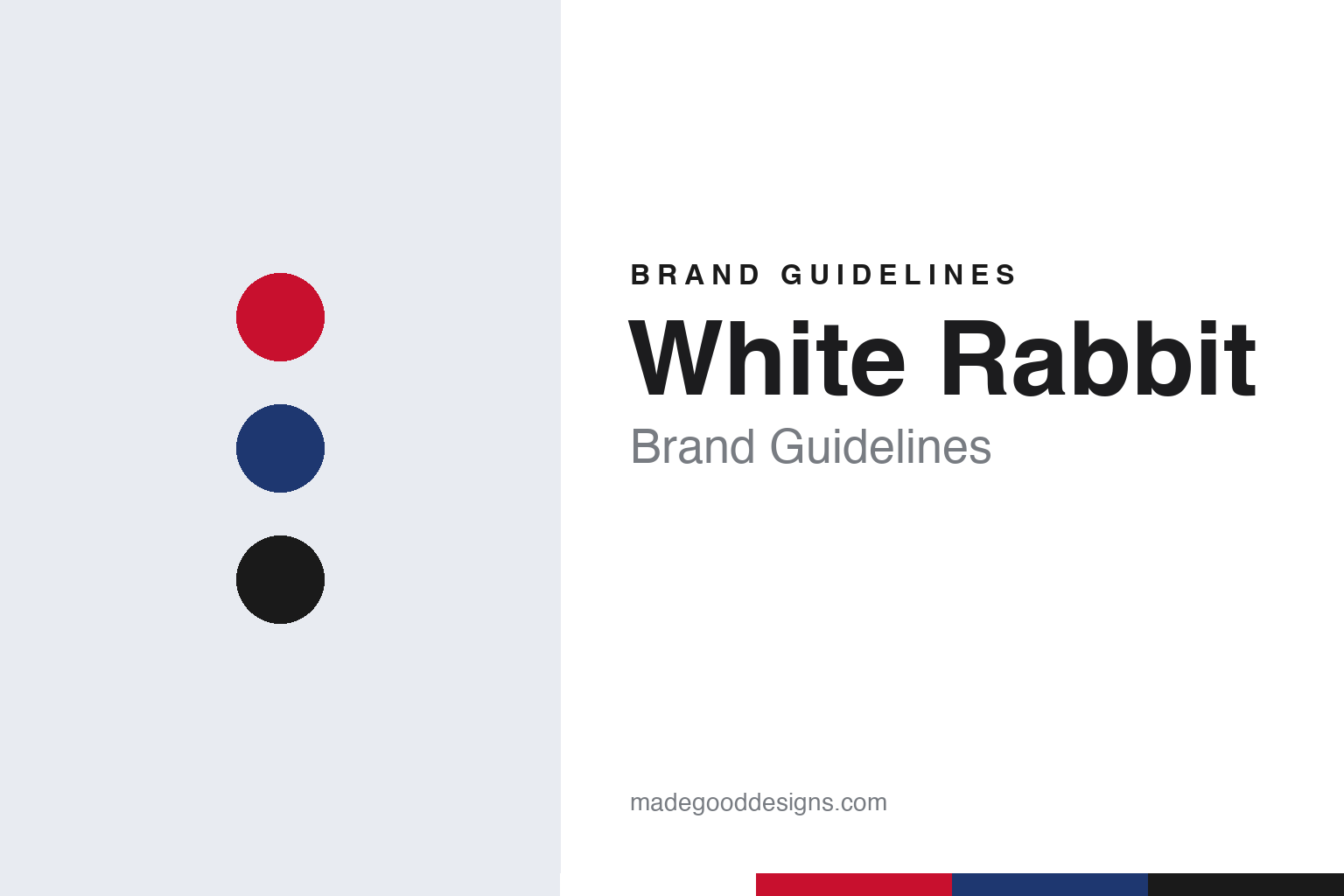
Two constants: a red, blue and black on white palette and an art deco sans register. Abstract homage — not a White Rabbit product or mark; no wrapper, rabbit or logo is reproduced.
From Mickey Mouse to a rabbit
A Shanghai candy factory, a borrowed mouse and a new name.
White Rabbit began in Shanghai in 1943, at a confectionery business called the ABC Candy Factory. English Wikipedia says a merchant who had visited England and tasted milk candy there spent six months developing a Chinese version, and that it sold well because it was cheaper than imported sweets. Chinese Wikipedia names the factory’s owner as Feng Boyong and credits the original formula — liquid glucose, white sugar, milk powder and condensed milk — to Liu Yiqing, adding that the first candies were made by hand. The wrapper did not show a rabbit. The sweets were sold as ABC Mickey Mouse candy, with the Disney character on the pack.
The rabbit arrived after the Communist takeover. In 1956, Chinese Wikipedia says, the ABC factory passed into state ownership and was renamed the Aimin Candy Factory. A mouse borrowed from an American film studio no longer fitted: the Mickey Mouse branding was criticised as “worship of foreign things,” and the Shanghai Art Design Company was asked to draw new packaging around a white rabbit. Chinese Wikipedia dates the White Rabbit candy’s debut to 1959, when it was produced as a gift for the 10th anniversary of the People’s Republic on National Day.
The candy then moved between Shanghai’s state food businesses. In 1976, according to Chinese Wikipedia, the Aimin factory was merged into Guan Sheng Yuan, one of the city’s best-known food names. Guan Sheng Yuan was older than the candy: Chinese Wikipedia says it was founded in Shanghai in 1918 by Xian Guansheng, grew branches in cities from Nanjing to Kunming in the 1920s, and in 1934 ran a mooncake campaign with the film star Hu Die. White Rabbit became that company’s most famous product, and it has stayed with Guan Sheng Yuan ever since.
Colour
A rabbit, a paint palette and an edible wrapper.
English Wikipedia describes the design that replaced Mickey Mouse as a naturalistically drawn white rabbit and an artist’s paint palette, with Chinese and English hand-lettering in red, blue and black against a white background. The same article says the rabbit has changed position over the years: on the earliest outer packs it was lying down, later it was shown jumping, and on today’s outer packaging the trademark animal has large, forward-facing eyes in what the article calls a “Disneyesque” style, while the individual candy wrappers keep the older art deco design and the naturalistic rabbit.
The candy itself is part of the identity. English Wikipedia describes each piece as a small cylinder about 3 cm long, wrapped first in a thin layer of edible rice paper and then in a printed waxed-paper twist. The original flavour is vanilla milk; the company has added many more over the years, among them chocolate, coffee, red bean and matcha.
White Rabbit also carries political history. When Richard Nixon visited China in 1972, Premier Zhou Enlai gave the US delegation White Rabbit candy, the Associated Press reported in September 2008. English Wikipedia calls the candy part of many mainland Chinese and Hong Kong people’s childhood nostalgia, and Chinese Wikipedia says the brand received a national silver award in 1979.
Since the mid-2010s the brand has leaned on that nostalgia through partnerships. Chinese Wikipedia lists a limited gift tin with the French fashion label agnès b. in 2016; a milk-scented lip balm made with Shanghai Jahwa’s Maxam brand in September 2018; a White Rabbit ice cream with the Shanghai Yimin food factory in March 2020; and a milk drink with Bright Dairy, a sister company in the same state group, in September 2021.
Typography
Design and documentation.
The seven brands in this group all make food or drink, and all of them come from mainland China, from groups founded in Taiwan, or from Hong Kong: Haday, Wahaha, Master Kong, Want Want, White Rabbit, Totole and Vitasoy. Chinese food and drink brands in general sit at many different points in the trade, from firms that still carry a founder’s family at the top to names that now belong to much larger groups, and a single brand can be sold everywhere from a corner shop to a supermarket shelf abroad.
A food or drink brand’s identity is usually carried less by a single product than by a pack, a name and the meal or snack it promises, because the company behind the name may have changed hands, moved its factories or grown far beyond the city where it started. That makes the questions behind each name worth asking plainly: who started it, who owns it now, and where its products are actually made and packed.
Each guide separates what independent sources record from what the company says about itself — its founding story, its owners over time, where its products are made and how its packaging has changed — and marks plainly what rests only on the company’s own word.
Aa
An art deco sans for a wrapper with hand-lettered Chinese and English. (Specimen set in Josefin Sans, a sans STAND-IN; NOT the White Rabbit logo or lettering.)
White Rabbit
A Guan Sheng Yuan brand inside a city-owned food group.
Today White Rabbit is made by Shanghai Guan Sheng Yuan Food. English Wikipedia, citing the Guan Sheng Yuan group’s website, says the brand was transferred to Guan Sheng Yuan (Group) Co., Ltd. in November 1997; Chinese Wikipedia dates the formation of that group company to 1996. The group is now a subsidiary of Bright Food (Group), which English Wikipedia says was formed in August 2006 by merging several Shanghai state food and drink businesses and is wholly owned by the Shanghai municipal government. Bright Food’s other brands include the Bright dairy range. The group’s website said the candy was exported to more than 40 countries and territories, English Wikipedia reports.
In September 2008 White Rabbit was among the Chinese milk-based products recalled in several countries during the melamine contamination of Chinese dairy supplies; in the UK, Tesco withdrew it on 24 September 2008.
A wrapper first built around a borrowed cartoon character was redrawn by a state design company in the late 1950s, and its basic elements — the white rabbit, the paint palette, the hand-lettering in two scripts and the red, blue and black on white — date from that redesign, and English Wikipedia says the individual wrappers still keep the classic design.
For a design guide, White Rabbit shows how a single wrapper can carry a brand for more than six decades: a clear animal mark, a limited three-colour palette and bilingual lettering that stays legible at the size of a sweet. Compare Werther’s Original, another individually wrapped caramel sweet, and Lao Gan Ma, a Chinese brand with its founder on the label. For this guide we use wrapper red, lettering blue and outline black on milk white with an art deco sans, an unofficial interpretation; no product or logo is reproduced.
Explore & save
Keep White Rabbit’s identity on hand — save it to a board in the Made Good inspiration library.
White Rabbit identity set
Pin the White Rabbit red, blue and black on white palette and the art deco sans register to your own board.