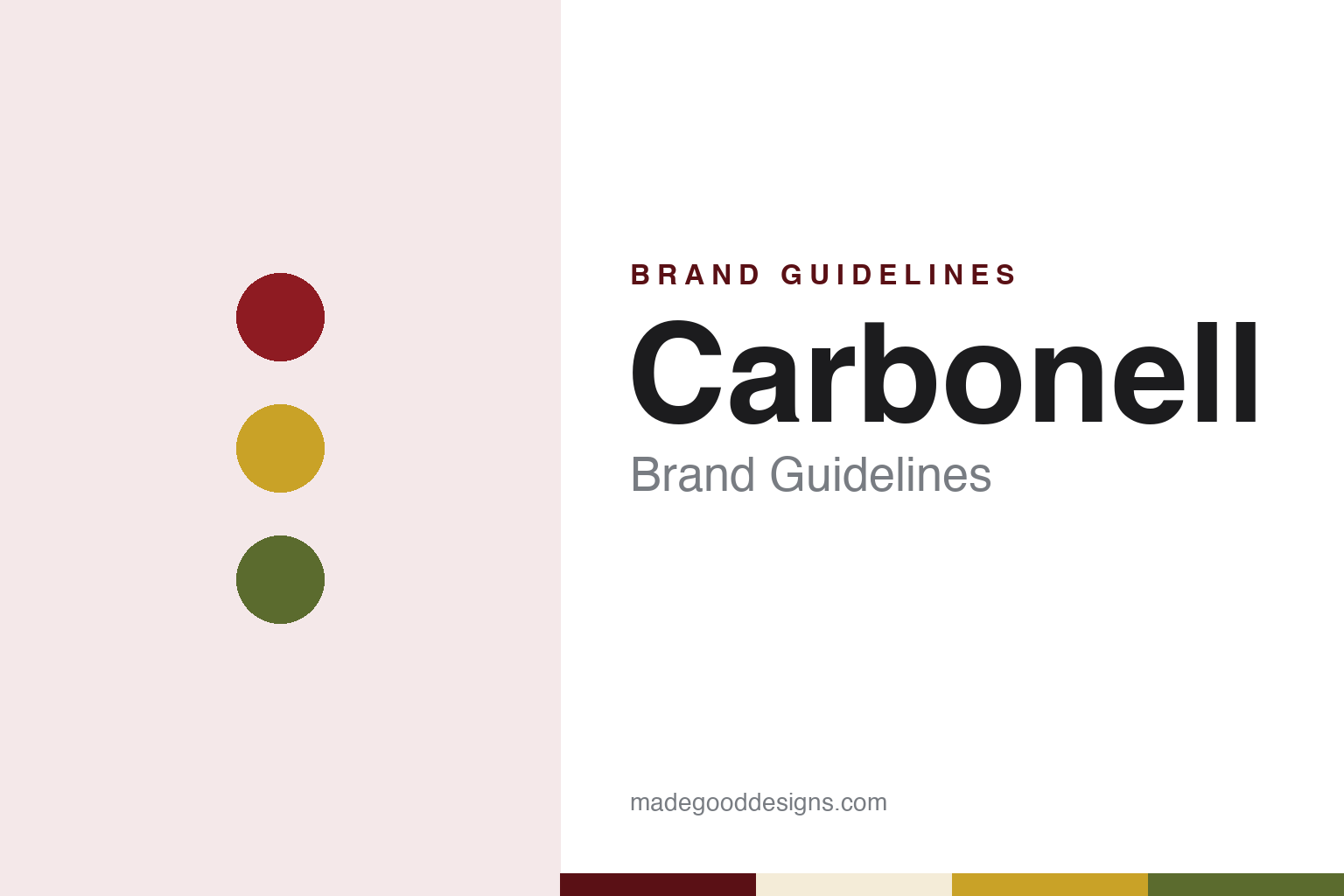
Carbonell Brand Guidelines
The 1866 Córdoba olive oil with the gitana label.
Aa
Two constants: a Córdoba red, oil gold and olive leaf palette and a Belle Époque serif register. Abstract homage — not a Carbonell product or mark; no bottle, label or logo is reproduced.
Casa Carbonell
An Alcoy family, a Córdoba oil house and an export trade.
Carbonell is one of the oldest names in Spanish olive oil. The company says Antonio Carbonell y Llácer, a nineteenth-century businessman, founded the Casa Carbonell in Córdoba in 1866, convinced that olive oil sold to the quality standards of the international market could bring wealth and work to the Andalusian countryside. Spanish Wikipedia dates the founding to July 1866, says the family came from Alcoy, in the province of Alicante, and gives the early trading name as “La Providencia – Carbonell.”
The founder’s son made it an exporter. Spanish Wikipedia says Carlos Carbonell y Morand, born in Alcoy in 1856, took over in 1878, at 22, and ran the house until 1917; it calls him the greatest promoter of Aceites Carbonell. He turned the business toward selling Spanish oil in Europe, founded Córdoba’s Chamber of Commerce, backed the Guadalmellato dam and the Puertollano–Córdoba railway, and was elected a deputy four times. He is credited with the house motto, “La unión, la providencia y el trabajo” — union, providence and work.
Prizes and patrons followed, as the company tells it. In 1888, it says, Carbonell won a British Admiralty competition and went on to supply oil to the British fleet until the end of the First World War, and the same year it took a gold medal at the Barcelona Universal Exposition. In 1895 the Queen Regent, María Cristina of Austria, named it an official supplier to the Spanish Royal Household. A Grand Prize at the St Louis exposition followed in 1904, and in 1910 three grand prizes of honour at Buenos Aires for its olive oil, olives and Montilla wines. From 1922 the company bought its first mills and olive estates, and in 1941 it set up a welfare fund for its employees. The business was broader than oil: the company says that in 1966 olive oil made up 45% of sales, alongside olives, timber, wine, soap and flour. It also says that by 1950 Carbonell was present in more than 70 countries and led Spain’s olive-oil exports.
Colour
The gitana, the Mezquita and the rPET bottle.
Carbonell’s emblem is a woman of Córdoba. The company says that in 1904 the painter Pere Casas Abarca made a poster of a gitana, a woman of Andalusia, that later became the brand’s icon, and that the illustration began to appear on its tins in 1910; it says it dressed those tins with work by the leading designers and illustrators of the time. Spanish Wikipedia describes the portrait as Art Nouveau in style. The image has been redrawn rather than retired: in 2009, the company says, it modernised the gitana to reflect the Spanish woman of today, and in 2024 it updated the look of its packs again.
The bottle carries the second half of the identity. The company says it moved from tins to glass bottles in the 1960s, and its timeline places the launch of the Mezquita bottle in 1987, a shape that nods to the horseshoe arches of the Mosque of Córdoba. It says the design won a special prize from the Centro del Envase de Vidrio, the Spanish glass-packaging body, in its launch year. In 2014 the same outline was applied to the brand’s PET bottle, unifying glass and plastic, and since 2023, the company says, the whole range has been packed in bottles of 100% recycled PET.
Advertising has leaned on home cooking and the land. In 2004 the company launched “Primera Campaña,” an oil it presents as a homage to its founder and to the harvest and first pressing of 1866. For its 150th anniversary in 2016 it published a family recipe book, 150 años en casa, and moved a bust of Carlos Carbonell from Deoleo’s site at Alcolea to the Plaza Flor del Olivo in Córdoba, where the old Carbonell factory stood. A 2018 campaign, “Sé de un lugar,” was built around a song by the Andalusian rock band Triana, and in 2019 the brand paid tribute to olive farmers. The company also lists a place in a “Top 100 European Brands” ranking in 1995 and a Premio Príncipe Felipe for brand management in 2007.
Typography
Design and documentation.
The seven brands in this group are food brands, and all of them come from Spain or Italy: Fontaneda, Carbonell, Hojiblanca, Galbani, Star, Ponti and Bauli. Spanish and Italian food brands in general sit at many different points in the trade, from family firms that still carry a founder’s surname to names that now belong to much larger food groups, and a single brand can be sold everywhere from a village shop to a supermarket shelf abroad.
A food brand’s identity is usually carried less by a single product than by a pack, a name and the meal or occasion it promises, because the company behind the name may have changed hands, moved its factory or grown far beyond the town where it started. That makes the questions behind each name worth asking plainly: who started it, who owns it now, and where its products are actually made and packed.
Each guide separates what independent sources record from what the company says about itself — its founding story, its owners over time, where its products are made and how its packaging has changed — and marks plainly what rests only on the company’s own word.
Aa
A Belle Époque serif for a label born at a 1904 exposition. (Specimen set in Playfair Display, a serif STAND-IN; NOT the Carbonell logo.)
Carbonell
Koipe, Grupo SOS and Deoleo.
Carbonell has changed hands more than once. The company says that after a period with business groups of French and then Italian origin, the brand belonged to Grupo Koipe, and that in 2001 Grupo SOS bought Koipe, Carbonell included, becoming in its words Spain’s second-largest food group. Spanish Wikipedia also gives 2001 as the year Carbonell joined Grupo SOS.
That group became Deoleo. Spanish Wikipedia traces it to Arana Maderas, a company set up in Bilbao in 1955, which became SOS Arana Alimentación through a merger in 1994. In 2011, Spanish Wikipedia says, SOS Corporación Alimentaria renamed itself Deoleo as it concentrated on olive oil; Carbonell’s own timeline marks the birth of Deoleo in 2010, with Carbonell as its ambassador brand. Spanish Wikipedia says the private-equity firm CVC Capital Partners became Deoleo’s principal shareholder in 2014. Deoleo’s brands today include Bertolli, Carapelli, Koipe and Maestros de Hojiblanca alongside Carbonell; Spanish Wikipedia places the group’s head office in Córdoba, while Deoleo’s own website lists its main office in Rivas-Vaciamadrid, near Madrid.
The oil is still bottled in its home province. Spanish Wikipedia says Carbonell is produced at Alcolea, on the outskirts of Córdoba, one of Deoleo’s two factories, the other being at Tavarnelle, in Italy. The company says the brand reaches more than 70 countries. Its range has grown from the classic olive oil to single-variety Arbequina, Hojiblanca and Picual extra virgin oils, which the company dates to 2015, sprays launched in 2012 and a line of table olives under the Carbonell name.
For a design guide, Carbonell shows how a single painted face and a bottle shaped like a Córdoba arch can keep a 160-year-old oil recognisable through several changes of owner. Compare Bertolli, its stablemate at Deoleo, and Núñez de Prado, the organic oil from Baena, also in the province of Córdoba. For this guide we use a Córdoba red, oil gold and olive leaf with a serif, an unofficial interpretation; no product or logo is reproduced.
Explore & save
Keep Carbonell’s identity on hand — save it to a board in the Made Good inspiration library.
Carbonell identity set
Pin the Carbonell Córdoba red, oil gold and olive leaf palette and the Belle Époque serif register to your own board.