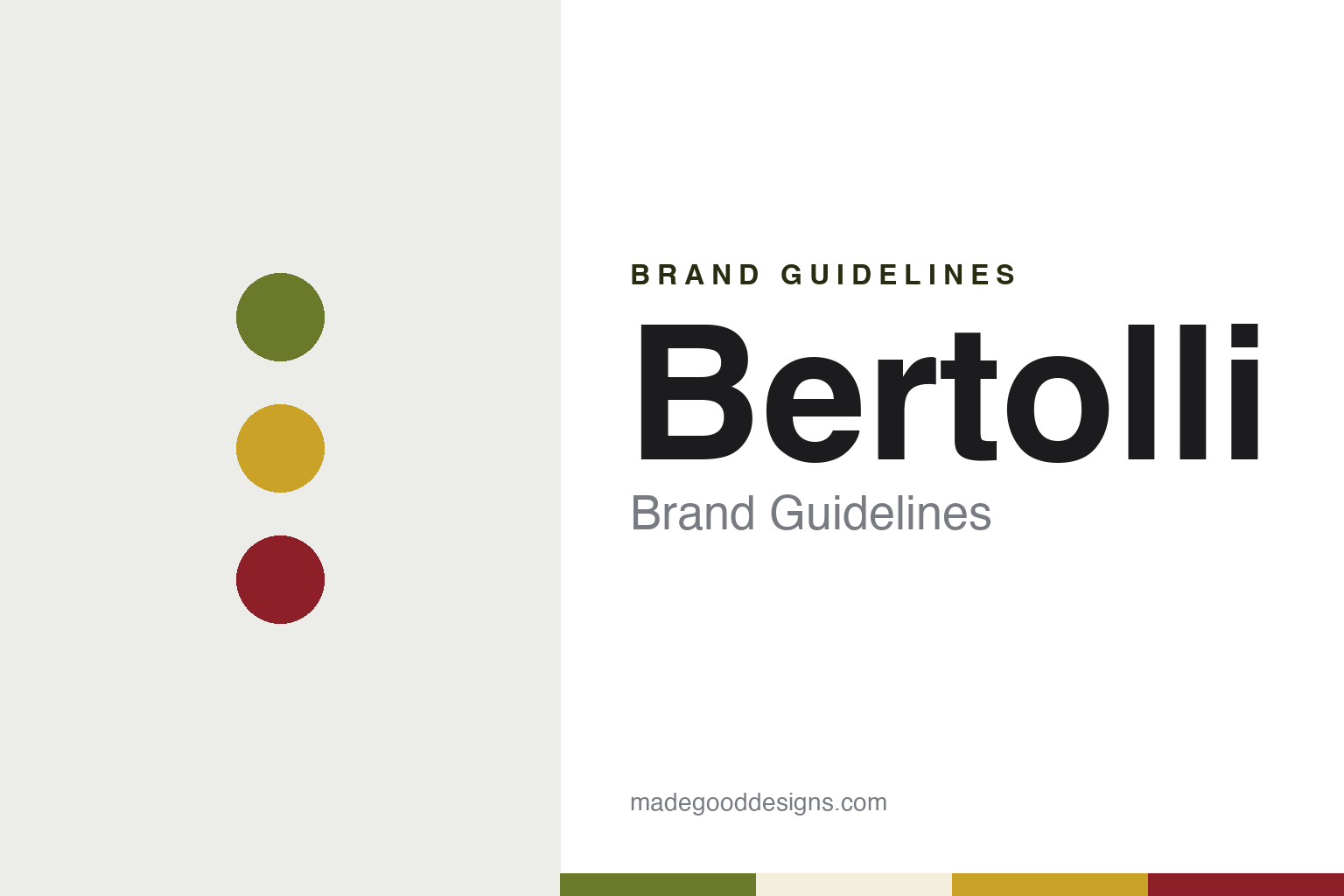
Bertolli Brand Guidelines
The 1865 Lucca olive-oil name now split between owners.
Aa
Two constants: an olive green, oil gold and Tuscan red palette and a classical Tuscan serif register. Abstract homage — not a Bertolli product or mark; no bottle, jar or logo is reproduced.
A shop in Lucca
A Tuscan couple, a shop and an export trade.
Bertolli began in Lucca, in Tuscany, in 1865, when Francesco Bertolli and his wife Caterina opened a business there. English Wikipedia says they started out selling produce such as wine, cheese, olives and olive oil; Italian Wikipedia describes a small shop that resold oil. Lucca was then part of the Kingdom of Italy, proclaimed four years earlier.
The shop grew into a regional company. Italian Wikipedia says that by the early twentieth century Bertolli had oil refineries in Lucca and in the port city of Livorno, a wine-bottling plant at Castellina Scalo and an export trade to the Americas. The family name also went into banking: a Banca Francesco Bertolli operated from 1875 until 1970, when it was merged into the Banca Commerciale Italiana, Italian Wikipedia says.
The family ran the oil company for more than a century. Italian Wikipedia says it ran into difficulties in the 1960s, and in 1972 the Bertolli family sold it to Alimont, the food arm of the chemicals group Montedison, English Wikipedia says. That began two decades of state and corporate ownership. Alimont was renamed Alivar, and Alivar passed in 1974, Italian Wikipedia says, to SME, a food and industrial holding company controlled by the Italian state through IRI. SME grouped Bertolli with other food brands it owned, and from 1986 the combined business was called Cirio Bertolli De Rica, joining the oil name to the Cirio tomato brand and the De Rica canned-goods brand.
When SME was broken up in the early 1990s, Cirio Bertolli De Rica was sold to Fisvi, a financial company, and Bertolli then passed from Fisvi to Unilever. The dates differ between sources: Italian Wikipedia says Fisvi sold the brand in 1993, acting on Unilever’s behalf, for 310 billion lire, while English Wikipedia dates Unilever’s purchase to 1994. Under Unilever, Italian Wikipedia says, oil production moved to the group’s factory at Inveruno, west of Milan.
Colour
Unilever builds a brand, then sells it in pieces.
Unilever used the Bertolli name well beyond olive oil. By the 2000s it sold Bertolli pasta sauces, frozen meals and spreads as well as oil, English Wikipedia says, which is why the brand is split between so many companies today. The dismantling came in stages over thirteen years, as Unilever sold businesses it no longer considered core.
The olive oil went first. In 2008 Unilever sold the Bertolli oil business to the Spanish group Grupo SOS, now Deoleo, together with the Italian oil brands Maya, Dante and San Giorgio and the Inveruno factory. English Wikipedia puts the price at £500 million; Italian Wikipedia gives €630 million. In August 2012 Unilever sold the Bertolli frozen-meals business in the United States to ConAgra Foods.
The decisive change for the trademark came in 2014. On 22 May 2014 Unilever agreed to sell its North American pasta-sauce business, under the Ragú and Bertolli names, to the Japanese food group Mizkan for US$2.15 billion. English Wikipedia says that as part of the deal Mizkan obtained the Bertolli brand and trademark itself, and licensed it to ConAgra, Deoleo and Unilever. Mizkan therefore owns the name, while Deoleo sells the oil under licence.
The remaining pieces followed. When Unilever spun off its spreads business in 2018 as Upfield, since renamed Flora Food Group, the Bertolli spread and its licence went with it, English Wikipedia says. In 2021 Unilever sold its European pasta-sauce and mayonnaise business under the Bertolli brand and licence to Enrico-Glasbest, a Dutch food manufacturer.
Typography
Design and documentation.
The seven brands in this group all make sauces, pestos, soups or cooking sauces, and they come from Italy, Britain and Hong Kong: Sacla’, Bertolli, Sharwood’s, Amoy, Baxters, Daddies and Dolmio. Sauce and soup brands in general sit at many different points in the trade, from family firms that still carry a founder’s surname to names that now belong to much larger food groups, and a single brand can be sold everywhere from a corner shop to a supermarket shelf.
A sauce brand’s identity is usually carried less by a single product than by a jar, a bottle, a name and the meal it promises, because the company behind the name may have changed hands, moved its factory or grown far beyond the town where it started. That makes the questions behind each name worth asking plainly: who started it, who owns it now, and where its sauces are actually cooked and packed.
Each guide separates what independent sources record from what the company says about itself — its founding story, its owners over time, where its products are made and how its packaging has changed — and marks plainly what rests only on the company’s own word.
Aa
A classical Tuscan serif for an olive-oil name from 1865. (Specimen set in Cormorant Garamond, a serif STAND-IN; NOT the Bertolli logo.)
Bertolli
One name, several owners and a bottle that changed colour.
The split ownership means that a shopper can meet several Bertolli businesses that share nothing but a name, a heritage and a licence. In North America, the Bertolli pasta sauces sit with Mizkan alongside Ragú; the frozen meals were sold to ConAgra; the oil comes from Deoleo; and the European sauces and the spreads belong to other companies again. English Wikipedia describes Bertolli as a brand of Italian food products made by several companies around the world, with the trademark owned by Mizkan.
The oil business also changed its labels and bottles because of a court case. English Wikipedia says that in 2010 a study by the University of California, Davis named Bertolli extra virgin olive oil among oils it found mislabelled as extra virgin. A class action in the United States later alleged that it was misleading to sell the oil as “Imported from Italy” when the olives had been grown and pressed in countries such as Greece, Spain, Tunisia and Chile and the oil only blended and bottled in Italy, and that clear bottles did not protect it from light. In 2018 Deoleo agreed a US$7 million settlement, English Wikipedia says.
As part of the settlement Deoleo dropped “Imported from Italy” from the packs and said it would not use similar wording unless the oil came entirely from olives grown and pressed in Italy. It also moved its extra virgin oil into dark green bottles to protect it from light, began printing the olive harvest date on the bottle, shortened the best-before period and tightened its testing, English Wikipedia says. Those changes — a darker bottle, a date and plainer wording about origin — are among the few documented decisions about Bertolli packaging.
For a design guide, Bertolli shows what happens to a brand identity when one Tuscan family name is licensed across oils, sauces, spreads and frozen meals by different owners. Compare Buitoni, another nineteenth-century Italian name divided by product and country, and Sacla’, the family-run Asti pesto maker. For this guide we use olive green, oil gold and Tuscan red with a serif, an unofficial interpretation; no product or logo is reproduced.
Explore & save
Keep Bertolli’s identity on hand — save it to a board in the Made Good inspiration library.
Bertolli identity set
Pin the Bertolli olive green, oil gold and Tuscan red palette and the classical Tuscan serif register to your own board.