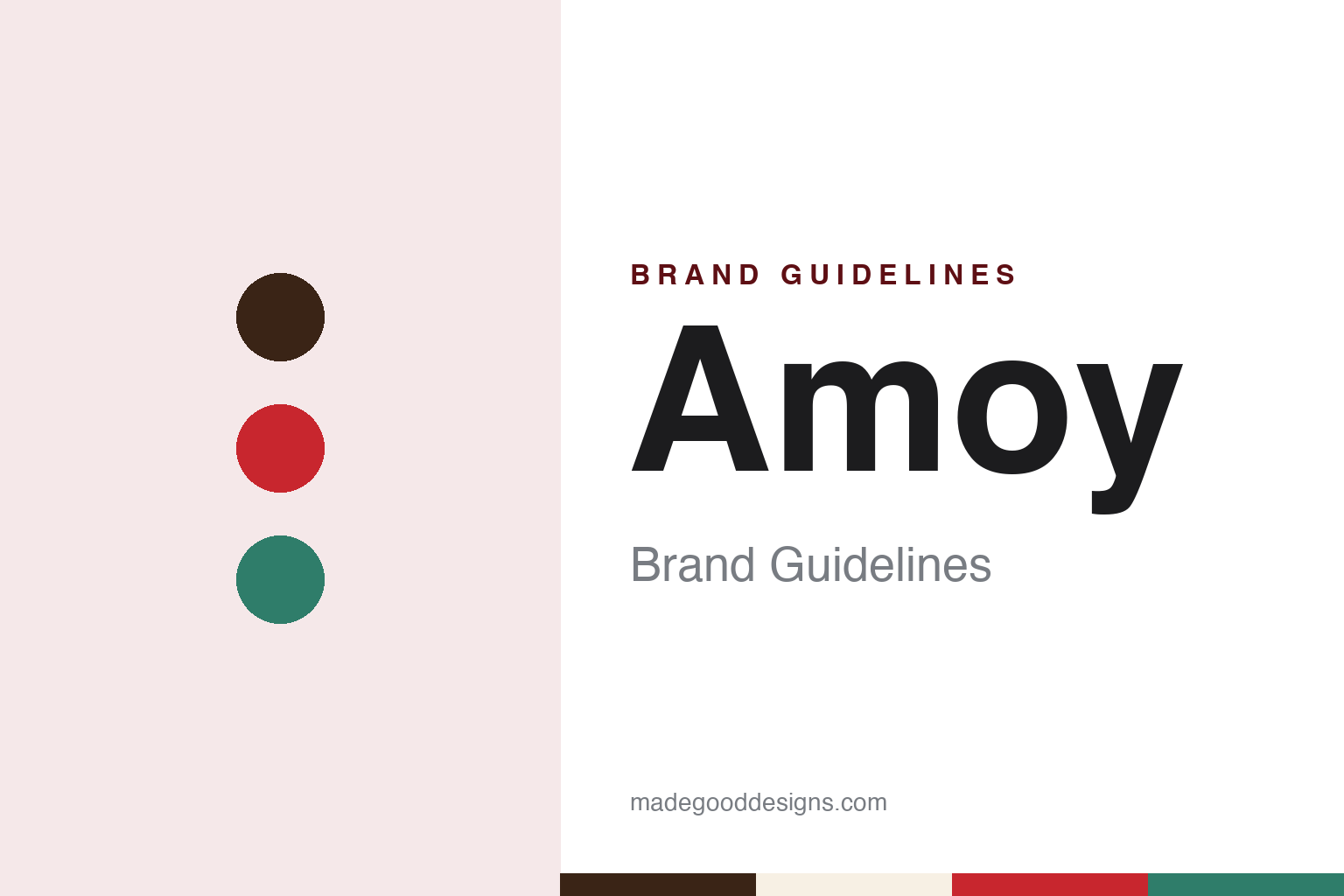
Amoy Brand Guidelines
The 1908 Xiamen soy sauce maker, run from Hong Kong.
Aa
Two constants: a soy brown, lacquer red and jade green palette and a clean modern sans register. Abstract homage — not an Amoy product or mark; no bottle, pack or logo is reproduced.
Gulangyu to Hong Kong
A soy sauce works in Xiamen, a merger and a move south.
Amoy takes its name from its birthplace. “Amoy” is an old English romanisation, based on the local Hokkien pronunciation, of Xiamen, the port city in China’s Fujian province, and the company’s Chinese name joins the names of two businesses that began there. Chinese Wikipedia says the first, the Tao Fa cannery, was founded in 1908 on the island of Gulangyu, off Xiamen, by overseas Chinese including Chen Tianen and Yang Gefei; it brewed soy sauce, canned food and ran a dairy business. Ajinomoto, a later owner, gave the company’s date of establishment as February 1908 in a 2018 announcement.
The founders soon went separate ways. Yang left Tao Fa in 1911 and in 1913 set up a second canning business, Tai Tung, and in 1927 the two were merged and reorganised as Tao Fa Tai Tung, Chinese Wikipedia says; Tao Fa had exhibited in Berlin in 1911 and won an award at the Panama exposition of 1915. In 1928 the merged company was formally established in Hong Kong, where it built a works to make soy sauce and, to mark where it had started, took the English name Amoy.
A 1947 advertisement cited by English Wikipedia names the business the Amoy Canning Corporation, with a factory at Ngau Tau Kok in Kowloon and a head office on Bonham Strand in Sheung Wan. In 1954, Chinese Wikipedia says, Amoy built an industrial village at Ngau Tau Kok, with a nursery and staff dormitories beside its factories, and listed its shares in Hong Kong; for a time it also made soft drinks and paper products. The Ngau Tau Kok land was sold in 1978 to the property group Hang Lung, which built the Amoy Gardens housing estate there.
Colour
Six owners in half a century.
Amoy changed hands repeatedly from the 1970s. Chinese Wikipedia says the Malaysian group Sime Darby built a stake of about 60% from 1972, while English Wikipedia, citing Sime Darby’s own timeline, dates its purchase of 50% to 1977. In 1980 Hang Lung bought 63% of Amoy Canning, according to Hang Lung’s corporate milestones, and in 1983 the American food company Pillsbury took half of Amoy Food, a soyfoods history by William Shurtleff and Akiko Aoyagi records. In 1987 the listed company became Hang Lung’s property arm, now Hang Lung Properties, and in 1991 the food business passed wholly to France’s Danone, Chinese Wikipedia says.
Production moved with the company. Amoy opened a large plant at the Tai Po Industrial Estate in the New Territories in 1987, and Tai Po remains its base. In 1988 it was reported to be the area’s largest soy sauce maker, producing 6,000 tonnes a year, Shurtleff and Aoyagi record. In 1982 Amoy moved into frozen dim sum by buying an exporter of it, and in 1993 it began selling microwaveable dim sum in Hong Kong; its frozen-food production, set up in Shenzhen in 1994, returned to Tai Po in 2013, Chinese Wikipedia says.
In January 2006 Danone sold Amoy Food to Japan’s Ajinomoto. On 19 November 2018 Ajinomoto agreed to transfer all of Amoy Food to a holding company owned by private-equity funds of CITIC Capital, moving with it the Amoy brand business run by Ajinomoto’s overseas subsidiaries and its Amoy trademark rights, and taking a 15% stake in the buyer, Ajinomoto said; at the time Amoy employed about 400 people. The sale completed in February 2019. CITIC Capital’s private-equity arm, now Trustar Capital, then sold Amoy to the Chinese soy sauce maker Foshan Haitian Flavouring and Food, which completed the purchase on 11 September 2026, DealStreetAsia reported; terms were not disclosed.
Typography
Design and documentation.
The seven brands in this group all make sauces, pestos, soups or cooking sauces, and they come from Italy, Britain and Hong Kong: Sacla’, Bertolli, Sharwood’s, Amoy, Baxters, Daddies and Dolmio. Sauce and soup brands in general sit at many different points in the trade, from family firms that still carry a founder’s surname to names that now belong to much larger food groups, and a single brand can be sold everywhere from a corner shop to a supermarket shelf.
A sauce brand’s identity is usually carried less by a single product than by a jar, a bottle, a name and the meal it promises, because the company behind the name may have changed hands, moved its factory or grown far beyond the town where it started. That makes the questions behind each name worth asking plainly: who started it, who owns it now, and where its sauces are actually cooked and packed.
Each guide separates what independent sources record from what the company says about itself — its founding story, its owners over time, where its products are made and how its packaging has changed — and marks plainly what rests only on the company’s own word.
Aa
A clean modern sans for a brand named after a port city. (Specimen set in Work Sans, a sans STAND-IN; NOT the Amoy logo.)
Amoy in Britain
A Hong Kong company and a Kraft Heinz licence.
In Britain the name works differently. When Heinz bought the HP Foods group from Danone in 2005, for £470 million, the deal included Lea & Perrins, HP Sauce and a perpetual licence to market Amoy Asian sauces in Europe, Heinz said at the time. The Amoy products on British shelves are therefore sold by Kraft Heinz: the Amoy UK web address now leads to a page on Kraft Heinz’s British site, which calls the brand a master of soy sauce since 1908.
Kraft Heinz has used the licence to stretch the brand. In late 2022 it launched Sosu from Amoy, a range of Korean- and Japanese-inspired meal kits and ingredients developed by its New Ventures unit with the design firm Designit and first stocked by Tesco, The Grocer and FoodBev reported. A masterbrand and packaging redesign for the UK range by the agency Brandon Consultants kept the established Amoy wordmark and built a visual system around the O of the name, with colour coding to help shoppers navigate the range, the agency says.
The Hong Kong company now belongs to Haitian, which said it would integrate the two firms’ distribution channels, production networks and supply chains; trade reports in September 2026 described the deal as giving China’s leading condiment maker an established international brand and sales network. Amoy Food says its products are sold in more than 40 countries, including the United States, Britain, Canada, Australia and Japan.
For a design guide, Amoy shows how the old name of a port city can carry a soy sauce brand across a century, two continents and six owners. Compare Kikkoman, the Japanese soy sauce maker, and Sharwood’s, its long-time neighbour in British Asian cooking sauces. For this guide we use soy brown, a lacquer red and a jade green with a sans, an unofficial interpretation; no product or logo is reproduced.
Explore & save
Keep Amoy’s identity on hand — save it to a board in the Made Good inspiration library.
Amoy identity set
Pin the Amoy soy brown, lacquer red and jade green palette and the clean modern sans register to your own board.