Hula Hoops Brand Guidelines
KP’s 1973 potato rings from Rotherham.
Aa
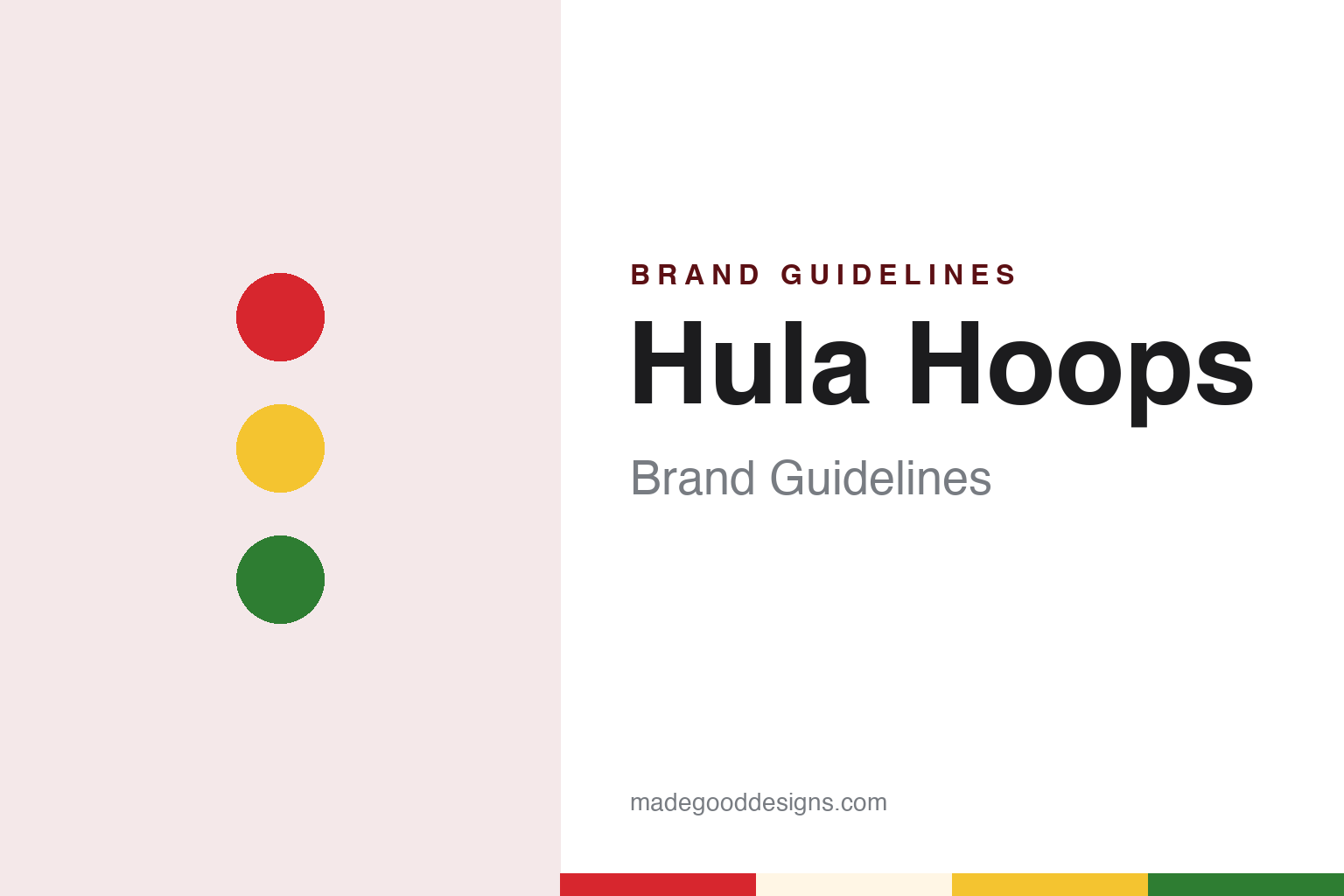
Two constants: a hoop red, potato gold and onion green palette and a rounded playful sans register. Abstract homage — not a Hula Hoops product or mark; no pack, logo or snack is reproduced.
Kenyon Produce
A Rotherham confectioner, a nut business and a ring-shaped snack.
Hula Hoops were launched in 1973 by KP, a business whose roots lie in Rotherham, South Yorkshire. KP Snacks says its story begins in 1853, when Charles Kenyon started the business it calls Kenyon Produce, the source of the letters KP. A local history of the firm published by the local-history site Let’s Look Again in 2017 places that first confectionery business on College Street in the town and says Kenyon’s son Harry later joined him at larger premises on Morpeth Street.
The business widened before it ever made a snack. In 1891, KP says, it merged to form Kenyon, Son & Craven, which also made pickles, sauces and confectionery; Let’s Look Again says the Craven side was Matthew Smith Craven, who ran a jam factory in Hull. In 1948 the firm was acquired by Simon Heller and began roasting and salting nuts, and in 1953 it launched salted peanuts, which KP says made it the first company in the UK to distribute them nationwide.
By the time Hula Hoops appeared, KP was no longer independent. United Biscuits bought Kenyon, Son & Craven in 1968 for £3.5 million and merged it into its Meredith & Drew subsidiary, Let’s Look Again says, and English Wikipedia also dates KP’s time as a United Biscuits subsidiary from 1968. English Wikipedia describes them as short, hollow cylinders made from potato and corn, and gives Rotherham as the home of the KP business that created them. KP itself lists “the launch of Hula Hoops” as its milestone for 1973, between the nuts of the 1950s and the dry roasted peanuts it introduced in 1983.
Colour
Flavour colours, bigger hoops and a world record.
The rings have stayed the core of the brand, while the range around them has kept changing. English Wikipedia lists a core set of flavours and gives each a pack colour: Original in red, Cheese & Onion in green, BBQ Beef in brown, Roast Chicken in mustard, Salt & Vinegar in blue and Smoky Bacon in purple. It also lists a long run of spin-offs: Big O’s in 1998, XL versions in 2001, Shoks in the early 2000s, a tortilla version in 2008, Big Hoops in 2011, the lighter Puft range in 2015 and Flavarings in 2018. A frozen version first appeared in 1999 and came back in 2013, sold only through the Iceland supermarket chain, English Wikipedia says. It gives the brand’s markets as the UK, Ireland, South Africa, Belgium and France.
The brand has borrowed its name’s associations for promotions. In 2010, English Wikipedia says, Hula Hoops worked with the charity Sport Relief on a series of “Hoopathons” and set a Guinness World Record when 1,388 people hula-hooped at the same time for two minutes.
Its packaging has been redrawn twice in recent years. In January 2017 the trade site Packaging Insights reported a new design by the branding consultancy Coley Porter Bell, described as the brand’s first rebrand in more than a decade. The brief, it reported, was to help Hula Hoops reclaim its place as a family snack by playing up the fun of the product. The agency stripped out non-essential effects and added dynamic hoops that spin around the logo to point to the ring shape. Craig Barnes, its design director, called it a chance to help “a well-known and much-loved brand” become “the hero of its category” again.
A second refresh followed at the end of 2021. The trade title Grocery Trader reported in November 2021 that KP Snacks was moving the whole range onto a single master-brand design with vibrant colours, sharp graphics and bold patterns, so that sub-ranges were easier to tell apart on the shelf, with roll-out starting in December. The same report put the brand’s annual sales at about £151 million, and quoted KP brand manager John McDougall calling Hula Hoops “an iconic brand.”
Typography
Design and documentation.
The seven brands in this group are savoury snack and crisp brands, mostly British, with one global sister brand: Hula Hoops, Monster Munch, Quavers, Wotsits, McCoy’s, Burts and Lay’s. Snack brands in general sit at many different points in the trade, from small makers that still carry a founder’s name to names that now belong to much larger food groups, and a single brand can be sold everywhere from a corner shop to a supermarket aisle.
A snack brand’s identity is usually carried less by a single product than by a pack, a name and the shape or flavour it promises, because the company behind the name may have changed hands, moved its factory or grown far beyond the town where it started. That makes the questions behind each name worth asking plainly: who started it, who owns it now, and where its snacks are actually made and packed.
Each guide separates what independent sources record from what the company says about itself — its founding story, its owners over time, where its snacks are made and how its packaging has changed — and marks plainly what rests only on the company’s own word.
Aa
A rounded playful sans for a snack shaped like a ring. (Specimen set in Fredoka, a sans STAND-IN; NOT the Hula Hoops logo.)
Hula Hoops
From United Biscuits to a German family-owned group.
Hula Hoops changed owners along with KP in the 2010s. In December 2012 United Biscuits, then owned by the private-equity firms Blackstone and PAI Partners, agreed to sell KP Snacks to the German snack group Intersnack for about £500 million, RTÉ and Talking Retail reported at the time. KP then employed about 1,500 people and had annual sales of about £280 million, Talking Retail reported. KP says it joined the Intersnack Group on 25 January 2013 and completed the integration in 2014.
Intersnack is based in Düsseldorf. English Wikipedia traces it to 1962, when Irmgard von Opel and her sons Carlo and Heinz began making crisps under the Chio name, and describes the group as part of the privately held sugar company Pfeifer & Langen. Under Intersnack, KP has grown by buying brands: KP lists Butterkist popcorn in 2017, Tyrrells and popchips in 2018 and Whole Earth in 2024. In 2015, KP says, it opened a new factory at Hellaby, near Rotherham, and moved its head office south to Slough.
KP’s own locations page lists factories at Ashby-de-la-Zouch in Leicestershire, Hellaby, Leominster, Pontefract, Tanfield in County Durham and Billingham on Teesside. The trade magazine Food Manufacture reported in September 2019 that the Ashby-de-la-Zouch plant made Hula Hoops, as well as own-label hoop-shaped snacks for large retailers. The trade site Potato Business reported in October 2018 that the Billingham site, which it described as making Hula Hoops Puft and McCoy’s, was adding a £6 million snack-pellet production line. KP’s sister brands from those plants include McCoy’s, the ridged crisps KP launched in 1985, and Pom-Bear, which KP brought to the UK in 1990.
The brand’s ownership also gives it an unexpected relative. English Wikipedia says Intersnack bought the French snack company Vico in 1998, along with its Vico and Monster Munch brands for France. In Britain, Monster Munch belongs to PepsiCo’s Walkers.
For a design guide, Hula Hoops shows how a single shape, a short hollow ring, can carry a brand through five decades, two owners and a run of spin-offs. Compare McCoy’s, its stablemate at KP, and Monster Munch, another shaped British snack of the 1970s. For this guide we use hoop red, potato gold and onion green with a rounded sans, an unofficial interpretation; no product or logo is reproduced.
Explore & save
Keep Hula Hoops’s identity on hand — save it to a board in the Made Good inspiration library.
Hula Hoops identity set
Pin the Hula Hoops hoop red, potato gold and onion green palette and the rounded playful sans register to your own board.