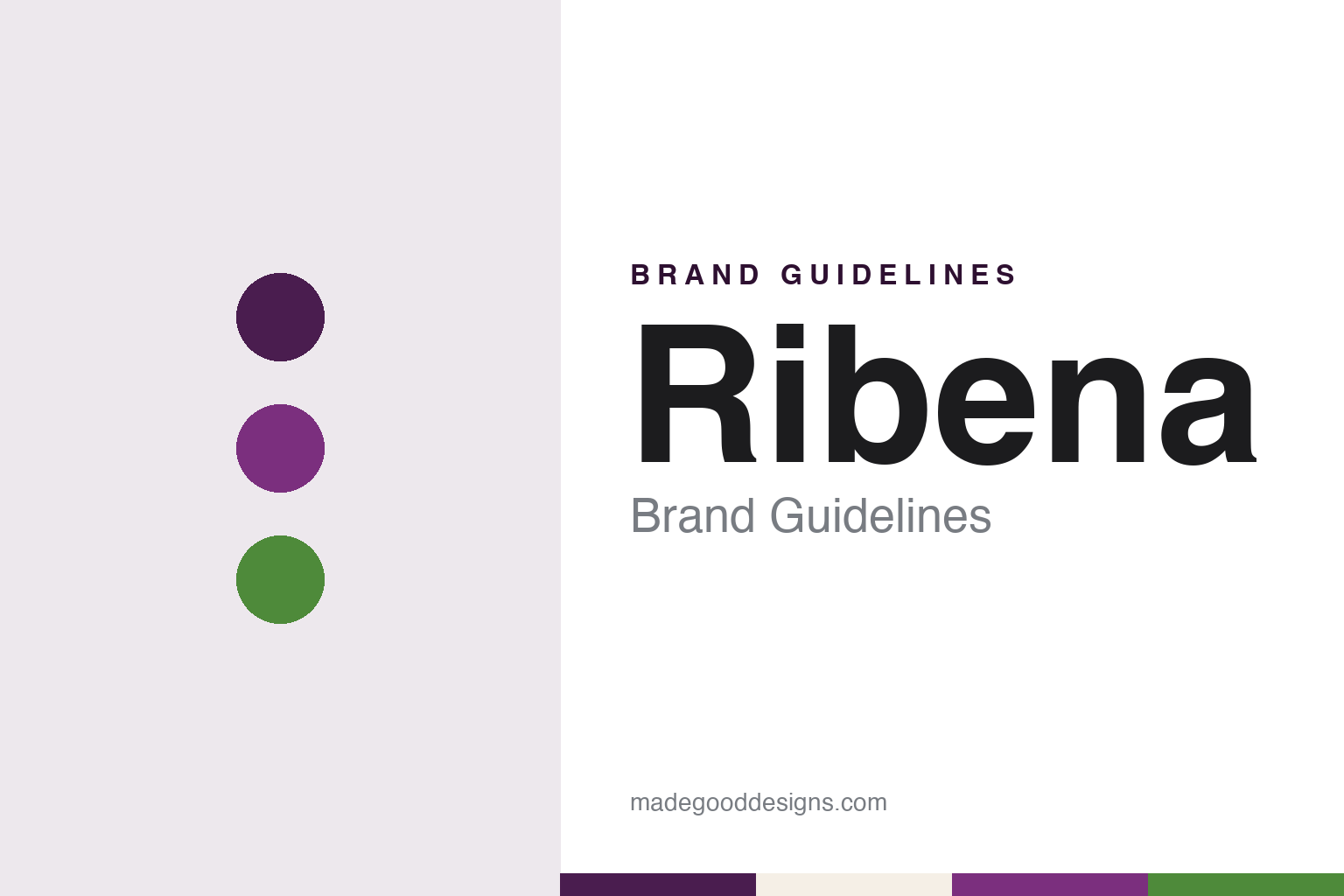
Ribena Brand Guidelines
The Bristol blackcurrant syrup made in the Forest of Dean.
Aa
Two constants: a blackcurrant purple, leaf green and cream palette and a soft display serif register. Abstract homage — not a Ribena product or mark; no bottle, carton, logo or label is reproduced.
Long Ashton and Bristol
A fruit-syrup process, a Bristol firm and a Latin name.
Ribena began as a piece of fruit science in the countryside south-west of Bristol. The brand’s own history says the drink was developed in Long Ashton by Dr Vernon Charley at H.W. Carter & Co, a Bristol firm that made a wide variety of products. English Wikipedia dates the work to 1933, names the biochemist Audrey Green alongside Charley, a University of Bristol scientist, and says the underlying research into pure fruit syrups was carried out at the Long Ashton Agricultural and Horticultural Research Station in north Somerset, using a pectinase enzyme process.
The name came in 1938. The company says Ribena was first used as a brand name that year and that it comes from the Latin name for the blackcurrant, Ribes nigrum; English Wikipedia credits the coinage to S. M. Lennox of Bristol. The first blackcurrant syrup, the company says, was sold to hospitals and maternity homes, and English Wikipedia notes that the variety chosen was rich in vitamin C.
The Second World War turned a Bristol syrup into a national one. With citrus imports cut, English Wikipedia says, the government encouraged blackcurrant growing, and from December 1941 a Vitamin Welfare Scheme gave blackcurrant syrup and cod liver oil free to children under two, until orange juice supplied under Lend-Lease replaced the syrup in April 1942. The company says H.W. Carter produced practically all of the blackcurrant syrup that the Ministry of Food distributed free to children during the war.
Bomb damage and rising demand then moved production out of the city. The company says a new factory was built at Coleford, in the Forest of Dean in Gloucestershire, and went into limited production in the autumn of 1947; English Wikipedia calls it the Royal Forest Factory. The company says Ribena has been made on that site ever since. After the war, it adds, the firm expanded a system of contract growing, under which farmers raised blackcurrants specifically for processing.
Colour
Beecham, GSK and a bottle made from bottles.
Ribena joined a much larger company in 1955, when Beecham bought H.W. Carter; the company names the buyer as Beecham Foods Limited. The brand then followed Beecham through the pharmaceutical mergers of the next half-century. Beecham combined with SmithKline Beckman in 1989 to form SmithKline Beecham, which merged with Glaxo Wellcome in 2000 to form GlaxoSmithKline (GSK). English Wikipedia says the range grew over those decades into many soft-drink variations.
Under GSK, Ribena was the subject of a dated advertising case in New Zealand. In March 2007 the country’s Commerce Commission brought 15 charges under the Fair Trading Act over vitamin C claims made for Ribena sold there; GSK pleaded guilty, was fined NZ$217,500 and was ordered to run corrective advertisements in national newspapers, the New Zealand Herald reported. The charges followed tests carried out in 2004 by two Auckland schoolgirls as a school science project. English Wikipedia records GSK’s position that the matter concerned products sold in Australia and New Zealand.
The bottle became part of the brand’s story in the same year. Packaging News reported in September 2007 that from that October Ribena’s ready-to-drink bottles would be made from 100% recycled PET, up from about 40% recycled content, with the squash range to follow within six months; GSK said it sold more than 60 million of those bottles a year in the UK. The current owner says Ribena was the first UK soft-drink brand to use 100% recycled plastic bottles, excluding the cap and label.
In November 2020, Packaging Insights reported, the owner announced a redesign that from January 2021 replaced the dark sleeve on Ribena’s 500ml bottles with a much smaller clear label and an embossed “recycle me” message, so that sorting equipment could identify the bottles as clear PET. The company, working with the waste firm Biffa, put the cost of the change at £1.6 million. The recipe changed too: English Wikipedia says that in April 2018 the long-standing blackcurrant recipe was altered to add sweeteners in response to the UK’s soft drinks levy.
Typography
Design and documentation.
The seven brands in this group all make soft drinks or cordials, and all of them come from Britain: Irn-Bru, Vimto, Ribena, Lucozade, Tango, Fentimans and Belvoir Farm. British soft-drink brands in general sit at many different points in the trade, from family firms that still carry a founder’s name to names that now belong to much larger drinks groups, and a single brand can be sold everywhere from a corner shop to a supermarket shelf.
A soft-drink brand’s identity is usually carried less by a single recipe than by a bottle, a colour, a name and the moment it promises, because the company behind the name may have changed hands, moved its bottling or grown far beyond the town where it started. That makes the questions behind each name worth asking plainly: who started it, who owns it now, and where its drinks are actually made and bottled.
Each guide separates what independent sources record from what the company says about itself — its founding story, its owners over time, where its drinks are made and how its packaging has changed — and marks plainly what rests only on the company’s own word.
Aa
A soft display serif for a brand named after a Latin plant name. (Specimen set in DM Serif Display, a serif STAND-IN; NOT the Ribena logo.)
Ribena
A Japanese owner, an old factory and British fruit.
GSK agreed to sell Ribena and Lucozade to Japan’s Suntory for £1.35 billion in September 2013, The Guardian reported, noting that the drinks were made at the Royal Forest Factory in Coleford. The company says the business was formed in January 2014 as Lucozade Ribena Suntory Limited, which still owns the brand and trades as Suntory Beverage & Food GB&I. Its UK head office is in Uxbridge, west London, at the ARC Uxbridge development, Insider Media reported.
The fruit is central to how the owner presents the brand. It says Ribena is made with 100% British-grown blackcurrants and takes about 90% of Britain’s blackcurrant crop. The James Hutton Institute in Scotland, which has bred blackcurrants since 1956, says it has carried out research for Ribena since the 1980s, that farmers grow around 10,000 tonnes of blackcurrants a year for the drink, and that virtually all British-grown blackcurrants come from varieties it bred, including its “Ben” series.
Coleford is still where the drink is made, the company says. In 2026 it announced a £25 million line at the site, called Apollo 5, which Food Manufacture reported will replace two older Ribena lines that separately make concentrate and ready-to-drink formats, filling up to 55,000 bottles an hour with aseptic technology, and is expected to be running in 2027. The company described the line as part of more than £57 million earmarked for its UK manufacturing.
For a design guide, Ribena shows how a Latin plant name, a single fruit and a recycled bottle can carry one brand from a Bristol laboratory to a Japanese-owned factory in the Forest of Dean. Compare Lucozade, made at the same Coleford site for the same owner, and Vimto, another long-running British cordial. For this guide we use a blackcurrant purple, a leaf green and a cream with a soft serif, an unofficial interpretation; no product or logo is reproduced.
Explore & save
Keep Ribena’s identity on hand — save it to a board in the Made Good inspiration library.
Ribena identity set
Pin the Ribena blackcurrant purple, leaf green and cream palette and the soft display serif register to your own board.