Tango Brand Guidelines
The Welsh-born orange fizz that taught Britain to be Tango’d.
Aa
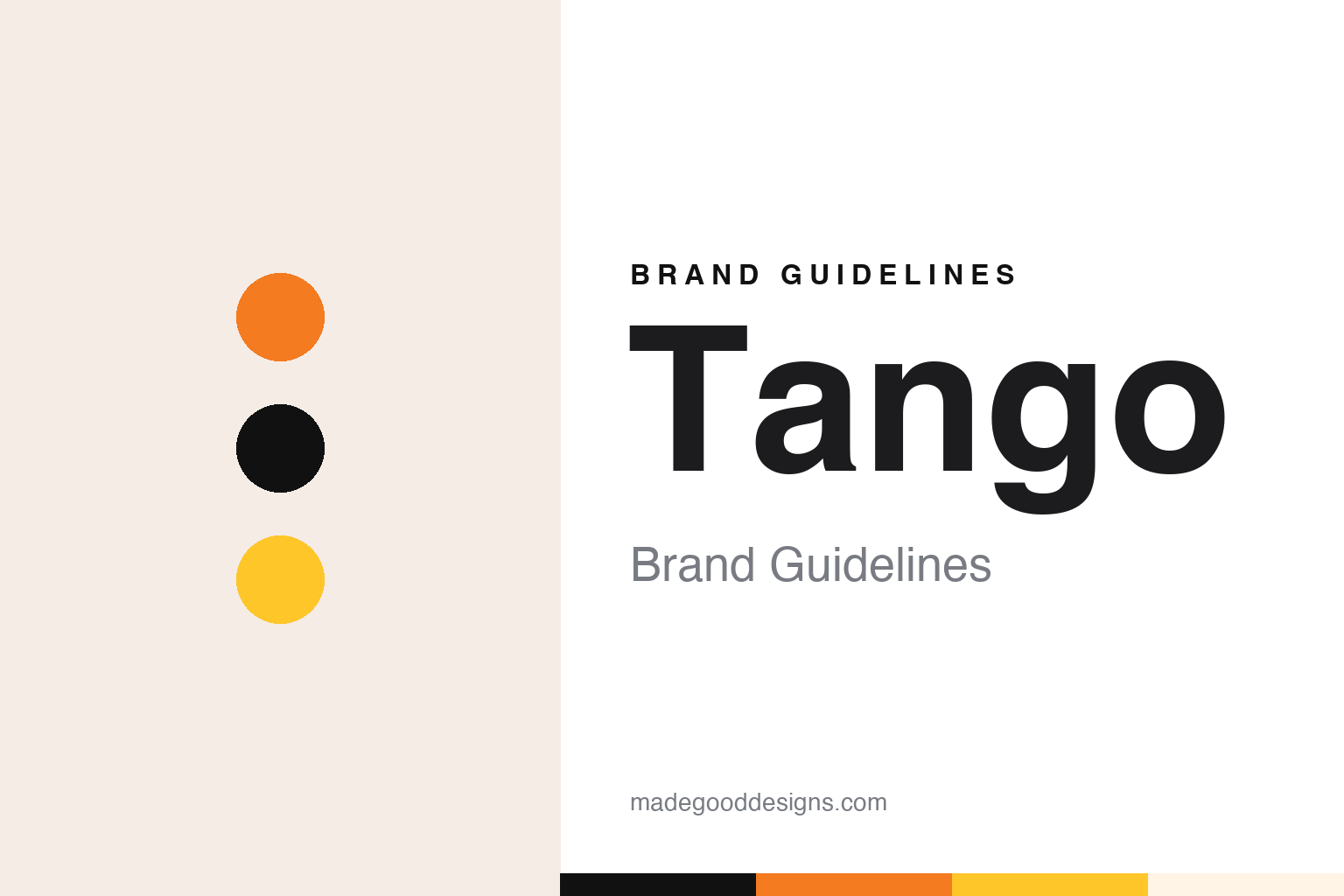
Two constants: a Tango orange, black and zest yellow palette and a heavy grotesque sans register. Abstract homage — not a Tango product or mark; no can, logo or advertisement is reproduced.
A Corona orangeade
Two Welsh grocers, a valley factory and a new orange drink.
Tango was born in Wales. It was launched in April 1958 as an orangeade by Corona Soft Drinks of Porth, in the Rhondda; the Glamorgan Advertiser announced it that month as a new “whole orange drink,” and in May an advertisement in the Sunday Pictorial called it a whole orange drink “made by Corona,” English Wikipedia records. What set it apart from ordinary Corona, the same account says, was the addition of real fruit and real sugar.
Corona itself went back to the 1880s. English Wikipedia, citing the Welsh Academy Encyclopaedia of Wales, says it was the brand of Thomas & Evans, a business set up by two grocers, William Thomas and William Evans, who saw a market for soft drinks in the growing temperance movement of the South Wales valleys. Their Welsh Hills Mineral Water Factory in Porth opened in the 1890s; the firm built its trade by selling door to door from horse and wagon, and eventually ran 87 depots and factories across Britain.
Tango changed hands almost at once. The Beecham Group, the pharmaceutical and consumer-goods company, bought Corona in September 1958, the Newcastle Journal reported, and the new orange drink came with it. Other flavours followed: in May 1961 an advertisement in the Montrose Review listed Tango bitter lemon, sparkling orange and sparkling lemon.
Beecham kept the brand for almost three decades. In October 1986 it sold Corona and its other soft-drink brands to Britvic for £120 million, the Aberdeen Press and Journal reported; English Wikipedia’s Britvic article dates the takeover to 1987. Britvic’s own website said in 2006 that Beecham had introduced Tango in 1958, “but the brand only reached its present status after Britvic bought it in 1986.” The Corona name itself stopped trading in the late 1990s, English Wikipedia says. Tango carried on without it.
Colour
An orange man, a slap and the agency that made them.
Tango’s fame rests on its advertising. In 1992 the London agency HHCL — Howell Henry Chaldecott Lury and Partners — introduced the line “You know when you’ve been Tango’d” with a spot later known as “Orange Man.” A young man sips from a can and is slapped round the face by a man painted entirely orange, played by Peter Geeves, while two mock commentators, voiced by Hugh Dennis and the footballer Ray Wilkins, replay the moment. The art director was Trevor Robinson and the copywriter Al Young, with Axel Chaldecott and Steve Henry as creative directors and Matt Forrest directing. Robinson wrote in The Guardian in 2015 that the idea was a reaction against the “cause and effect” advertising of the time, in which contact with a product makes someone’s life better.
The campaign worked, and it caused trouble. A 1995 marketing study text cited by English Wikipedia says Britvic launched it in response to slowing sales and that sales rose by 30% in the month after it began. Children copied the slap in school playgrounds, with reports of injuries, and the original was withdrawn and replaced by a version in which the orange man kisses the drinker instead. In 2000 a poll by Channel 4 and The Sunday Times of the 100 greatest television adverts placed the original third.
HHCL kept the brand loud. For the launch of Blackcurrant Tango in 1996 it made “St George,” in which a Tango customer-service manager, Ray Gardner, answers a French exchange student’s letter of complaint by marching, in one seemingly continuous take, out of his office and into a boxing ring on the White Cliffs of Dover, with three Harrier jump jets hovering behind him. Later campaigns stayed close to the line: in 2009 the Advertising Standards Authority cleared a “Tango with added Tango” poster campaign after complaints, The Guardian reported.
The packs have changed often. Tango Orange was relaunched in a new pack design in March 2001, followed by Cherry and Tropical that September, just-drinks reported. In May 2009 Blue Marlin Brand Design redesigned the range with mashed-up images of fruit and graffiti-style lettering, Packaging News reported; the same month Britvic printed Tango cans upside down after a dare on a social-networking site. In March 2015 the agency Brandhouse, part of Hangar Seven, redesigned the packaging and updated the identity, launched alongside a Blood Orange flavour, The Drum reported.
Typography
Design and documentation.
The seven brands in this group all make soft drinks or cordials, and all of them come from Britain: Irn-Bru, Vimto, Ribena, Lucozade, Tango, Fentimans and Belvoir Farm. British soft-drink brands in general sit at many different points in the trade, from family firms that still carry a founder’s name to names that now belong to much larger drinks groups, and a single brand can be sold everywhere from a corner shop to a supermarket shelf.
A soft-drink brand’s identity is usually carried less by a single recipe than by a bottle, a colour, a name and the moment it promises, because the company behind the name may have changed hands, moved its bottling or grown far beyond the town where it started. That makes the questions behind each name worth asking plainly: who started it, who owns it now, and where its drinks are actually made and bottled.
Each guide separates what independent sources record from what the company says about itself — its founding story, its owners over time, where its drinks are made and how its packaging has changed — and marks plainly what rests only on the company’s own word.
Aa
A heavy grotesque sans for a brand that shouts. (Specimen set in Archivo, a sans STAND-IN; NOT the Tango logo.)
Tango
From Beecham to Britvic to a Danish brewer.
Tango has belonged to Britvic for almost four decades, and Britvic now belongs to a brewer. On 8 July 2024 the Danish Carlsberg Group agreed to buy Britvic for £3.3 billion. The Competition and Markets Authority cleared the deal on 17 December 2024, The Guardian reported, the High Court approved it on 15 January 2025, the BBC reported, and Carlsberg announced that it had completed the acquisition on 16 January 2025. Britvic was combined with Carlsberg’s UK brewing business as Carlsberg Britvic, based in Hemel Hempstead, where Tango sits alongside Robinsons, J2O and Fruit Shoot and the Pepsi and 7up drinks the company makes under licence.
The brand also reaches beyond the can. Tango Ice Blast, a slush drink introduced in 2004, is made under licence by Frozen Brothers, previously by Slush Puppie, English Wikipedia says.
Its newest look arrived in 2026. In January Carlsberg Britvic announced a redesign of Tango Orange and the sugar-free Tango Zero’d range, rolling out from March, with bolder fruit cues on pack; David Laidler, its brand director for carbonates, said the new look was about “increasing visibility.” Creative Boom reported that the identity was created by the agency Bloom, with a hidden pip inside the “a” of the logo, a detail on the “g” that echoes the hiss of a can being opened, high-saturation colour against black-dominant packs, and a limited sugar-free edition called Thirst Trap as the first release.
For a design guide, Tango shows how a single colour and a single advertising line can carry a soft drink for decades. Compare Vimto, another British fruit-flavoured soft drink, and IRN-BRU, the Scottish soft drink. For this guide we use orange, black and a zest yellow with a heavy sans, an unofficial interpretation; no product or logo is reproduced.
Explore & save
Keep Tango’s identity on hand — save it to a board in the Made Good inspiration library.
Tango identity set
Pin the Tango orange, black and zest yellow palette and the heavy grotesque sans register to your own board.