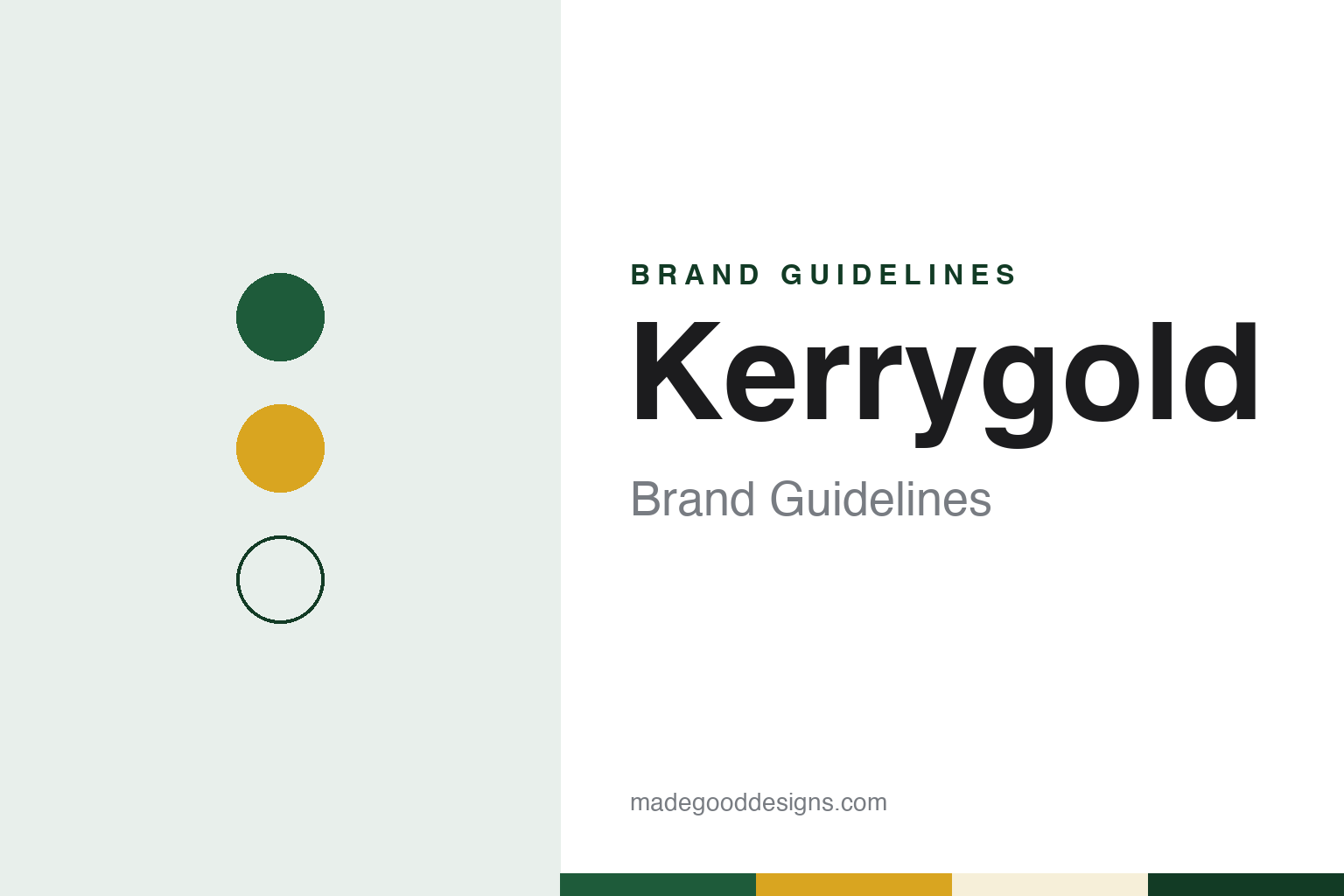
Kerrygold Brand Guidelines
The Irish Dairy Board butter that turned grass and gold foil into a brand.
Aa
Two constants: a Kerrygold green, gold and cream palette and a soft serif register. Abstract homage — not a Kerrygold product or mark; no pack, foil or logo is reproduced.
An Bord Bainne
A state marketing board and a young chief executive.
Kerrygold was created by a marketing board rather than a dairy. In 1961 Ireland set up An Bord Bainne, the Irish Dairy Board, under the Dairy Produce Marketing Act, to “promote, facilitate, encourage, assist, co-ordinate and develop the exportation of milk and milk products,” in the words its successor quotes today. English Wikipedia says the board replaced an earlier Butter Marketing Committee.
Its first chief executive was Tony O’Reilly, later Sir Anthony, who led the board until 1966 and whom Ornua credits with “creating the much-loved Kerrygold brand in 1962.” Ornua’s tribute to him, published in May 2024, says he set out to create a brand for Irish dairy “in what at the time was a commodity market,” one that would reflect the quality of grass-fed Irish milk. O’Reilly, who had played rugby for Ireland and the British and Irish Lions, went on to run the American food company H. J. Heinz, English Wikipedia says.
The name was picked from a long list. Ornua says there were 60 proposals, among them Buttercup, Shannon Gold, Leprechaun, Tub-o-gold and Golden Farm; The Irish Times reported the same figure of 60 suggestions in 2019.
The first market was not Ireland. In October 1962, English Wikipedia and Ornua say, the board test-launched Kerrygold in Britain, in the Winterhill television area of north-west England. By 1965, Ornua says, the board was exporting to up to twenty countries. Kerrygold only went on sale at home in 1973, eleven years after its British debut.
Colour
Germany first, then America.
Ireland’s entry into the European Economic Community in 1973 opened continental Europe. English Wikipedia says the board began in the German state of North Rhine-Westphalia and reached national distribution in Germany in 1982. The Irish Times reported in April 2019 that a 250g block of Kerrygold had been the fastest-selling food or drink item on German supermarket shelves the year before, and Ornua says a street in Germany was renamed Kerrygoldstrasse in 2007.
The same year, 1973, An Bord Bainne changed from a semi-state body into a co-operative, Ornua says. A year earlier it had bought Adams Butter in Leek, Staffordshire.
America came in two steps. Ornua says Kerrygold cheese arrived in the United States in 1991, marketed at first to the Irish diaspora, and that Kerrygold Dubliner cheese followed in 1998, “an overnight success,” in the company’s words. The butter came in 1999, Ornua said in a March 2019 release marking twenty years in the US. By 2019, the release said, Kerrygold was the number two butter brand in the country, a ranking The Irish Times also reported, placing it behind Land O’Lakes.
The brand’s look rests on the gold foil pack, by which, Ornua says, the brand is recognised around the world. In October 2017 Ornua launched “Memories in the Making,” made by Publicis, its first new Irish advertising campaign since 2010.
In April 2019 The Irish Times reported that Kerrygold had passed €1 billion in annual retail sales in 2018, which it called Ireland’s first billion-euro food brand, and that about 7.5 million packets were sold every week that year. Ornua says the brand’s retail value had reached €500 million in 2013. In its 2019 US release, Ornua put American sales at 2.6 million blocks of the gold foil a week.
Typography
Design and documentation.
The seven brands in this group all sell butter, cheese or other dairy products, and they come from Denmark, Ireland, France, the United States and Britain: Lurpak, Kerrygold, Président, Babybel, Philadelphia, Cathedral City and Yeo Valley. Dairy brands in general sit at many different points in the trade, from farmer-owned co-operatives and family firms to names that now belong to much larger food groups, and a single brand can be sold everywhere from a corner shop to a supermarket chiller.
A dairy brand’s identity is usually carried less by a single product than by a pack, a name and the kitchen or table it promises, because the company behind the name may have changed hands, licensed its name to another maker or grown far beyond the place where it started. That makes the questions behind each name worth asking plainly: who started it, who owns it now, and where its butter, cheese or yoghurt is actually made and packed.
Each guide separates what independent sources record from what the company says about itself — its founding story, its owners over time, where its products are made and how its packaging has changed — and marks plainly what rests only on the company’s own word.
Aa
A warm, soft serif for a brand named in 1962. (Specimen set in Fraunces, a serif STAND-IN; NOT the Kerrygold logo.)
Kerrygold
From the Irish Dairy Board to Ornua.
On 31 March 2015 the Irish Dairy Board renamed itself Ornua, from the Irish ór nua, “new gold,” English Wikipedia says. Ornua is a co-operative owned by Irish dairy processors; English Wikipedia lists its members as Tirlán, Dairygold, Lakeland Dairies, Arrabawn, Aurivo, North Cork, Tipperary and Carbery.
In 2016, Ornua says, it opened Kerrygold Park in Mitchelstown, Co. Cork, which it describes as a “state-of-the-art Kerrygold butter production and packing facility.” English Wikipedia also records a later investment in the Leek site, announced in 2020. Its UK business is based in Leek, Staffordshire, and English Wikipedia lists further Ornua operations in Germany, the United States and the Middle East.
The Kerrygold name has spread beyond butter, to cheese such as Dubliner and to a cream liqueur that carries the brand. Today Ornua’s portfolio also includes Pilgrims Choice cheese, and English Wikipedia says it bought the Spanish cheese maker Luxtor in 2014. Ornua’s history also records a business in Saudi Arabia from 1980, SIDCO, and English Wikipedia notes that the board was named Exporter of the Year by the Irish Exporters Association in 2010.
For a design guide, Kerrygold shows how a farm-co-operative product can be sold as one national story: a name chosen from sixty, a gold foil wrapper and a story about grass-fed Irish milk. Compare Lurpak, the Danish co-operative butter mark, and Tillamook, a farmer-owned dairy brand from Oregon. For this guide we use pasture green, foil gold and cream with a serif, an unofficial interpretation; no product or logo is reproduced.
Explore & save
Keep Kerrygold’s identity on hand — save it to a board in the Made Good inspiration library.
Kerrygold identity set
Pin the Kerrygold green, gold and cream palette and the soft serif register to your own board.