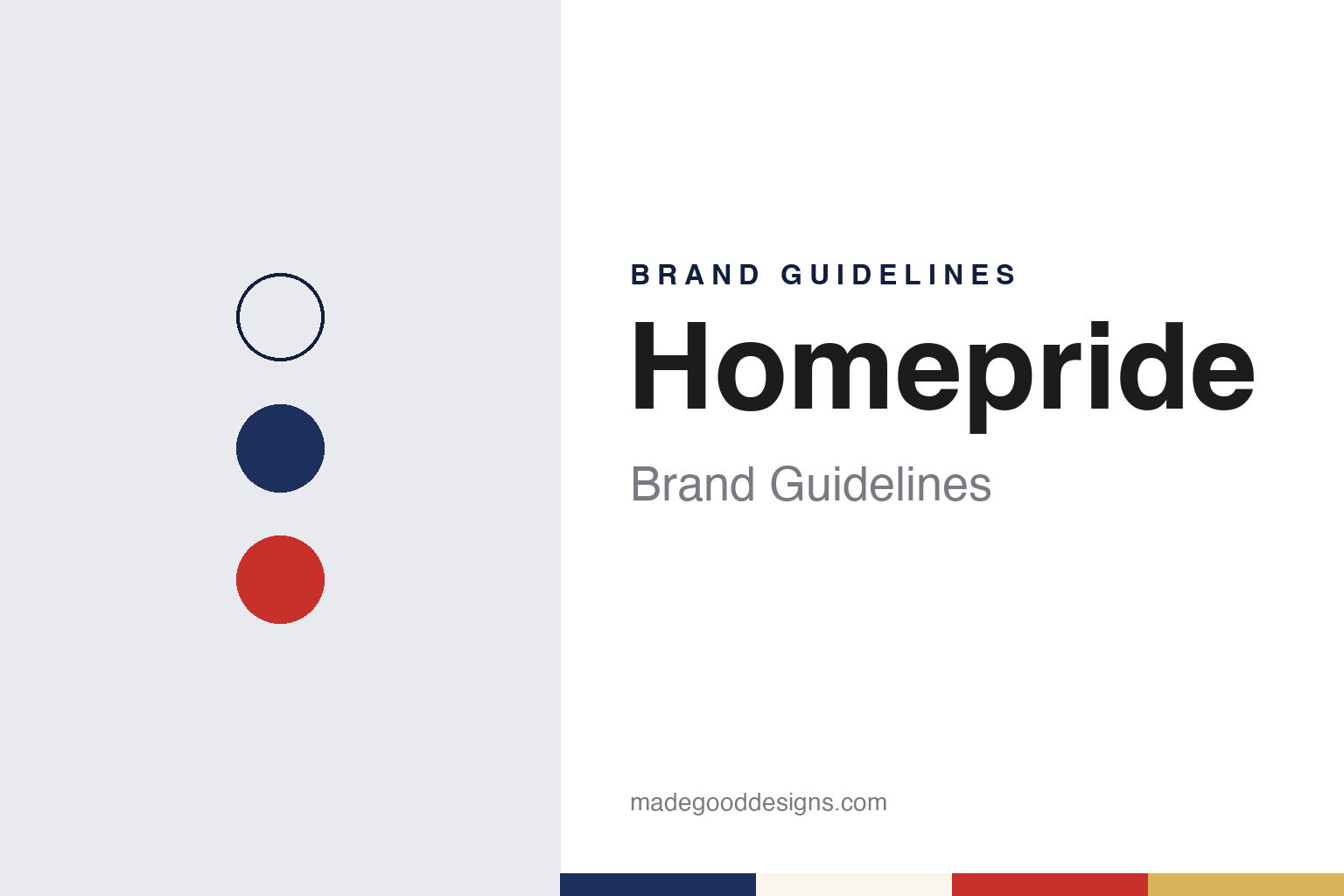
Homepride Brand Guidelines
Fred the flour grader and a name with two makers.
Aa
Two constants: a grader navy, sifted white and sauce red palette and a soft old-style display serif register. Abstract homage — not a Homepride product or mark; no pack, logo or character is reproduced.
Graded grains
A Midlands flour, a milling giant and a man called Fred.
Homepride is the rare British grocery brand that lives two lives at once: a flour and a range of cooking sauces, made by different companies under one name and one mascot. Its flour came first. The company that makes it today says Homepride began in 1920 in the Midlands as a pre-packed flour made by a firm called Robbins and Power, and was later taken over by Spillers, one of Britain’s big flour millers. Between about 1940 and 1960, the company says, Homepride was put on hold while Spillers sold its pre-packed flour under a range of regional names, among them Feathery Flake and Spillers Albatross.
The modern brand dates from 1963. A breakthrough in flour production that year meant home bakers no longer needed to sift their flour, English Wikipedia says, and Spillers launched the new product nationally as Spillers Homepride. Its advertising stressed that the flour came pre-sieved, under the line “Graded grains make finer flour,” which the company says still appears on its lids. English Wikipedia dates the slogan’s use to 1965.
The character arrived in 1964. English Wikipedia says Fred the Flour Grader was created by the advertising agency Geers Gross; the company tells the same story through the agency’s founders, saying Spillers was approached by two copywriters, Bob Geers and Bob Gross, with the idea of a campaign led by a chief flour grader called Fred. The actors John Le Mesurier and Richard Briers were among the voice-over artists on Homepride advertising, English Wikipedia says. In the 1970s, the company says, the Spillers name was removed from the packs and Homepride became a brand in its own right. Fred has stayed ever since; Homepride’s flour website calls him its chief flour grader and runs a shop of Fred collectables, some original pieces of which the company says are now treated as antiques.
Colour
Dalgety, Kerry, Campbell’s and Premier Foods.
The split between flour and sauces goes back to the 1970s and the break-up of Spillers. Homepride launched a range of prepared cooking sauces in 1974, English Wikipedia says. In October 1979 Spillers was acquired by the food and agribusiness group Dalgety after a hostile takeover battle. Dalgety kept the rights to the Homepride name for cooking sauces, and the brand later passed to Campbell’s, under whose ownership Homepride sauces sponsored the ITV police series The Bill with the slogan “the one with the bag,” English Wikipedia says.
The flour went a different way. In January 1998 the Irish food group Kerry paid £335 million for Dalgety’s food ingredients businesses, The Irish Times reported at the time. The deal included Spillers Milling, then the third-largest flour milling business in Britain, and Spillers Consumer Foods, the maker of pre-packed flour and bakery mixes under the Homepride and Green’s names. Homepride’s own timeline says the flour and the licence to the Homepride brand were acquired by Kerry Foods in 1998. Under Kerry the flour kept its British focus: in September 2016 Kerry Foods began marking packs “100% British wheat,” Talking Retail and Farmers Weekly reported, after obtaining legal verification of the claim.
The sauces, meanwhile, found their present owner. Premier Foods acquired Homepride sauces in 2006 as part of its £460 million purchase of Campbell’s UK and Ireland businesses, English Wikipedia says. In 2014, the year of Fred’s 50th birthday, Premier brought him back to television after ten years off screen in a £2.3 million campaign, alongside five new sauces including Hunter’s Chicken and Peri-Peri, Talking Retail reported. Today Premier Foods owns the Homepride and Fred trade marks for both products: the flour website states that they are trademarks of the Premier Foods Group, used under licence by Carr’s Flour Mills Limited. Carr’s Flour Mills had been sold by the Cumbrian group Carr’s to the flour and baking ingredients business Whitworths in September 2016 for £36 million, Bakery and Snacks reported, with mills at Silloth in Cumbria, Kirkcaldy in Fife and Maldon in Essex.
Typography
Design and documentation.
The seven brands in this group all sell baking, sugar, flour and spice products, and all of them are sold under their own names on British shelves: Lyle’s, Tate & Lyle, Silver Spoon, Billington’s, McDougalls, Homepride and Schwartz. British baking and store-cupboard brands in general sit at many different points in the trade, from names that still carry a founder’s surname to names that now belong to much larger food groups, and a single brand can be sold everywhere from a corner shop to a supermarket baking aisle.
A store-cupboard brand’s identity is usually carried less by a single product than by a pack, a name and the kitchen task it promises to help with, because the company behind the name may have changed hands, moved its factory or grown far beyond the town where it started. That makes the questions behind each name worth asking plainly: who started it, who owns it now, and where its products are actually made and packed.
Each guide separates what independent sources record from what the company says about itself — its founding story, its owners over time, where its products are made and how its packaging has changed — and marks plainly what rests only on the company’s own word.
Aa
A soft old-style serif for a brand with a mascot. (Specimen set in Fraunces, a serif STAND-IN; NOT the Homepride logo.)
Homepride
A can, a paper bag and Fred at 60.
Homepride’s packaging has been part of its story as much as its mascot. In 1990, the company says, Homepride flour launched a rigid-sided, resealable “can,” sold as a pack that made less mess, kept the flour fresh and was easy to store. In 2024 it moved the other way, replacing that box with a recyclable paper bag; the company says the old pack had to be taken apart, with its lid and silver seal removed, before it could be recycled, while the new bag can go straight into household recycling.
The flour range has grown in small steps. Homepride added a sponge flour and an extra-fine “00” flour in 2019, the company says, and its timeline records tie-ins with Wallace and Gromit’s Big Bake in 2013, the ceramics designer Emma Bridgewater in 2017, and children’s books and films from Peter Rabbit to Matilda. Fred turned 60 in 2024. To mark the anniversary, the branding agency The Food Brand Guys, which names Carr’s Flour Mills as its client, refreshed the Homepride brand and its retail packaging with new, contemporary illustrations; the agency says the aim was to introduce Fred to new audiences while keeping him recognisable across generations.
The sauces have followed their own design route under Premier Foods, with new packs and flavours launched around Fred’s 50th birthday in 2014. The result is a single character working for two different businesses: Premier Foods in the cooking-sauce aisle, and a licensed miller in the baking aisle.
For a design guide, Homepride shows how one character can hold a brand together across two product lines, two owners and more than sixty years. Compare McDougalls, the other big British flour name owned by Premier Foods, and Bisto, a Premier gravy brand with its own long-running advertising characters. For this guide we use a grader navy, a sifted white and a sauce red with a soft old-style serif, an unofficial interpretation; no product or logo is reproduced.
Explore & save
Keep Homepride’s identity on hand — save it to a board in the Made Good inspiration library.
Homepride identity set
Pin the Homepride grader navy, sifted white and sauce red palette and the soft old-style display serif register to your own board.