Maoam Brand Guidelines
The Düsseldorf palindrome chew that Haribo bought in 1986.
Aa
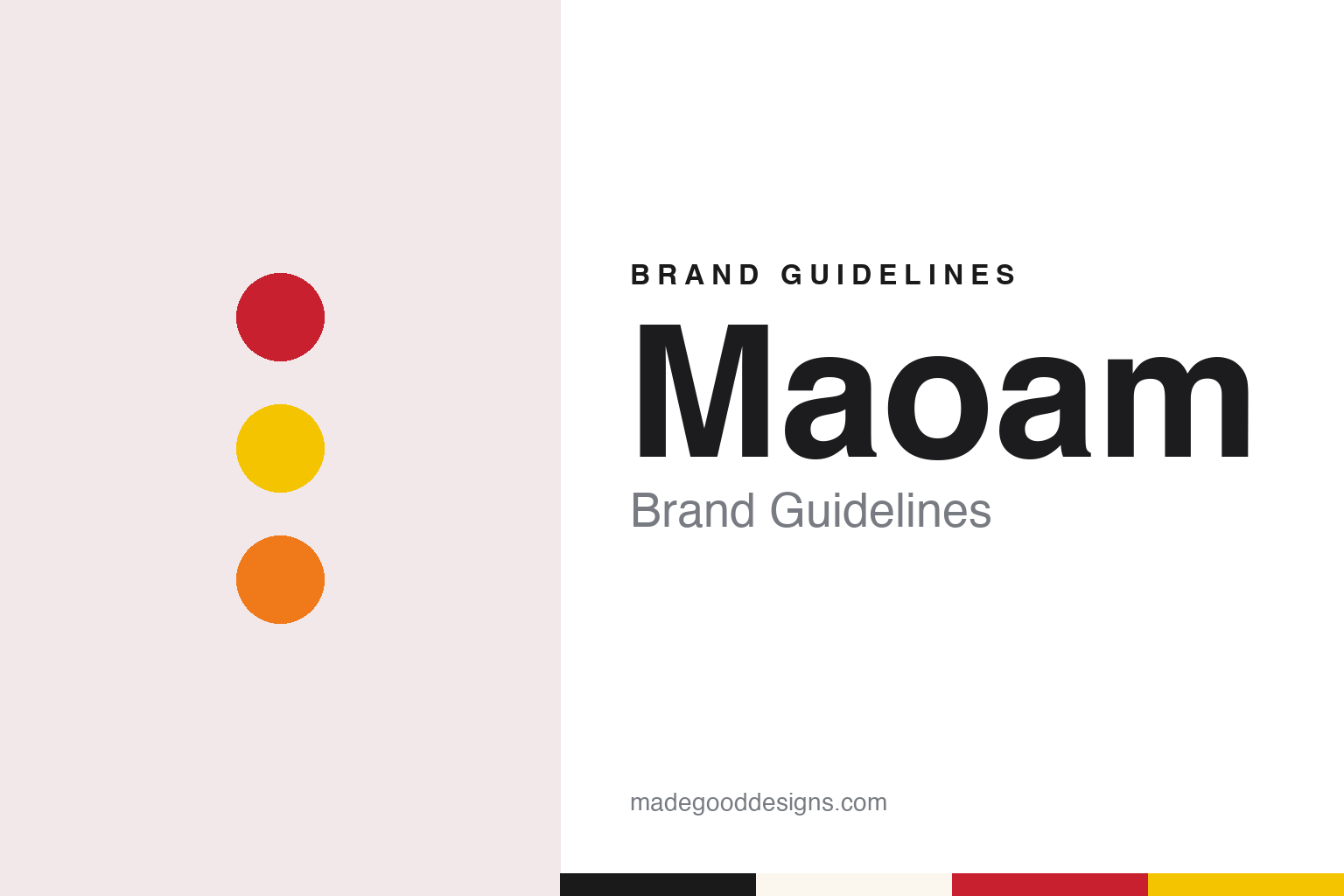
Two constants: a fruit red, lemon and orange on liquorice black palette and a rounded bold sans register. Abstract homage — not a Maoam product or mark; no pack, logo or sweet is reproduced.
The liquorice works
A Düsseldorf liquorice firm and a licensed chew.
Maoam is younger than the company that made it. According to German Wikipedia and a 2007 consumer brochure published by Haribo, the business behind the chew was the Düsseldorfer Lakritzenwerk, a liquorice works that the Haribo brochure dates to 1898. In 1900 Edmund Münster took it over, and for its first three decades under him liquorice was the core of the business, Haribo says.
The change came at the start of the 1930s. Both German Wikipedia and Haribo say that in 1930 Münster acquired a licence from abroad for a fruity chewing sweet made without gum, from sugar, syrup and other ingredients; neither source names the country. He called it MAOAM, an invented word that reads the same backwards and forwards. German Wikipedia says that in August 1930 he applied to the district court in Düsseldorf for design protection, which covered the name, the product and its packaging, and that the sweet was first offered to customers at Easter 1931, wrapped in wax paper. Haribo says it was advertised then as a special sweet much in demand abroad. Imitators soon followed, German Wikipedia adds.
Production stayed in Düsseldorf for half a century. German Wikipedia places the works on Hildebrandtstraße, in the Friedrichstadt district, from 1930 until 1982, when production moved to the former Novesia works on Jülicher Landstraße in Neuss, across the Rhine; Haribo’s 2007 brochure also dates the move to 1982. After the Second World War Münster restarted production. Haribo’s own timeline lists the restart under 1950 and says the sweets came back in the same colourful packaging they had worn in the 1930s, in the classic flavours of lemon, strawberry, pineapple, orange and raspberry.
Colour
Haribo, Neuss and a stadium chant.
In 1986 Haribo, the Bonn gummy maker, bought the Münster company, Edmund Münster GmbH & Co. KG, by then based in Neuss, and with it the Maoam trademark rights. The year is given by German Wikipedia, by Haribo’s 2007 brochure and by Jean-Philippe André, then head of Haribo France, in an interview with Le Point in October 2016. Haribo says the Maoam wordmark was kept after the takeover, and calls it one of the best-known classic trademarks.
Under Haribo, Maoam has stayed in Neuss. Haribo says that in 2024 it planned a new plant in Neuss-Holzheim, at what it calls the brand’s traditional site, and it says it makes two million MAOAM Bloxx a day. André told Le Point that Maoam quickly became the leader in Germany and was then exported to the United Kingdom, the Netherlands, Austria and Poland. In Britain, he said, it took about ten years to become joint leader of the chews category. An earlier launch in France, about ten years before the interview, did not take, and Haribo relaunched Maoam there in 2016 against established French chews such as Kréma and Carambar.
The advertising is remembered for a chant. German Wikipedia and Haribo describe television spots in which a crowd answers the question “Was wollt ihr denn?” (“So what do you want?”) by shouting “MA-O-AM!” Haribo says an earlier version had cult status from the 1970s, and that in 1990 the football referee Walter Eschweiler appeared in a stadium version of the spot. German Wikipedia, citing the German Volleyball League and the broadcaster SWR, adds that the volleyball club VC Eintracht Mendig played as MAOAM Mendig from 2003 to 2005.
Typography
Design and documentation.
The seven brands in this group all make sweets or chocolate, and they come from four European countries — Germany, Britain, Spain and Finland: Maoam, Barratt, Walker’s Nonsuch, Toffifee, Merci, Fini and Panda. European confectionery brands in general sit at many different points in the trade, from family firms that still carry a founder’s surname to names that now belong to much larger food groups, and a single brand can be sold everywhere from a corner kiosk to a supermarket shelf.
A confectionery brand’s identity is usually carried less by a single sweet than by a pack, a name and the treat it promises, because the company behind the name may have changed hands, moved its factory or grown far beyond the town where it started. That makes the questions behind each name worth asking plainly: who started it, who owns it now, and where its sweets are actually made and packed.
Each guide separates what independent sources record from what the company says about itself — its founding story, its owners over time, where its sweets are made and how its packaging has changed — and marks plainly what rests only on the company’s own word.
Aa
A rounded bold sans for a chewy, colourful palindrome. (Specimen set in Baloo 2, a sans STAND-IN; NOT the Maoam logo.)
Maoam
A wordmark that outlasted its maker.
As a design story, Maoam is mostly one of continuity. German Wikipedia says the typical Maoam logo was already in use in 1931 and is still used in little-changed form, and Haribo makes the same point about the year of the takeover, saying simply that the wordmark stayed. The name was part of the identity from the start: the 1930 application for protection, German Wikipedia says, covered the name, the product and the packaging together.
The packs show the same continuity. German Wikipedia says the first Maoam of 1931 was sold wrapped in wax paper, and Haribo says that when production resumed after the war the sweets returned in the colourful packaging of the 1930s, in five classic fruit flavours: lemon, strawberry, pineapple, orange and raspberry. Those fruit colours, rather than any published specification, are the starting point for the palette used here, which is our own interpretation.
Haribo’s timeline records a handful of later changes. In 2002 it introduced a mascot, Mr. Fruitman, a green figure that appeared on the bags and the website. In 2015, it says, all Maoam packaging was redesigned and modernised. In 2022 it ran television advertising for Maoam Kracher. In France, André told Le Point, the 2016 relaunch printed “By Haribo” on every bag, tying the chew to its owner’s better-known name. Today the maoam.com address redirects to Haribo’s own website.
For a design guide, Maoam shows how a short invented word, readable in both directions, can carry a sweet through more than ninety years and a change of owner. Compare it with Katjes, another sweet maker from North Rhine-Westphalia, and Trolli, a German gummy brand. For this guide we use fruit red, lemon and orange on liquorice black with a rounded bold sans, an unofficial interpretation; no product or logo is reproduced.
Explore & save
Keep Maoam’s identity on hand — save it to a board in the Made Good inspiration library.
Maoam identity set
Pin the Maoam fruit red, lemon and orange on liquorice black palette and the rounded bold sans register to your own board.