Barratt Brand Guidelines
The Victorian London sweet maker behind the Sherbet Fountain.
Aa
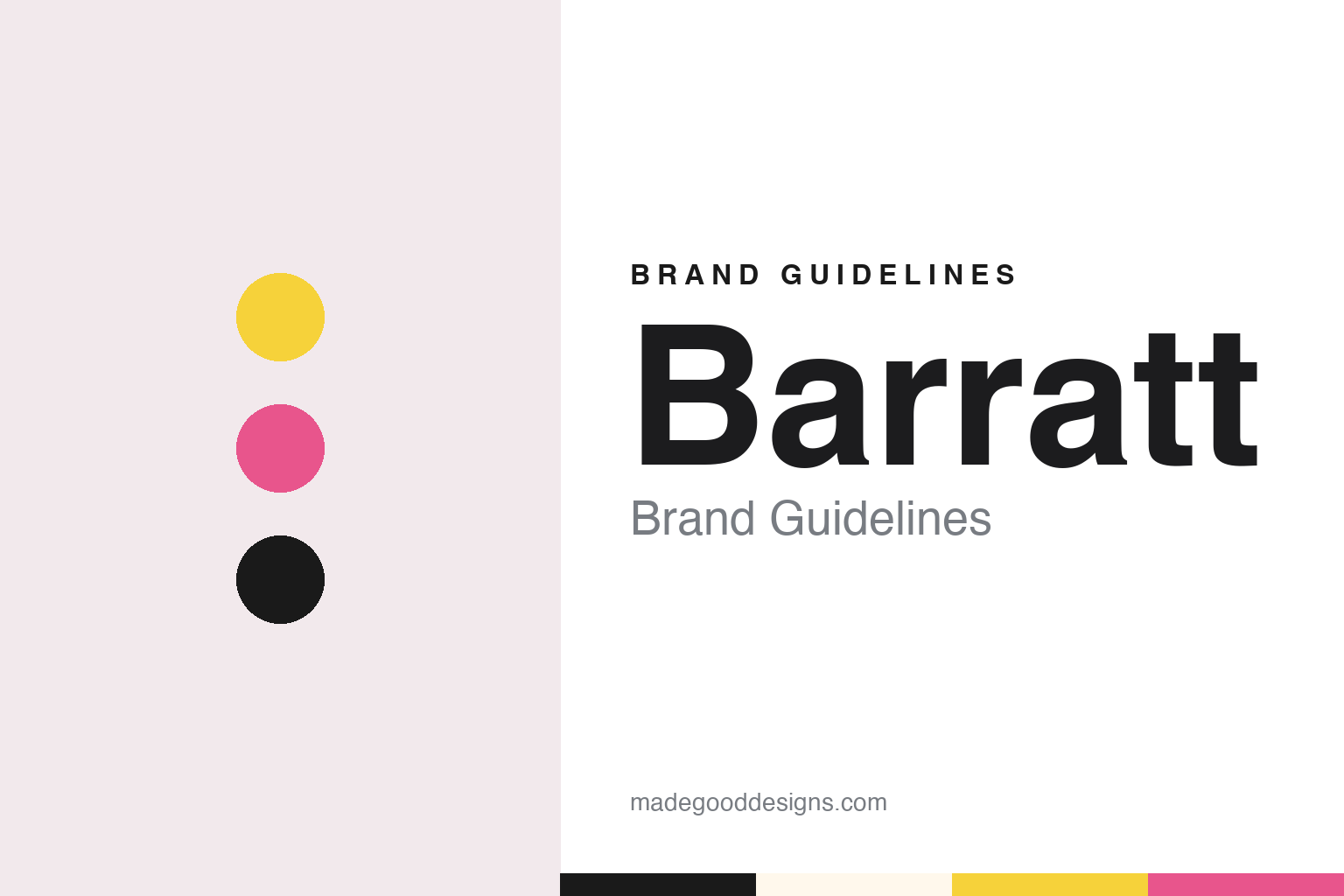
Two constants: a sherbet yellow, fruit-salad pink and liquorice black palette and a bold rounded sans register. Abstract homage — not a Barratt product or mark; no pack, logo or sweet is reproduced.
Hoxton to Wood Green
A pastry cook, one sugar boiler and a piano factory.
Barratt began in 1848 with George Osborne Barratt (1827–1906). According to a history written in 2004 for the Greater London Industrial Archaeology Society by Dennis G. Plowright, who worked at the factory as deputy chief engineer in the 1950s, Barratt’s family were law bookbinders near the Strand, but he trained as a pastry cook. He started a sugar confectionery business employing a single sugar boiler in Shepherdess Walk, Hoxton, just off the City Road; the company today says the brand was founded in Shoreditch. One early success, both Plowright and English Wikipedia say, was a toffee sold as “stickjaw,” which proved popular with children.
When Hoxton ran out of room, the business moved north. Plowright says Barratt bought a piano factory in Mayes Road, Wood Green, owned by a Mr Ivory; the first new building went up in 1882 and the next in 1883, and by 1904 the firm occupied a run of buildings on a site of more than five acres. A fire in October 1899 destroyed one five-storey block, which was rebuilt. English Wikipedia, citing a 2015 history blog, says that by about 1906 some 2,000 people were producing 350 tonnes of sweets a week, and calls Barratt the largest confectionery manufacturer in the world at the time.
After George Osborne Barratt’s death in 1906 his eldest son took over as chairman. The business became a limited company in 1909, according to English Wikipedia, citing The Times; Plowright dates it to 1908, when the firm also set aside shares for its most attentive and diligent employees. The founder’s youngest son, Albert, was chairman and managing director from 1911 to 1921 and was knighted in 1922. Plowright notes that the office block still carries the motto “Labor et Probitas” and the initials of four directors above its entrance.
Colour
Black Jack, Fruit Salad and the Sherbet Fountain.
Barratt’s early range was boiled sweets and toffees. English Wikipedia lists butter, raspberry and ginger toffees, then lines such as Almond Rock, Brandy Snaps and Tichborne Rock, a pulled rock with the figure of Sir Roger Tichborne running through it. The best-known names came in the twentieth century. The company dates Black Jack and Fruit Salad chews to the start of the 1920s, the Sherbet Fountain to 1925, the DipDab to 1935 and Refreshers to the 1940s. The Sherbet Fountain was a paper-wrapped cardboard tube of sherbet with a liquorice “straw” pushed into the top; English Wikipedia says the original idea was sold to Barratt by Henry Edward Brunt.
By 1950, Plowright says, about 200 lines were in production at Wood Green, and no other British manufacturing confectioner offered such a range; a company handbook described an output running from lollipops and sherbet fountains to sweet cigarettes, dolly mixtures, jelly babies and nougat. The factory’s own workshop built prototype equipment for filling sherbet fountains and making sweet cigarettes. Each September from 1896 the firm held an exhibition for the trade in a large marquee, showing more than 2,000 lines.
The family era ended in the 1960s. Plowright says that after the death of the chairman H. O. Barratt in 1965, George Bassett & Co. of Sheffield approached the firm, and in October 1966 Bassett’s acquired its whole share capital; the Financial Times had reported a £3.9 million offer that September. Barratt kept its identity at first, but Wood Green was gradually run down, machinery was moved to Sheffield, and the gates closed in 1980. The site is now occupied by The Chocolate Factory, English Wikipedia says, and old photographs, brochures and letters are held at Bruce Castle Museum in Haringey.
Typography
Design and documentation.
The seven brands in this group all make sweets or chocolate, and they come from four European countries — Germany, Britain, Spain and Finland: Maoam, Barratt, Walker’s Nonsuch, Toffifee, Merci, Fini and Panda. European confectionery brands in general sit at many different points in the trade, from family firms that still carry a founder’s surname to names that now belong to much larger food groups, and a single brand can be sold everywhere from a corner kiosk to a supermarket shelf.
A confectionery brand’s identity is usually carried less by a single sweet than by a pack, a name and the treat it promises, because the company behind the name may have changed hands, moved its factory or grown far beyond the town where it started. That makes the questions behind each name worth asking plainly: who started it, who owns it now, and where its sweets are actually made and packed.
Each guide separates what independent sources record from what the company says about itself — its founding story, its owners over time, where its sweets are made and how its packaging has changed — and marks plainly what rests only on the company’s own word.
Aa
A bold rounded sans for a sweet-shop name. (Specimen set in Fredoka, a sans STAND-IN; NOT the Barratt logo.)
Barratt
A name retired, revived and redrawn.
Bassett’s, and Barratt with it, was bought by Cadbury Schweppes in 1989. In January 2008 Cadbury sold its Monkhill Confectionery business to Tangerine Confectionery for £58 million, a deal that included the Barratt lines, Packaging News reported. The next year Tangerine replaced the Sherbet Fountain’s paper wrapper with a resealable plastic tube. Packaging News reported in April 2009 that the change drew outraged headlines in the national press, while Tangerine said the modernised design would be instantly recognisable to loyal customers. The liquorice straw became a solid stick, English Wikipedia says.
The Barratt name then left the shelves for a while. Tangerine said in January 2018 that the brand had last been seen in 2013, and announced its return that spring, marking its 170th anniversary, with an initial £1.5 million investment covering a new website, a full redesign and television advertising. The Barratt logo and pack designs were revamped, Tangerine said, while keeping a familiar identity. Valeo Foods, an Irish food group, completed its purchase of Tangerine in August 2018, and English Wikipedia says Bain Capital bought Valeo Foods in 2021; the Barratt business now trades as part of Valeo Foods UK.
In February 2026 Valeo relaunched the range as BARRATT Sweet Shop, with new packs across nine WHAM, FLUMPS and FRUIT SALAD products and a new mascot, George the Jaguar. The company said the designs were inspired by the founder and gave the mascot “East London swagger”; its chief marketing officer, Michael Inpong, said the aim was to bring the fun back to a category that had started to feel like a commodity.
For a design guide, Barratt shows a heritage name that has been retired, revived and redrawn twice in eight years, each time leaning on its 1848 founding date. Compare it with Maynards Bassetts, the brand that carries on its former Sheffield parent’s name, and Swizzels, another British sugar-sweet maker. For this guide we use sherbet yellow, fruit-salad pink and liquorice black with a bold rounded sans, an unofficial interpretation; no product or logo is reproduced.
Explore & save
Keep Barratt’s identity on hand — save it to a board in the Made Good inspiration library.
Barratt identity set
Pin the Barratt sherbet yellow, fruit-salad pink and liquorice black palette and the bold rounded sans register to your own board.


