Walker’s Nonsuch Brand Guidelines
The Longton toffee family and its little hammer.
Aa
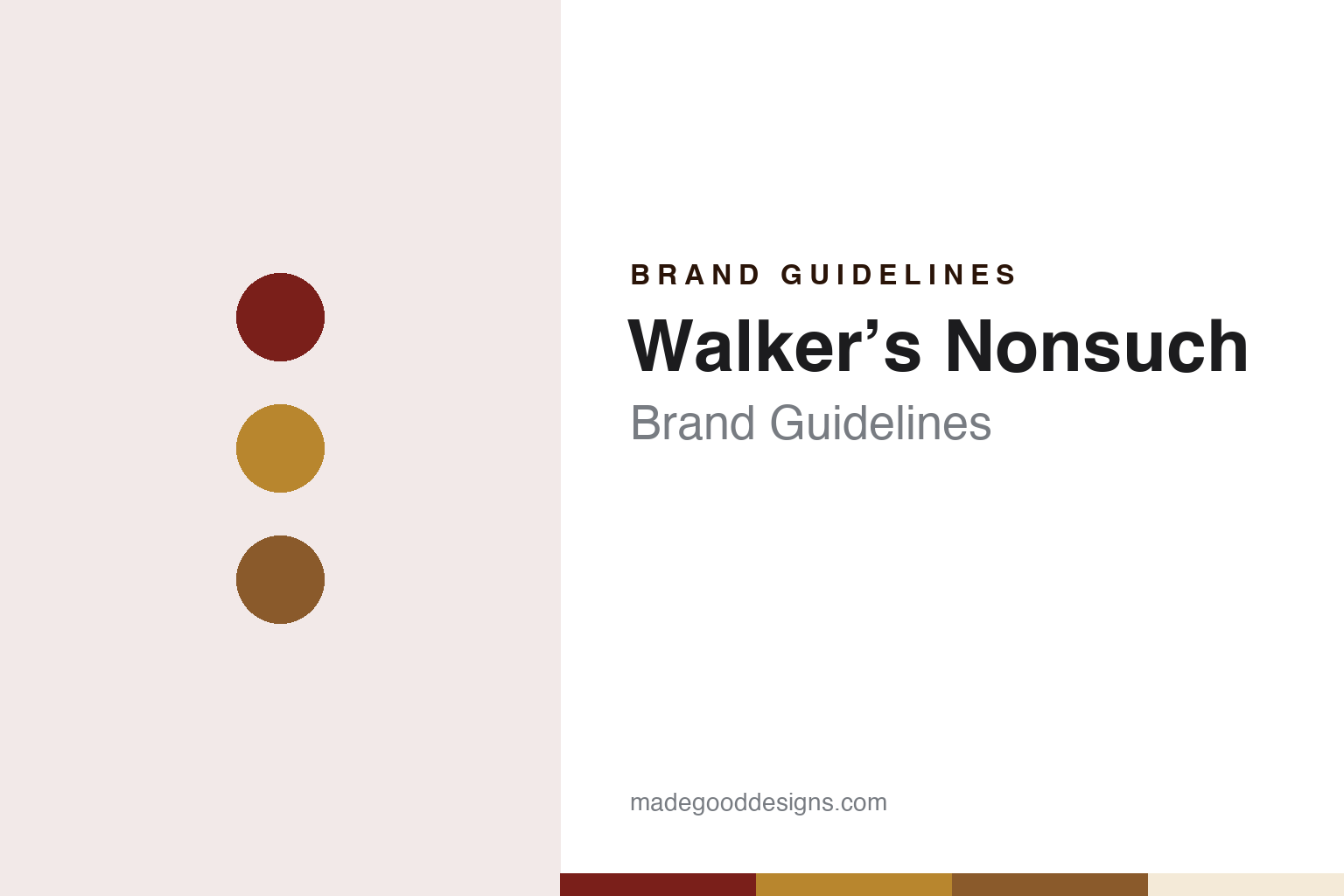
Two constants: a red, gold and toffee-brown palette and a Victorian display serif register. Abstract homage — not a Walker’s Nonsuch product or mark; no pack, logo or wrapper is reproduced.
A sweet shop in the Potteries
A former potter, his sister and a secret recipe.
Walker’s Nonsuch makes toffee in Longton, one of the six towns of Stoke-on-Trent, the Staffordshire city known as the Potteries. The company dates its beginnings to 1894, the year it gave for its 125th anniversary in 2019, and to its founder, Edward Joseph Walker, whom it describes as a former potter. On its history page the company says he and his sister Florence opened a tiny sweet shop in Longton, where he began making toffee to a recipe he kept a closely guarded secret; a company post from 2020 instead places that first toffee-making at his tobacconist’s shop on King Street in Fenton, another of the Potteries towns. English Wikipedia names both Edward Joseph and his son Edward Victor as founders.
Local customers, the company says, came for his slab toffee, which was broken with a special hammer and sold by the quarter. Demand led him to open a small factory. His son Edward Victor Walker joined the business in 1915, and the two carried on making toffee to the original recipe. The company says the Walker’s Nonsuch brand was launched as the business grew, and Companies House records Walker’s Nonsuch Limited as incorporated on 15 December 1922.
The Second World War brought hard years. In its anniversary history the company says Edward Victor had to restrict production because ingredients were difficult to find, and sweet rationing followed. Once restrictions were lifted he set about growing the business again and moved it to a larger factory that had belonged to Horleston Brothers, a boiled-sweet maker, which Walker’s Nonsuch bought in 1947; it added Siddalls Blue Churn Confectionery in 1961. That factory, on Calverley Street in Longton, is still the company’s home.
Colour
A palace for a name, a hammer for a signature.
The name is the brand’s boldest idea. The company calls it “something of a family legend” that Edward Joseph, looking for a name that would stand out from his competitors, came upon the story of Nonsuch Palace, which Henry VIII built between 1538 and 1546 and whose very name was a boast that nothing could match it. There was “nonsuch” like it, the reasoning went, and there was “nonsuch” toffee like Walker’s. The company also says it makes toffee only under the Walker’s Nonsuch brand.
The toffee hammer is the brand’s other signature. The company says the founder’s toffee and his “famous little hammers” are still the hallmarks of its business, and its gift range is built around Hammer Packs, which it says are unique to Walker’s Nonsuch: boxes of chunky toffee bars sold with a small hammer for breaking them. In November 2020 the company introduced a newly designed Luxury Selection Hammer Pack with four bars, a hammer and instructions on how to break the toffee. Emma, a great-granddaughter of the founder, said in the announcement that the pack moved from a sleeve to a box-and-lid format, that “red and gold always have gift appeal,” and that a new technique on the gold foil kept a luxury finish while leaving 98% of the packaging recyclable. The company said it was revising its other gift lines the same way.
Beyond the bars and slabs, the range runs to twist-wrapped toffees and chocolate éclairs in bags and sweet-shop jars, with varieties such as Original Creamy, Real Liquorice, Roasted Hazelnut and Nutty Brazil; in 2019 the company counted 14 varieties of twist-wrapped toffee. Salted Caramel and Double Chocolate lines followed in March 2018, stocked by Sainsbury’s. The company says it makes more than 1.25 million toffees a day on a continuous production line, worked around the clock by its boiler men, wrappers and packers.
Typography
Design and documentation.
The seven brands in this group all make sweets or chocolate, and they come from four European countries — Germany, Britain, Spain and Finland: Maoam, Barratt, Walker’s Nonsuch, Toffifee, Merci, Fini and Panda. European confectionery brands in general sit at many different points in the trade, from family firms that still carry a founder’s surname to names that now belong to much larger food groups, and a single brand can be sold everywhere from a corner kiosk to a supermarket shelf.
A confectionery brand’s identity is usually carried less by a single sweet than by a pack, a name and the treat it promises, because the company behind the name may have changed hands, moved its factory or grown far beyond the town where it started. That makes the questions behind each name worth asking plainly: who started it, who owns it now, and where its sweets are actually made and packed.
Each guide separates what independent sources record from what the company says about itself — its founding story, its owners over time, where its sweets are made and how its packaging has changed — and marks plainly what rests only on the company’s own word.
Aa
A high-contrast Victorian-flavoured serif for a toffee maker of the 1890s. (Specimen set in Playfair Display, a serif STAND-IN; NOT the Walker’s Nonsuch logo.)
Walker’s Nonsuch
Five generations, one factory, 45 countries.
Walker’s Nonsuch describes itself as an independent, family-owned and family-run company now in its fifth generation. After Edward Victor, the business passed in 1962 to his sons Edward and Ian Walker, who became joint managing directors and, with the help of the company secretary Cyril Jackson, invested in modern machinery to raise capacity, the company says. Ian Walker led the firm for decades, developed the range and travelled to sell it abroad. In its 2019 anniversary history the company named Adrian Hill, who had worked alongside Ian for 32 years, as managing director; its website now names the sisters Katie and Emma as managing directors, with Jonathan Rae of the fifth generation as operations director. Companies House lists the company as active, with its registered office in Longton and its business as the manufacture of sugar confectionery.
Exports have been part of the business for more than half a century. The company says it first exhibited at the ISM sweets fair in Cologne in 1971 and has attended every year since. It now says it sends toffee to 45 countries, “from Aruba to Australia,” and that the fishermen of the Faroe Islands are among its fans. The company makes it all in Stoke-on-Trent, and every page of its website carries the line “Made in Stoke-on-Trent by Walker’s Nonsuch Toffee.”
For a design guide, Walker’s Nonsuch shows how a boastful Tudor name and a small steel hammer can carry a Victorian toffee recipe into a modern gift box. Compare Tunnock’s, another family confectioner still making its sweets in its home town, and Swizzels, the family sweet maker of New Mills. For this guide we use a hammer-pack red, a foil gold and a slab-toffee brown with a Victorian display serif, an unofficial interpretation; no product or logo is reproduced.
Explore & save
Keep Walker’s Nonsuch’s identity on hand — save it to a board in the Made Good inspiration library.
Walker’s Nonsuch identity set
Pin the Walker’s Nonsuch hammer-pack red, foil gold and slab-toffee brown palette and the Victorian display serif register to your own board.