Pot Noodle Brand Guidelines
Golden Wonder’s 1979 snack, made in a Welsh valley.
Aa
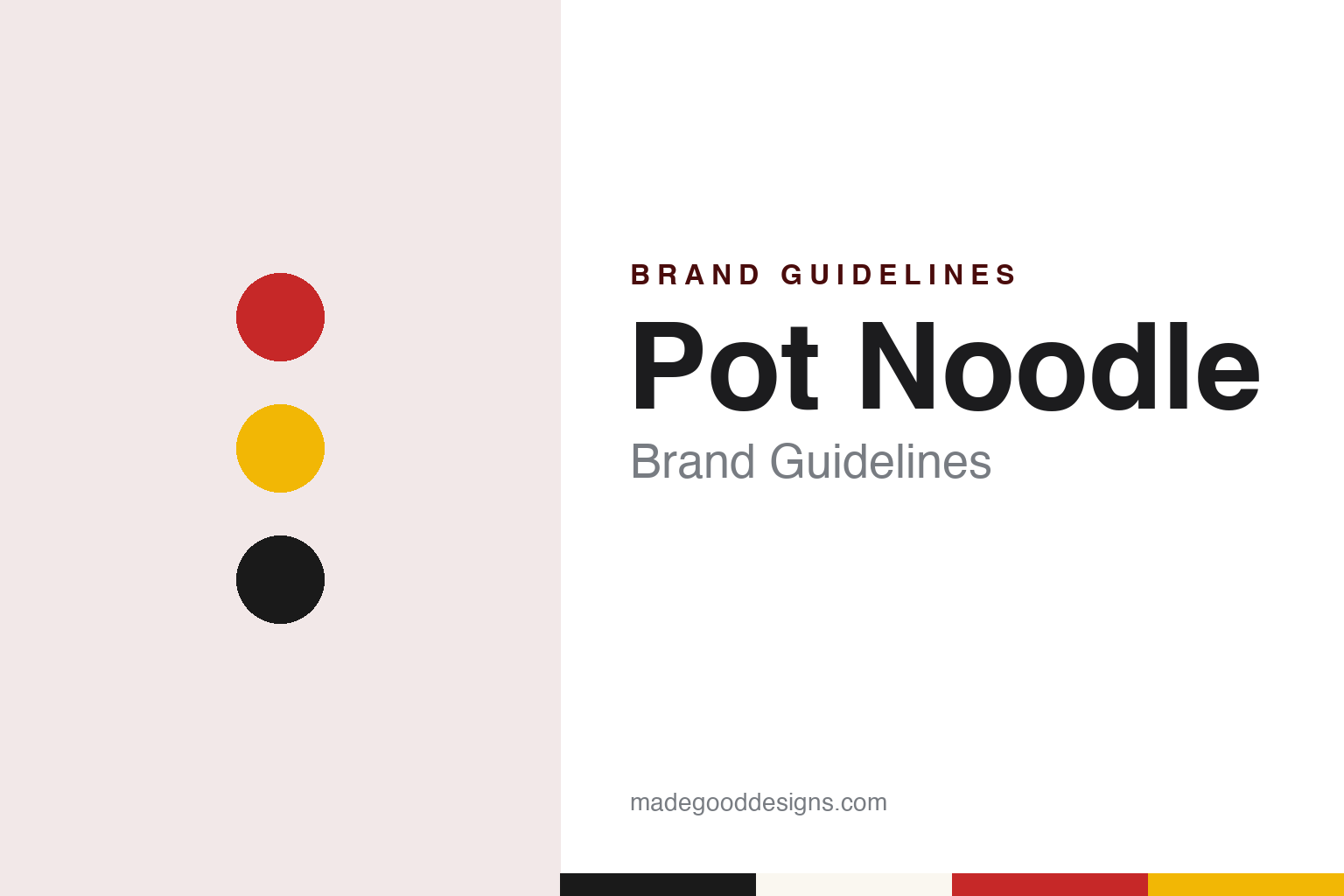
Two constants: a pot black, chilli red and noodle gold palette and a heavy grotesque register. Abstract homage — not a Pot Noodle product or mark; no pot, pack or logo is reproduced.
A crisp maker’s noodle
Golden Wonder, a plastic pot and a kettle.
Pot Noodle is a British brand, though the idea behind it came from Japan. Instant noodles were invented by Momofuku Ando, whose company Nissin launched Chicken Ramen in 1958 and the Cup Noodle in 1971, The Independent noted in 2007. In Britain the format was taken up by Golden Wonder, the crisp maker founded in Edinburgh in 1947 by the baker William Alexander and owned since 1961 by Imperial Tobacco, according to English Wikipedia, citing the BBC and The Guardian.
Golden Wonder launched Pot Noodle in the United Kingdom in 1979, according to BBC News in 2006 and The Independent in 2007; English Wikipedia gives 1977. The product is simple: dried noodles, dried vegetables and a flavouring powder in a plastic pot, made up by pouring in boiling water and eaten from the same pot. Many pots carry an extra sachet of sauce, and larger “King” versions exist of several flavours.
The pots have long come from one place. A Golden Wonder site at Crumlin, in Caerphilly county, south Wales, produced Pot Noodle, BBC News reported in 2022, and English Wikipedia places today’s factory at Croespenmaen, near Crumlin. BBC News reported in 2006 that the Crumlin factory turned out 175 million pots a year. That Welsh base later became part of the brand’s own story.
Golden Wonder also tried the pot format on other foods. English Wikipedia lists a Pot Rice from the early 1980s, a short-lived Pot Sweet dessert range from the mid-1980s and, later, a Pot Pasta, alongside the noodles that outlasted them all.
Colour
The slag of all snacks, a horn and a mine.
Pot Noodle is as well known for its advertising as for its noodles, and several campaigns ended up before regulators. In August 2002 a television campaign describing Pot Noodle as “the slag of all snacks” drew more than 300 complaints. The Independent Television Commission, then the regulator of television advertising, had already restricted it to after the 9pm watershed; it then upheld the complaints and said a term capable of causing such offence was not suitable for broadcast at any time, BBC News reported on 19 August 2002. The slogan was changed.
Later that month a poster for the spicy Hot Noodle range, with the line “hurt me, you slag,” was withdrawn after the Advertising Standards Authority upheld 286 complaints and called it irresponsible, BBC News reported on 28 August 2002. The maker, then named as Unilever Bestfoods, said the line was meant to convey the heat of the flavour and that the campaign was meant to be humorous.
In May 2005 the ASA received 620 complaints about television adverts showing a man with a large brass horn in his trousers and asking “Have you got the Pot Noodle horn?” It did not uphold them; it accepted the campaign was a little crude but judged the after-watershed timing restriction appropriate, The Guardian reported.
The tone shifted with a £10 million relaunch in 2006. For a new advert, ten workers from the Crumlin factory, former miners among them, went back underground in a disused pit to “mine” noodles, under the Welsh-accented line “Fuel for Britain, isn’t it”, BBC News reported in May 2006. A Unilever spokeswoman called the advert “very tongue-in-cheek but not naughty like some of our previous adverts,” and said it was meant to reach beyond the brand’s student audience. In 2008 the brand sponsored Pot Noodle: The Musical at the Edinburgh Festival Fringe, created by the advertising agency Mother and set in a Pot Noodle factory, The Daily Telegraph reported.
Typography
Design and documentation.
The seven brands in this group all make instant noodles, and they come from Japan, Indonesia, Thailand, Britain, South Korea and Singapore: Nissin, Maruchan, Indomie, Mama, Pot Noodle, Nongshim and Koka. Instant noodle brands in general sit at many different points in the trade, from family firms that still carry a founder’s name to names that now belong to much larger food groups, and a single brand can be sold everywhere from a corner shop to a supermarket shelf on another continent.
An instant noodle brand’s identity is usually carried less by a single product than by a pack, a name and the quick meal it promises, because the company behind the name may have changed hands, opened factories abroad or grown far beyond the city where it started. That makes the questions behind each name worth asking plainly: who started it, who owns it now, and where its noodles are actually made and packed.
Each guide separates what independent sources record from what the company says about itself — its founding story, its owners over time, where its noodles are made and how its packaging has changed — and marks plainly what rests only on the company’s own word.
Aa
A heavy grotesque for a loud, cheeky brand. (Specimen set in Archivo Black, a sans STAND-IN; NOT the Pot Noodle logo.)
Pot Noodle
From a crisp company to Unilever, and a new food group.
Pot Noodle has changed hands with its owners’ wider businesses. Golden Wonder passed to Dalgety in March 1987, when Hanson broke up Imperial Tobacco, The Independent reported in 2002. In July 1995 Best Foods, the food arm of CPC International, paid Dalgety about $280 million for Golden Wonder’s Pot Noodle instant hot snacks business, according to a company history cited by English Wikipedia. CPC International renamed itself Bestfoods in 1997, The Wall Street Journal reported, and Unilever bought Bestfoods in 2000. When the rest of Golden Wonder was sold to Tayto in January 2006, Pot Noodle and its factory stayed with Unilever, English Wikipedia says.
Its former owner later came back as a rival. From 2009 the Golden Wonder name was licensed for a competing pot snack, The Nation’s Noodle, Marketing magazine reported, which English Wikipedia says was renamed Noodle Pot in 2016.
Under Unilever the range has widened: a thinner, ramen-style Posh Noodle in 2003 and a pot-free Lost the Pot Noodle in loose packs in 2020, the brand says, and an Asian-inspired Fusions range in 2021, The Grocer reported. In July 2023 Unilever said Pot Noodle was trialling paper-based pots in the UK, and the brand says it is moving much of its range from plastic to paper pots.
Another change of owner is under way. In March 2026 Unilever agreed to combine most of its remaining food business with the spice maker McCormick & Company, The Wall Street Journal reported, with Unilever shareholders expected to hold about 65% of the new company. The trade site FoodBev Media reported in August 2026 that the deal covers brands including Hellmann’s, Knorr, Marmite and Pot Noodle, and that it was expected to close in 2027.
For a design guide, Pot Noodle shows how a made-in-Wales snack built a brand voice through cheek, complaint rulings and a Welsh valley. Compare Golden Wonder, the crisp maker that launched it, and Knorr, a Unilever stablemate in the same McCormick deal. For this guide we use pot black, a chilli red and a noodle gold with a heavy sans, an unofficial interpretation; no product or logo is reproduced.
Explore & save
Keep Pot Noodle’s identity on hand — save it to a board in the Made Good inspiration library.
Pot Noodle identity set
Pin the Pot Noodle pot black, chilli red and noodle gold palette and the heavy grotesque register to your own board.